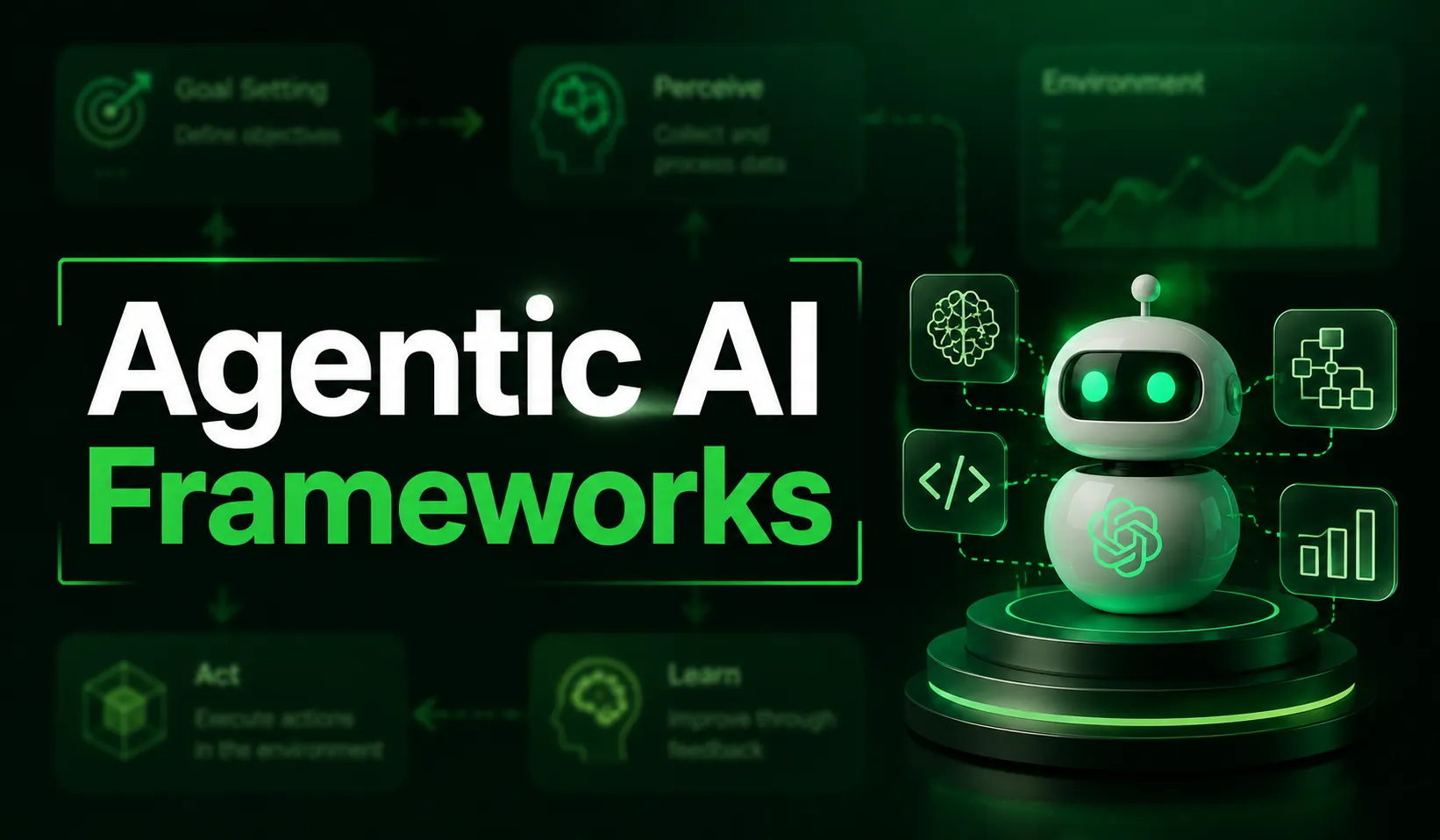

Agentic AI Frameworks are transforming the landscape of artificial intelligence, enabling businesses, developers, and researchers to build autonomous systems that can think, act, and adapt without constant human supervision.
These frameworks provide the tools and environments necessary for AI agents to make independent decisions, learn from interactions, and respond dynamically to ever-changing conditions.
Unlike traditional AI systems, which often rely on static rules or require ongoing human intervention, agentic AI frameworks empower intelligent agents to operate with a high degree of autonomy.
The rise of agentic AI frameworks tackles one of the core challenges in modern AI: developing systems that can manage uncertainty and complexity while performing tasks efficiently.
By incorporating reinforcement learning, adaptive behaviors, and real-time decision-making, these frameworks allow organizations to automate intricate workflows, enhance operational efficiency, and reduce human workload.
From robotics and autonomous vehicles to finance, healthcare, and gaming, agentic AI frameworks are enabling innovative applications that were once considered impossible.
Organizations that adopt these frameworks can accelerate product development, deploy smarter applications, and stay ahead in competitive industries.
In this article, we’ll dive into the most influential agentic AI frameworks, explore their real-world use cases, highlight key benefits, and provide guidance for choosing the right framework for your needs.
What Are Agentic AI Frameworks?
Agentic AI Frameworks are specialized platforms that provide the tools and structured environments needed to build AI agents capable of autonomous reasoning and decision-making.
Unlike traditional AI systems, which rely heavily on predefined rules or supervised learning, agentic AI frameworks focus on self-directed learning, adaptability, and goal-driven behavior.
These frameworks empower AI agents to perceive complex environments, learn from interactions, and act independently to achieve defined objectives, making them ideal for dynamic, real-world applications.
Some of the key features that define agentic AI frameworks include:
- Autonomy: Agents can execute tasks without continuous human supervision, reducing the need for manual intervention and enhancing operational efficiency.
- Learning Capability: These frameworks support advanced learning methods such as reinforcement learning, simulation-based training, and adaptive algorithms, enabling agents to improve over time.
- Environment Interaction: AI agents can sense, interpret, and respond to changes in complex and unpredictable environments, allowing for more robust and intelligent behavior.
- Goal-Oriented Decision Making: Agents optimize their actions to meet objectives while adapting to evolving conditions, ensuring outcomes are aligned with organizational goals.
Together, these features make agentic AI frameworks particularly effective for robotics, autonomous systems, simulations, and enterprise-level applications where adaptability and intelligence are critical.
Benefits of Agentic AI Frameworks
Implementing agentic AI frameworks offers several transformative advantages:
Increased Efficiency
One of the most significant advantages of agentic AI frameworks is increased efficiency. Autonomous AI agents can handle repetitive, time-consuming, or highly complex tasks far faster than human workers.
By automating these processes, organizations can reduce operational costs, minimize human errors, and free up valuable employee time for higher-value, strategic initiatives.
This efficiency not only boosts productivity but also allows teams to focus on creative problem-solving, innovation, and decision-making, ultimately helping businesses achieve faster results while maintaining quality and consistency in operations.
Enhanced Decision-Making
Agentic AI frameworks enhance decision-making by providing continuous, real-time analysis of vast datasets. AI agents can identify patterns, detect anomalies, and learn from previous outcomes, offering actionable insights that inform smarter choices.
By combining autonomy with data-driven intelligence, these frameworks enable organizations to respond to challenges quickly and make evidence-based decisions.
This capability is particularly valuable in fast-paced industries such as finance, healthcare, and logistics, where timely, accurate decision-making can provide a competitive edge and minimize operational risks.
Scalability
Scalability is another major benefit of agentic AI frameworks. Once AI agents are developed on robust frameworks, they can be deployed across multiple systems, applications, or departments without significant redesign.
Whether handling increased workloads, new business functions, or expanding user demands, agentic AI agents can scale efficiently while maintaining performance and reliability.
This flexibility reduces the need for costly infrastructure adjustments and allows organizations to grow rapidly while ensuring that intelligent automation continues to meet operational requirements across all areas of business.
Innovation Acceleration
By automating complex processes, simulations, and experimental workflows, agentic AI frameworks accelerate innovation.
Developers and researchers can rapidly test ideas, iterate on designs, and deploy prototypes without being limited by manual processes or infrastructure constraints.
These frameworks encourage experimentation, reduce time-to-market for new solutions, and provide a controlled environment for learning from failures and successes.
The result is faster, more efficient innovation cycles, enabling businesses to develop competitive products, services, and intelligent systems that adapt to changing market demands.
Adaptability
Adaptability is a core strength of agentic AI frameworks. AI agents can adjust their behavior based on new data, evolving objectives, or unexpected environmental changes.
This dynamic adaptability is crucial for industries experiencing rapid technological, economic, or regulatory shifts. Organizations can rely on agentic AI to continuously optimize operations, respond to emerging challenges, and maintain productivity under changing conditions.
By building systems that evolve alongside business needs, companies gain resilience, maintain operational continuity, and stay ahead in competitive, fast-moving markets.
Top 5 Agentic AI Frameworks
1. OpenAI Gym
OpenAI Gym is one of the most widely used platforms for reinforcement learning and agent-based simulations. It offers a versatile library of pre-built environments that range from simple games to complex robotics challenges, enabling developers to train AI agents efficiently.
The framework supports experimentation with a variety of algorithms, providing detailed evaluation metrics and visualization tools.
Its flexibility and ease of use make it ideal for both academic research and industrial applications, allowing teams to prototype, test, and refine intelligent agents in controlled yet diverse scenarios.
2. Ray RLlib
Ray RLlib is a highly scalable reinforcement learning framework designed for enterprise-level AI applications. Its distributed architecture allows AI agents to learn and train efficiently across large-scale environments, making it suitable for real-world workloads that require speed and reliability.
RLlib supports multiple reinforcement learning algorithms, seamless integration with Python, and compatibility with cloud-based infrastructures.
Organizations use Ray RLlib to accelerate experimentation, deploy robust AI models, and scale intelligent agents across complex systems, enabling high-performance, adaptive AI solutions that can evolve with dynamic business needs.
3. Unity ML-Agents
Unity ML-Agents bridges the gap between AI and interactive 3D simulations. It enables developers to train AI agents within rich virtual environments, making it perfect for robotics, gaming, and autonomous system research.
The framework allows agents to perceive, learn, and act in dynamic scenarios while supporting reinforcement learning and imitation learning. Unity ML-Agents is particularly valuable for developing
AI that interacts with complex, realistic worlds, providing visual feedback and performance metrics. By combining immersive simulations with agentic AI, organizations can experiment safely and optimize intelligent behaviors before real-world deployment.
4. PettingZoo
PettingZoo is a framework specialized for multi-agent reinforcement learning (MARL) environments. It allows developers to create both competitive and cooperative scenarios, simulating interactions among multiple AI agents.
This makes it ideal for research on collaboration, competition, and complex decision-making in dynamic environments. PettingZoo provides a standardized API for consistency across experiments and supports a variety of agent-based learning algorithms.
Researchers and developers leverage this framework to study emergent behaviors, optimize agent interactions, and develop systems that can handle multiple autonomous agents simultaneously, reflecting real-world challenges in industries like logistics, finance, and gaming.
5. TensorFlow Agents (TF-Agents)
TensorFlow Agents is a comprehensive reinforcement learning framework built on top of TensorFlow. It provides tools for policy optimization, value function estimation, and interaction with diverse simulation environments.
TF-Agents supports deep learning integration, enabling the creation of complex, high-performance AI agents capable of sophisticated decision-making. Developers benefit from pre-built modules, flexible experimentation pipelines, and extensive documentation.
This framework is particularly suited for projects requiring robust reinforcement learning combined with neural network capabilities, allowing organizations to develop scalable agentic AI systems for research, robotics, autonomous systems, and industrial applications.
Real-World Applications of Agentic AI Frameworks
Robotics
Autonomous robots leverage agentic AI frameworks to navigate environments, perform tasks, and adapt to obstacles without human intervention.
Autonomous Vehicles
Self-driving cars use agentic AI to process sensor data, predict traffic conditions, and make real-time driving decisions safely.
Financial Services
AI agents analyze market trends, execute trades, and optimize investment portfolios dynamically.
Healthcare
Agentic AI assists in diagnostics, treatment planning, and patient monitoring, providing adaptable solutions for diverse medical scenarios.
Gaming and Simulation
Game developers use agentic AI frameworks to create intelligent NPCs, enhancing realism and player engagement.
How to Choose the Right Agentic AI Framework
Selecting the right agentic AI framework depends on your project’s objectives, scalability needs, and technical expertise:
- Project Scope: Match the framework to the complexity and size of your AI tasks.
- Learning Requirements: Ensure the framework supports the learning methods your agents need (reinforcement, supervised, unsupervised).
- Integration: Choose a framework compatible with your existing tech stack and cloud infrastructure.
- Community and Support: An active community and documentation accelerate development and troubleshooting.
Performance and Scalability: Evaluate whether the framework can handle large-scale deployments and real-time applications.
Challenges in Implementing Agentic AI Frameworks
While powerful, agentic AI frameworks have considerations:
- High Computational Demand: Training agents can require significant processing power and memory.
- Complexity: Developing autonomous agents is technically challenging and requires expertise in AI and reinforcement learning.
- Safety and Ethics: Ensuring agents act within ethical and safe boundaries is critical in real-world deployments.
- Data Dependency: Effective learning relies on high-quality data and accurate environmental simulations.
Addressing these challenges ensures AI agents deliver reliable, ethical, and effective outcomes.
Future of Agentic AI Frameworks
The future of agentic AI frameworks looks promising, with innovations like multi-agent collaboration, self-improving agents, and AI-human hybrid systems. As AI evolves, these frameworks will become more accessible, efficient, and capable of solving increasingly complex real-world problems.
Businesses adopting these frameworks today gain a competitive edge, leveraging automation, insight, and innovation like never before.
Why Choose Moon Technolabs
When it comes to developing advanced AI solutions using agentic AI frameworks, choosing the right technology partner is crucial. Moon Technolabs offers extensive experience in designing, implementing, and optimizing AI-driven applications for enterprises, startups, and research institutions.
Their team of skilled AI engineers and data scientists understands how to leverage frameworks like OpenAI Gym, Ray RLlib, Unity ML-Agents, PettingZoo, and TensorFlow Agents to build scalable, autonomous systems tailored to your business needs.
With Moon Technolabs, organizations benefit from:
- Custom AI Solutions: Tailored frameworks that align with your business objectives, workflows, and industry requirements.
- End-to-End Support: From strategy and prototyping to deployment and maintenance, ensuring seamless AI integration.
- Scalable Architectures: AI agents designed to grow with your business, handling increasing data volumes and evolving requirements.
- Cutting-Edge Expertise: Access to the latest advancements in reinforcement learning, multi-agent systems, and autonomous AI solutions.
By partnering with Moon Technolabs, companies can harness the full potential of agentic AI frameworks, accelerate innovation, and deploy intelligent systems that deliver measurable efficiency, adaptability, and business value.
Conclusion
Agentic AI frameworks are transforming industries by enabling autonomous, adaptable, and intelligent agents.
From robotics to healthcare, finance, and gaming, these frameworks accelerate innovation, reduce operational load, and enhance decision-making.
By understanding their features, benefits, and applications, organizations can confidently integrate agentic AI frameworks to drive growth, efficiency, and future-ready solutions.
















Sign in to leave a comment.