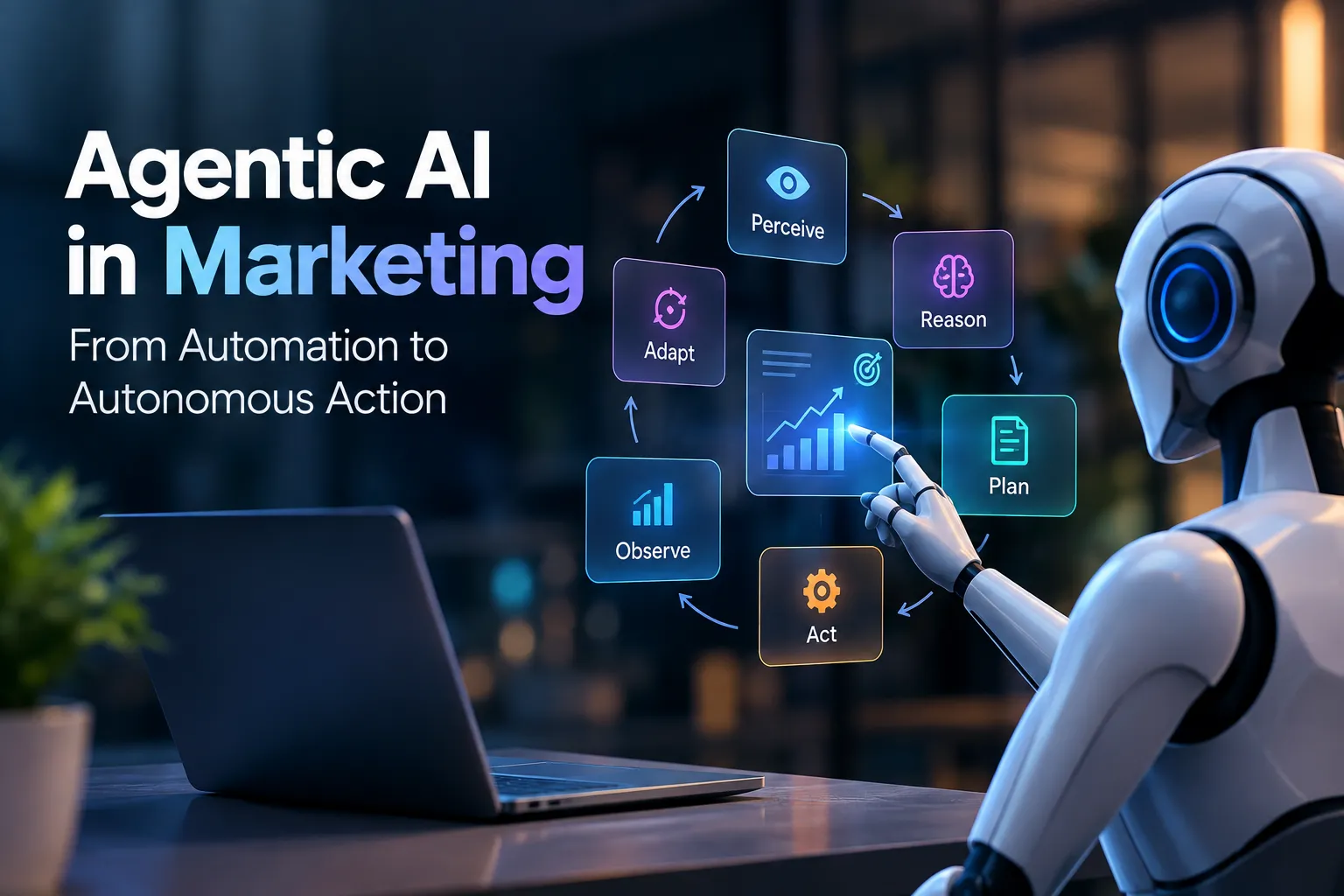


AI has already changed the way marketing teams work.
Marketers now use AI to write content, study data, create ideas and automate tasks.
But a new shift is taking place.
AI is moving from helping with tasks to taking action.
This is where agentic AI comes in.
What Is Agentic AI?
Agentic AI refers to AI systems that can work toward a specific goal.
Instead of waiting for a person to give every instruction, an AI agent can take several steps on its own.
It can:
- Understand information
- Think through a problem
- Plan the next step
- Use connected tools
- Take action
- Check the result
- Change its approach when needed
A simple way to look at it is:
Understand → Plan → Act → Check → Improve

This is different from traditional marketing automation.
How Is It Different From Automation?
Marketing automation usually works with fixed rules.
For example:
If a customer leaves a shopping cart, send an email after two hours.
The system follows the rule that a marketer created.
Generative AI works differently. You give it a prompt, and it creates something.
For example, you could ask an AI tool to write five versions of an ad.
An AI agent can go further.
You could give it a goal such as:
“Improve qualified leads while staying within the campaign budget.”
The agent could study campaign data, find problems, suggest changes and, where it has permission, make those changes through connected tools. It could then watch the results and adjust its next action.
That is the key difference.
The system is not just creating something. It is working through a process.
Where Can Marketers Use AI Agents?
There are many possible uses.
Campaign Optimisation
An AI agent could watch campaign results and identify changes in performance.
It could help find which audiences, ads or channels are producing better results.
With the right controls, it could also make approved changes.
Customer Insights
Marketing teams deal with large amounts of customer data.
An AI agent could study this data and find useful patterns.
For example, it could identify changes in customer behaviour or highlight groups that may need different messages.
Lead Management
AI agents could also help sales and marketing teams manage leads.
They could review lead data, identify high-priority prospects and trigger follow-up actions based on set rules.
Customer Experience
Customer service is another possible use.
Imagine a customer reports a delivery problem.
An AI agent could check the order, review the available options and offer an approved solution.
If the issue is more complex, it could send the case to a human employee.
AI Could Also Change How People Find Brands
There is another important change taking place.
People are increasingly using AI tools to find information.
Instead of searching for ten websites themselves, a person may ask an AI system to compare products or services.
The AI then studies different sources and gives the person a recommendation.
This could change how brands think about search visibility.
A company may not only need to appear in traditional search results. Its information also needs to be clear and reliable enough for AI systems to understand.
This does not mean SEO is going away.
Useful content, good website structure and strong technical SEO still matter.
But brands may also need to think about how their information appears in AI-generated answers.
More AI Action Means More Control
Agentic AI can save time, but it also creates new risks.
An AI agent can make a mistake.
It may use incorrect data, misunderstand a goal or take an action that was not intended.
The risk becomes greater when the system can directly change campaigns, customer records or other business systems.
This is why human control remains important.
Companies should decide what an AI agent can do without approval.
They should also define which actions require a human review.
For example, an agent may be allowed to suggest a budget change.
A person may still need to approve the change before it goes live.
How Should Businesses Start?
There is no need to automate everything at once.
Start with one simple and measurable process.
Look for a task that is:
- Repetitive
- Time-consuming
- Easy to measure
- Low risk
- Based on reliable data
Then set clear rules.
Decide what the AI can access. Decide what actions it can take. Also decide when it must ask a person for help.
After that, measure the results.
Did the process become faster?
Did performance improve?
Did the AI make accurate decisions?
Did employees spend less time on manual work?
These questions can help companies decide whether to expand the use of AI agents.
What Does This Mean for Marketers?
Agentic AI may change the role of the marketer.
Instead of spending hours moving data between systems or checking routine reports, marketers may spend more time on strategy, creativity and customer understanding.
AI can handle more of the repetitive work.
People can remain responsible for important decisions.
This is becoming an important topic for anyone following an AI Conference 2026 or MarTech Conference 2026.
The bigger question is not simply:
“What can AI create?”
It is:
“What should AI be allowed to do?”
That question will become increasingly important as AI agents move from simple assistants to systems that can take real marketing actions.
That may ultimately be more important than deciding which AI tool to buy.
Read the full article on What Is Agentic AI in Marketing? A 2026 Guide for Marketing Leaders
























Sign in to leave a comment.