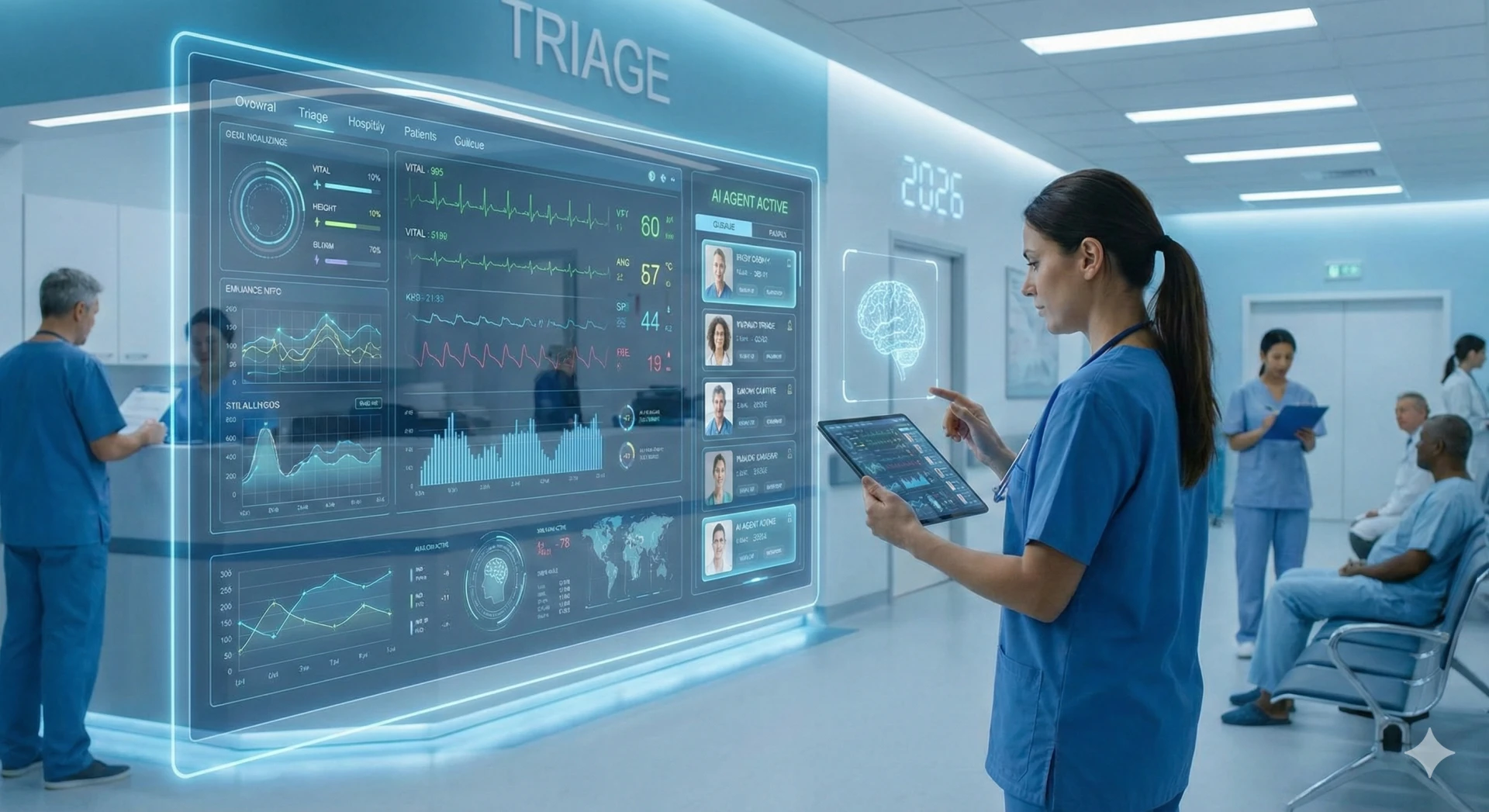

The healthcare sector has spent the last three years experimenting with generative AI, largely as a tool for summarisation and drafting. However, 2026 marks a complete pivot in the technology’s application. We are moving past Large Language Models (LLMs) that chat and entering the era of Agentic AI systems designed not just to process information but to execute complex, multi-step workflows autonomously.
Nowhere is this shift more critical, or more disruptive, than in medical triage.
For decades, triage has been a human-intensive bottleneck. It requires highly trained clinicians to perform repetitive data gathering, often leading to burnout and delayed care. The integration of agentic AI in triage is fundamentally altering this dynamic, shifting the digital front door from a passive waiting room to an active clinical assessment tool.
Beyond the Chatbot: Defining Agentic AI
To understand the magnitude of this shift, it is necessary to distinguish between the AI of 2024 and the agentic systems of 2026.
Traditional generative AI is reactive. It waits for a prompt and generates text based on patterns. It is an information retrieval tool. Agentic AI, by contrast, is goal-oriented. It is given an objective, such as triage this patient or reconcile medication list and has the agency to interface with external systems to achieve that outcome.
In a triage context, a standard chatbot might ask a patient about their symptoms and summarise the text. An agentic system does the following:
Perceives: It analyses the patient's reported symptoms alongside their real-time biometric data (from wearables) and historical Electronic Health Record (EHR).
Reasons: It applies clinical risk stratification protocols to determine urgency.
Acts: It autonomously schedules the appointment, orders the necessary preliminary lab panels, and pings the on-call physician with a decision package rather than a raw transcript.
This capability transforms the AI from a scribe into a genuine clinical partner.
The Economic and Operational Driver
The adoption of Agentic AI in triage is not being driven by novelty; it is being driven by necessity. The healthcare workforce is currently facing a dual crisis: a shortage of clinical staff and an explosion of administrative complexity.
Industry reports from late 2025 indicate that nurses spend up to 40% of their shifts on documentation and administrative routing rather than direct patient care. In high-pressure environments like Emergency Departments (ED), the triage nurse is often reduced to a data entry clerk, manually inputting symptoms while a queue of patients waits.
Agentic AI stops this inefficiency by automating the logic layer of triage. By handling the initial data collection and risk scoring, the system removes the friction that slows down patient flow. Early pilots in large US hospital systems have shown that agentic triage tools can reduce door-to-doctor time by over 30%, largely by ensuring that the physician receives a patient who has already been worked up, with vitals recorded and history summarised before the physical exam begins.
Transparency Gap and Clinical Safety
The integration of autonomous agents into clinical pathways naturally raises significant safety concerns. The transparency problem, where the AI’s reasoning is opaque, remains a barrier to full trust.
However, the regulatory landscape has evolved rapidly. The FDA now lists over 1,000 AI/ML-enabled medical devices, and the focus has shifted toward human in the Lloop (HITL) architectures. In 2026, Agentic AI in triage does not make the final diagnostic decision. Instead, it operates on a recommendation engine basis.
For example, if an agent identifies a potential sepsis risk based on a patient’s temperature and heart rate variability, it does not prescribe antibiotics autonomously. Instead, it elevates the case to critical priority and presents the triage nurse with a flagged alert: Sepsis markers detected. The protocol suggests an immediate lactate test. Authorise?
The nurse retains the clinical authority, but the cognitive load of detecting that pattern in a crowded waiting room is offloaded to the agent. This symbiotic relationship reduces the likelihood of human error caused by fatigue, a leading cause of sentinel events in hospitals.
Restructuring the Workforce
Perhaps the most profound impact of Agentic AI is not on the software, but on the people. As algorithms take over the task of sorting and routing patients, the role of the nurse is being rewritten.
We are seeing a move away from the gatekeeper model of nursing, where a significant portion of the job was managing access to resources. In its place, the caregiver model is returning to the forefront. When an AI agent handles the scheduling, the insurance pre-authorization, and the symptom documentation, the nurse is freed to focus on the human elements of care, empathy, complex judgment, and patient education.
This shift has immediate implications for how the industry trains its future workforce. Facilities can no longer treat student placements as opportunities to train admin assistants. The new generation of nurses must be trained to work alongside these agents, interpreting their outputs and managing the complex social dynamics that no bot can replicate.
Forward-thinking organisations are already restructuring their education partnerships to reflect this. We are seeing a rise in [innovative student placement models] that prioritise clinical judgment and social interaction over administrative tasks. By utilising students to fill the empathy gap, spending time listening to residents and patients while the AI handles the data, facilities are not only improving patient satisfaction but also training a workforce that is resilient to automation.
The Future of the Digital Front Door
Looking ahead to the remainder of 2026, the trajectory is clear. Single-purpose AI tools are consolidating into multi-agent systems. We will soon see triage agents communicating directly with radiology agents and pharmacy agents to align a care plan before the patient even leaves the waiting room.
The friction that has defined the patient experience for decades, the endless repetition of medical history, the lost faxes, and the scheduling tag are evaporating. For the healthcare provider, the promise of agentic AI in triage is not about replacing the clinician. It is about removing the noise so that the clinician can actually hear the patient.
The technology is no longer a futuristic concept; it is an operational reality. The organisations that succeed in this new era will be those that view AI not as a cost-cutting tool, but as a lever to elevate the human capacity for care.


























Sign in to leave a comment.