
There’s a very specific phase every intern pharmacist goes through.
You’re no longer a student.
You’re not fully registered yet, either.
You’re somewhere in between.
Your days are filled with dispensing, counselling, fixing small mistakes, learning fast… and then suddenly, in the middle of all that, one thought starts getting louder:
“When should I sit the intern pharmacist written exam?”
Not when you start your internship.
Not even in the first few months.
But one random day usually after a long shift you realise:
This exam decides when I will finally become a registered pharmacist.
And that’s when the pressure begins.
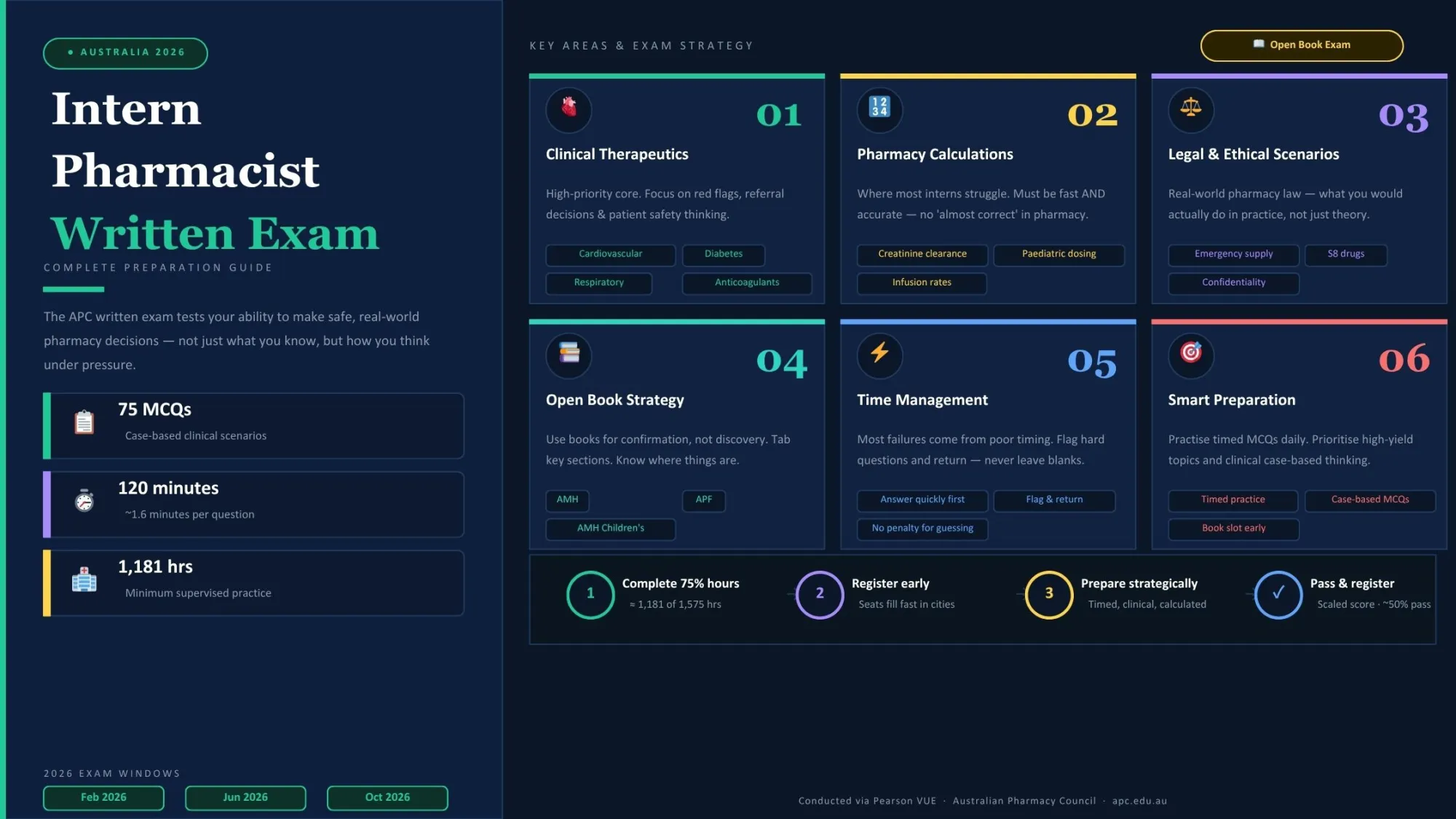
If you’re preparing for the intern pharmacist written exam in 2026. This guide will give you exactly what you need:
- No confusing language
- No outdated advice
- No unnecessary theory
Just a clear, honest roadmap based on official guidance. So you can walk into that exam with confidence.
What Exactly Is the Intern Pharmacist Written Exam?
Let’s simplify this first.
The intern pharmacist written exam is conducted by the Australian Pharmacy Council.
It is not designed to trick you.
It is designed to answer one important question:
Can you make safe, real-world pharmacy decisions?
This exam is not about memorizing textbooks.
It focuses on:
- Clinical reasoning
- Patient safety
- Legal decision-making
- Practical pharmacy situations
Think of it like this:
University exams test what you know.
This exam tests how you think under pressure.
Exam Format (Based on Official APC Information)
Here’s exactly what you’re walking into:
- 75 Multiple Choice Questions (MCQs)
- 120 minutes (2 hours)
- Computer-based exam
- Conducted via Pearson VUE
- Case-based clinical scenarios
Each question presents a real pharmacy situation, such as:
- A patient with multiple medications
- A dosing problem
- A legal supply issue
- A counselling scenario
The passing score is scaled (~50%), meaning:
- Difficulty is adjusted
- Not every exam paper is identical
Pharmacy Intern Written Exam Dates 2026 (What You Must Know)
One of the biggest mistakes interns make?
Missing the exam window.
Based on official patterns or the pharmacy intern written exam dates are expected to follow three cycles:
2026 Expected Exam Windows
- February 2026
- June 2026
- October 2026
Registration usually opens weeks in advance and seats at Pearson VUE centres fill quickly especially in cities like:
- Melbourne
- Sydney
- Brisbane
Important tip: Book your slot as soon as registration opens.
Waiting even a day can cost you your preferred centre or date.
Eligibility: When Can You Sit the Exam?
You can’t take the exam whenever you feel ready.
The APC has a strict rule:
You must complete 75% of your supervised practice hours.
For most interns:
- Total hours: 1,575
- Required before exam: ~1,181 hours
This must be:
- Logged properly
- Verified by your preceptor
No shortcuts here.
The “Open Book” Reality (And Why It’s Misleading)
Yes, the pharmacist’s written exam is an open book.
But here’s the truth most people don’t tell you:
If you rely too much on your books. You will run out of time.
Let’s break it down:
- 75 questions
- 120 minutes
- ~1.6 minutes per question
That’s not enough time to search for everything.
What You Can Bring
- Australian Medicines Handbook (AMH)
- Australian Pharmaceutical Formulary (APF)
- AMH Children’s Dosing Companion
But:
- Only physical copies
- No digital devices
- No loose papers
Smart Strategy
- Tab important sections
- Know where things are
- Use books for confirmation, not discovery
What Topics Actually Matter?
Let’s remove the guesswork.
Based on official APC sample papers and exam structure. It’s here’s where you should focus.
1. Clinical Therapeutics (High Priority)
This is the core of the exam.
Focus on:
- Cardiovascular diseases
- Diabetes management
- Respiratory conditions
- Infectious diseases
Especially:
- Insulin safety
- Anticoagulants
- Methotrexate
Also expect:
- “Red flag” symptoms
- Referral decisions
2. Calculations (Where Most Interns Struggle)
This is where confidence drops.
Expect:
- Creatinine clearance (Cockcroft-Gault)
- Paediatric dosing
- Infusion rates
- Unit conversions
Accuracy matters.
There is no “almost correct” in pharmacy.
3. Legal & Ethical Scenarios
You will be tested on real-world pharmacy law.
Examples:
- Emergency supply rules
- Controlled drugs (S8)
- Prescription validity
- Patient confidentiality
This is not theoretical.
It’s about what you would actually do in practice.
How This Exam Connects to OPRA (And Why That Matters)
There are many interns preparing for global pathways and also studying for the OPRA exam.
The connection is important.
OPRA tests:
- Clinical knowledge
The intern written exam tests:
- Clinical application in Australian practice
There is overlap in:
- Therapeutics
- Calculations
- Patient safety
So if you prepare smartly. You’re building skills for both.
Exam Day: What to Expect at Pearson VUE
Walking into the test centre can feel intimidating if you don’t know the process.
Here’s what actually happens.
Before Entry
- Bring your original passport
- No digital copies accepted
Security Process
- Personal items stored in lockers
- No watches, phones, or notes allowed
Inside the Exam
- Computer-based system
- On-screen navigation
- “Flag” option for difficult questions
Important Rule
You need to never leave a question blank.
There is:
- No negative marking
- No penalty for guessing
Time Management Strategy (The Real Game-Changer)
Most failures are not due to a lack of knowledge.
They happen because of poor time management.
Simple Strategy
- First pass: Answer quickly
- Flag difficult questions
- Return later
Don’t get stuck on one question.
One slow decision can affect your entire paper.
Common Mistakes Interns Make
Let’s be honest.
Most interns don’t fail because they are unprepared.
They fail because of avoidable mistakes.
1. Over-relying on books
2. Ignoring calculations
3. Not practising timed exams
4. Waiting too long to book
5. Underestimating exam pressure
Awareness itself gives you an advantage.
What If You Don’t Pass?
First take a breath.
This is not the end.
The APC provides:
- Performance feedback
- Section-wise insights
Most candidates who don’t pass:
- Improve on the second attempt
- Fix timing issues
- Strengthen weak areas
This is a refinement process, not failure.
Smart Preparation: What Actually Works
Let’s simplify preparation.
Do This:
- Practise case-based MCQs
- Focus on high-yield topics
- Train under timed conditions
- Revise calculations daily
- Learn patient safety thinking
Avoid This:
- Passive reading
- Memorising rare topics
- Ignoring exam format
Final Thoughts
The intern pharmacist’s written exam is not just another test.
It’s the moment everything comes together.
- Your university knowledge
- Your internship experience
- Your clinical thinking
It’s the final academic checkpoint before full registration.
And yes it feels overwhelming sometimes.
But here’s the truth:
You are already closer than you think.
If you:
- Stay consistent
- Prepare strategically
- Understand the exam structure
You won’t just pass.
You’ll walk into that exam knowing exactly what to expect.
One Last Thought
This exam is not there to stop you.
It’s there to make sure that when you finally become a pharmacist…
You are safe or confident and ready.
And once you pass?
Everything changes.































Sign in to leave a comment.