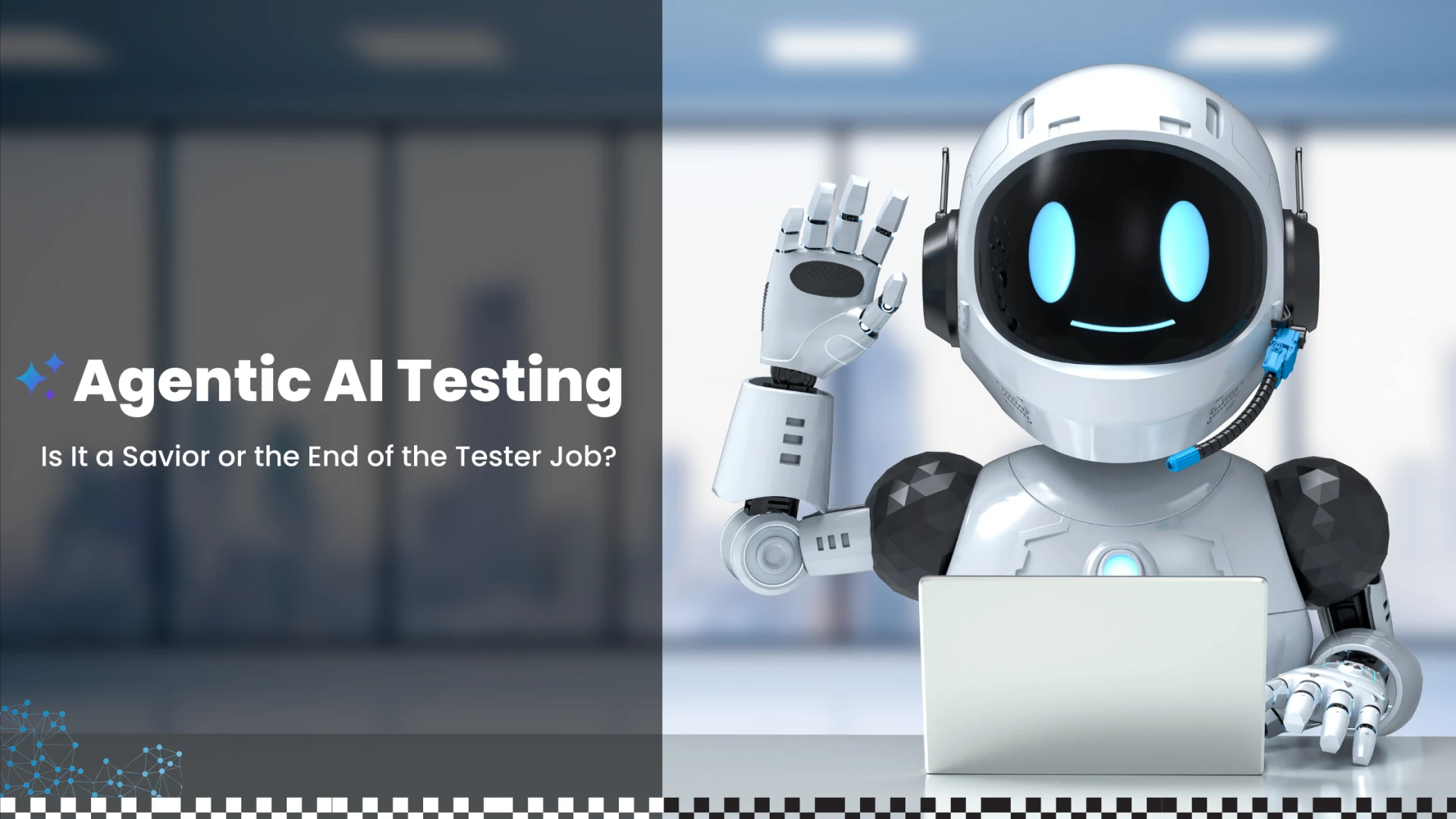

Everyone in the tech industry is whispering about the same thing right now. You hear it in conference halls, read it on LinkedIn feeds, and see it in almost every tech newsletter. The subject? Artificial Intelligence (AI) is taking over jobs. But we aren't talking about simple chatbots or basic automation scripts anymore. We are looking at something far more advanced: Agentic AI in software testing.
For years, quality assurance was straightforward. You wrote a script, the script ran a test, and if something broke, you fixed it. But now, we have AI agents capable of planning, executing, and even fixing their own tests without human help. It sounds great for business owners watching their bottom line, but for the tester sitting at a desk, it feels personal. Is this the end of the line for human QA professionals, or is it the start of a partnership we never knew we needed?
Let’s get into the details and separate the hype from the reality.
What Is Agentic AI Testing Really All About?
To understand why people are panicking (or celebrating), we have to define what this actually is. Traditional automation is static. You tell it exactly what to do. If a button moves five pixels to the left, the script fails, and you spend your morning debugging.
Agentic AI is different. Think of it as giving a goal to a smart assistant rather than giving instructions to a robot. You don't say, "Click coordinate X, Y." You say, "Login and purchase a red shirt." The AI figures out how to do it. It looks at the screen like a person would, finds the login form, finds the shirt, and finishes the transaction.
These agents have the ability to make their own decisions. They see what's going on around them, consider the difficulties, and take steps to achieve specific results. By leveraging LLM model optimization, they interact directly with software interfaces just like a human user. They close any pop-ups that show up. They wait if the website takes too long to load. This change from "script-based" to "goal-based" testing is what makes agentic AI testing so disruptive.
How Is Agentic AI Changing the Software Testing Landscape?
The shift is happening fast. Just a few years ago, AI in testing meant simple visual regression tools. Now, it is reshaping the entire workflow.
Self-Healing Capabilities: Maintenance is one of the biggest headaches of QA. Due to developers' code changes, automation suites might break. Agentic AI corrects this by repairing the test data. If the element ID is changed but the button is kept, the AI recognizes this and dynamically updates the test logic. All this self-healing saves testers a lot of time that would otherwise be spent correcting old scripts.
Exploratory Testing: This never ceased to be the forte of manual testing. Man is a prodigy in clicking all over and locating strange insects. It is now possible to replicate this behavior by AI agents. They will be able to play around with an application without a predetermined course of action, attempting to break it in ways a regular script never would.
Test Data Generation: The generation of user-realistic data is time-consuming. With agentic AI, it is possible to create thousands of distinct user profiles, transaction histories, and edge-case scenarios in seconds, and make sure that the system is being tested with data that appears and behaves real.
Is Agentic AI a Threat to QA Tester Jobs?
This is the question keeping people up at night. Let’s be honest: yes, it is a threat to certain types of jobs.
If your daily work consists entirely of writing basic Selenium scripts or manually checking if a login page works for the 500th time, those tasks are in danger. AI can do rote, repetitive work faster and cheaper than a human. It doesn't get tired, it doesn't need coffee breaks, and it works weekends.
However, saying it will replace all testers is an exaggeration. AI is brilliant at following goals, but it lacks context. It doesn't understand business nuance. It can't tell you if a user interface "feels" clumsy or if a brand voice is off. It can catch a crash, but it might not catch a frustration.
The role of the tester isn't dying; it is shifting. The "click-monkey" era is over. The era of the "Quality Strategist" is beginning.
What New Opportunities Does Agentic AI Create for Testers?
Instead of viewing this as a replacement, look at it as a promotion. Agentic AI in software testing handles the grunt work, freeing up humans to do the cool stuff.
AI Auditing and Oversight
Who tests the tester? Unless an AI agent is running your tests, somebody will have to ensure it is not hallucinating. Testers will turn into auditors who review AI decisions to ensure accuracy.
Complex Scenario Planning
AI requires excellent objectives to work. Testers will become "Timely Engineers of QA and strategize intricate user flows and edge cases that the AI will perform.
Focus on User Experience (UX)
Testers will be able to work on usability because functional checks are automated. Does the flow make sense? Is the app accessible? These are questions that involve human beings and demand human empathy.
Performance Engineering
While AI can run the load, interpreting the data requires expertise. A performance testing service is more than just blasting a server with traffic; it’s about analyzing bottlenecks and architecture. AI can generate the load, but humans provide the architectural insights to fix the issues.
Can We Trust Agentic AI to Make Testing Decisions Independently?
Trust is a major hurdle. We have all seen AI make things up. In the world of software development, a "hallucination" can mean a critical bug goes into production because the AI thought it looked fine.
Agentic AI testing operates on probabilities. It predicts the next best action. Mostly, it is right. Sometimes, it is confidently wrong. For example, an AI might mark a test as "passed" because it found a "Success" message, ignoring the fact that the database wasn't actually updated.
You cannot hand over the keys completely. There must be a "human in the loop." Organizations that try to run purely on autopilot will likely face quality issues. The AI should do what it's told, but a person should come up with the plan and go over the outcomes. It is not a replacement for critical thinking; it is a tool.
Is Agentic AI Truly a “Savior” for Modern QA Teams?
"Saviour" may be an extreme term, but for teams who are drowning in technical debt, it could seem like one. The speed of modern software development is mind-boggling. DevOps and CI/CD pipelines push code daily or even hourly. Traditional manual testing services cannot keep up, and maintaining brittle automation suites slows everything down.
Agentic AI offers a way out of this bottleneck. It allows teams to scale their testing efforts without linearly scaling their headcounts. It allows for "shift-left" testing to happen more effectively, catching bugs earlier in the cycle.
For a startup with limited resources, it acts as a force multiplier. For a large enterprise, it cuts through the noise of massive regression suites. It saves teams from the burnout of repetitive tasks. If saving your team from weekend work and endless maintenance tickets counts as being a savior, then yes, it fits the description.
What Does the Future of QA Look Like in an Agentic AI World?
The future isn't a Terminator-style wasteland for testers. It is a hybrid model. In the next few years, we will likely see QA teams shrink in raw numbers but grow in influence. The ratio of developers to testers might widen, as one tester armed with agentic tools can cover the work of five traditional testers.
We will see a rise in manual software testing services focused strictly on high-value, creative testing such as exploratory security testing, accessibility audits, and subjective user acceptance testing (UAT). These are areas where human intuition remains king.
Integration will become the main skill. How well can you integrate AI agents into your Jenkins pipeline? How well can you train an agent to understand your specific domain logic? The testers who do well will be the ones who learn how to use these tools, not the ones who try to fight them.
Final Thoughts
The industry is reaching a turning point. Agentic AI testing isn't just a buzzword; it's a big revolution in how we think about the quality of software. It gives us speed, independence, and productivity that we could only have dreamed of about ten years ago. But it is not a magic wand. It requires supervision, strategy, and a deep understanding of what quality actually means beyond just "pass/fail."
The tester of the future is a pilot, not a passenger. If you are a business looking to integrate these advanced capabilities, or if you simply need a team that understands the balance between human ingenuity and AI efficiency, you need a partner who gets it. Whether you need cutting-edge automation, deep-dive manual software testing services, or robust performance testing services, the right expertise matters.
Adapting to this change is not optional. It is the only way forward. Do not let your QA strategy fall behind. Connect with a reliable software testing service provider today to see how the future of testing can work for you.





















Sign in to leave a comment.