
Not every lead is created equal. Some prospects are ready to buy today. Others are just browsing. And a significant chunk will never convert — no matter how many follow-up emails your team sends. The challenge for any sales organization is figuring out which is which, fast enough to actually do something about it.
That's exactly the problem AI lead scoring was built to solve. And when it's embedded into modern lead management software, it transforms how sales teams prioritize, engage, and close — turning what used to be gut-feel guesswork into a data-driven, scalable system.
In this post, we'll explore how AI lead scoring works, why it's become the engine behind effective lead management, and how automated lead follow up closes the loop between scoring and revenue.
The Problem with Traditional Lead Management
Before AI entered the picture, lead scoring was either nonexistent or dangerously oversimplified. Sales teams would work leads in the order they came in — first in, first called. Or they'd rely on basic demographic filters: company size, job title, industry. Points were assigned manually based on rules someone in marketing created months ago and never revisited.
The result? Sales reps spent enormous amounts of time chasing cold leads while genuinely interested prospects went quiet — either because no one followed up fast enough or because they got the same generic outreach as everyone else.
Traditional lead management software helped organize the chaos, but it couldn't think. It could store leads, track statuses, and send reminders. What it couldn't do was tell you which leads were most likely to convert right now — and why.
What AI Lead Scoring Actually Does
AI lead scoring changes the equation entirely by replacing static rule-based scoring with dynamic, machine-learning-driven analysis.
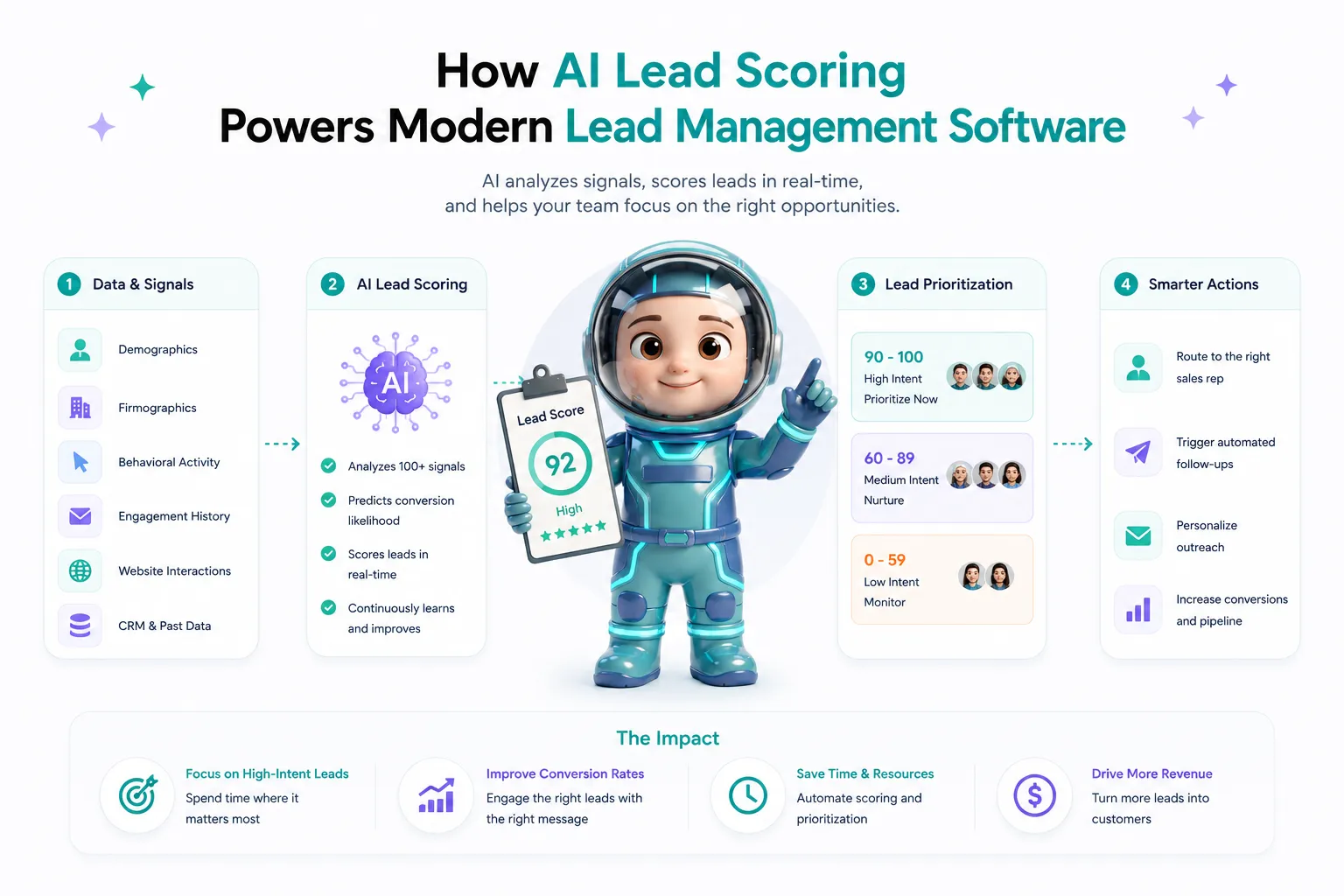
Instead of assigning points based on a fixed set of criteria, AI models analyze hundreds of behavioral and firmographic signals simultaneously — and continuously update each lead's score based on new activity. The kinds of signals a well-trained model considers include:
- Behavioral signals — pages visited, time spent on site, content downloaded, emails opened and clicked, demo requests, pricing page visits
- Firmographic signals — company size, industry, revenue, geography, tech stack
- Engagement velocity — how quickly and frequently a lead is interacting with your brand
- Negative signals — inactivity, unsubscribes, low-intent page visits
What makes AI scoring powerful isn't just the volume of signals — it's the model's ability to learn which combinations of signals actually predict conversion for your specific business. A lead who downloads a whitepaper and visits your pricing page twice in three days means something very different than one who signed up for a webinar six months ago and hasn't been back since. AI knows the difference. A static scoring rubric often doesn't.
Over time, as the model is exposed to more won and lost deals, its predictions become sharper. It's a compounding advantage that widens the gap between AI-powered teams and those still scoring manually.
How AI Lead Scoring Powers Better Lead Management
When AI lead scoring is built into your lead management software, the entire pipeline becomes smarter.
Prioritization Becomes Automatic
Instead of reps deciding each morning who to call based on recency or instinct, the software surfaces the highest-scoring leads automatically. Reps start every day knowing exactly who deserves their attention — not because a manager told them, but because the data says so. This alone can dramatically increase conversion rates, because high-intent leads get reached while their interest is still hot.
Segmentation Gets Precise
AI scores don't just rank leads — they reveal patterns. Your software can automatically segment leads into buckets: ready to buy, nurture required, not a fit. Each segment gets a different treatment. High-score leads go straight to sales. Mid-score leads enter a nurture sequence. Low-score leads are deprioritized without anyone having to make that call manually.
Sales and Marketing Align
One of the most persistent tensions in revenue teams is the disagreement over lead quality. Marketing says they're sending great leads. Sales says they're wasting time on poor ones. AI lead scoring gives both teams a shared, objective framework — leads graduate from marketing to sales only when the score says they're ready. That handoff becomes clean, data-backed, and defensible.
The Role of Automated Lead Follow Up
Scoring a lead highly means nothing if no one follows up. And here's the brutal reality: studies consistently show that the majority of leads never receive a timely follow-up. Reps get busy, leads fall through the cracks, and deals that could have closed quietly disappear.
This is where automated lead follow up becomes the critical final piece of the puzzle.
When integrated with AI lead scoring, automated follow-up systems trigger personalized outreach the moment a lead's score crosses a threshold. A prospect who just visited your pricing page for the third time and opened your last two emails can receive a tailored message within minutes — not days. The message references what they've been looking at. It arrives when their interest is highest. And it happens without a rep lifting a finger.
Automated sequences also ensure consistency. Every high-score lead gets the same quality of follow-up — no matter how busy the team is, how many leads came in that day, or whether it's a Monday morning or Friday afternoon.
Lio: AI Lead Scoring Built Into Smarter Lead Management
For sales teams ready to move beyond spreadsheets and static scoring models, Lio delivers AI-powered lead management software that combines intelligent scoring with seamless automated lead follow up in one connected platform.
Lio's AI engine continuously analyzes lead behavior and engagement data, scoring and re-scoring leads in real time as new signals come in. Sales reps get a clear, prioritized view of their pipeline — always up to date, always reflecting the latest activity. And when a lead's score signals buying intent, Lio's automation kicks in immediately, triggering personalized follow-up sequences that keep prospects engaged without adding to your team's workload.
The result is a sales process that's faster, more consistent, and significantly more effective — with fewer leads lost to slow follow-up and more deals closed from the same pipeline.
The Competitive Case for AI-Powered Lead Management
Speed and precision now define who wins in sales. Buyers expect fast, relevant outreach. They lose interest quickly, and they're talking to your competitors at the same time they're talking to you.
Lead management software powered by AI lead scoring and automated lead follow up gives your team the edge to respond faster, prioritize smarter, and personalize at scale. It's not about replacing your sales team — it's about making every rep dramatically more effective with the leads they already have.
Businesses that invest in AI-powered lead management now are building a compounding advantage. Better data leads to better scoring. Better scoring leads to better conversion. Better conversion funds more growth. The cycle is self-reinforcing — and it starts the moment you stop scoring leads by hand.
With platforms like Worksbuddy Lio making this technology accessible and immediately actionable, there's no reason to leave that advantage on the table.
Frequently Asked Questions
What is AI lead scoring and how does it work?
AI lead scoring uses machine learning algorithms to analyze a variety of behavioral and firmographic signals to predict which leads are most likely to convert. Unlike traditional methods, which rely on static criteria, AI continuously updates lead scores based on real-time activity, providing a dynamic and data-driven approach to lead management.
How does AI lead scoring improve sales team efficiency?
By automating the prioritization of leads, AI lead scoring allows sales teams to focus on high-intent prospects rather than wasting time on cold leads. This data-driven approach ensures that sales reps know exactly who to engage with each day, significantly increasing chances of conversion and streamlining the sales process.
What are the benefits of integrating automated lead follow-up with AI lead scoring?
Automated lead follow-up ensures timely and personalized outreach to high-scoring leads, which is crucial for maintaining engagement. This integration allows for consistent follow-up without relying on busy sales teams, meaning potential deals are less likely to slip through the cracks due to delays or oversight.
Can AI lead scoring adapt to different business needs?
Yes, AI lead scoring models are designed to learn and adapt based on the unique signals that predict conversions for each specific business. As they process more data from won and lost deals, these models become increasingly effective at providing accurate scores tailored to a company's sales patterns.
How does AI lead scoring enhance collaboration between sales and marketing teams?
AI lead scoring creates a shared framework for both sales and marketing teams to assess lead quality objectively. By ensuring leads are handed off to sales only when they meet a certain score threshold, it reduces disputes over lead quality and aligns both departments towards common revenue goals.
What challenges does AI lead scoring address compared to traditional lead management?
AI lead scoring addresses the limitations of traditional lead management, such as reliance on outdated demographic filters and manual point assignments. It eliminates guesswork by providing a real-time, data-driven understanding of lead potential, helping sales teams focus their efforts where they are most likely to succeed.
Is AI lead scoring suitable for all types of businesses?
AI lead scoring is highly adaptable and can benefit businesses of all sizes and industries by providing insights that enhance lead management. However, its effectiveness can vary based on the data quality and volume available, making it essential for businesses to have a solid data strategy in place.




























Sign in to leave a comment.