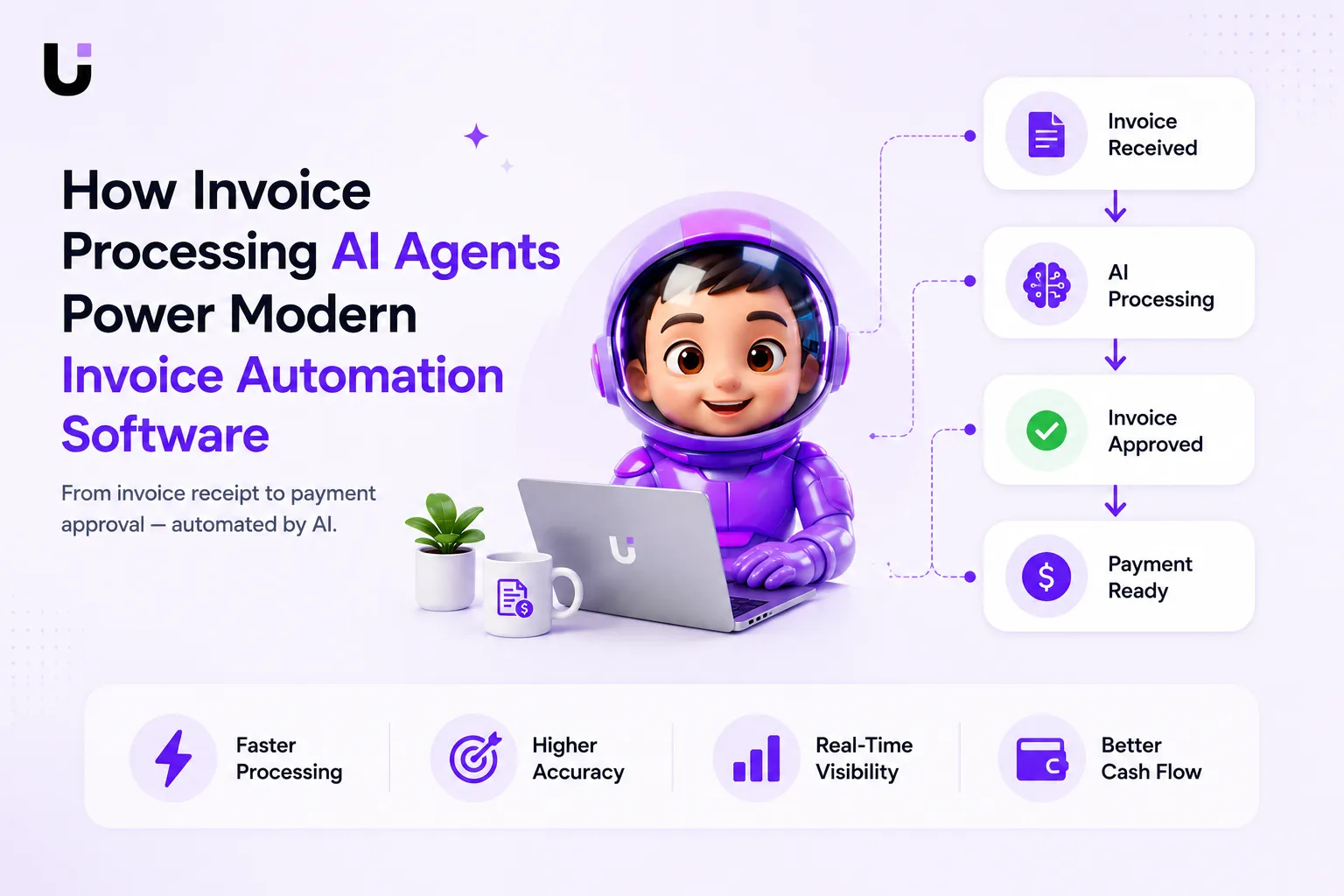

Invoice automation software has existed in some form for over two decades.
The first generation was essentially digitized paper. PDF invoices instead of printed ones. Email delivery instead of physical mail. The process was the same. Only the medium changed. A human still received the invoice, read it, typed the data into an accounting system, filed the document somewhere, and moved on to the next one.
The second generation introduced rules. If the invoice matches the PO, approve it. If the amount exceeds a threshold, route it to the manager. If payment is overdue, send a reminder. Rules were a genuine improvement. They removed the most repetitive human decisions from the process and created consistency where individual judgment had previously created variance. But rules have a ceiling that every business eventually hits. The rule set covers the scenarios you anticipated. Reality presents the scenarios you did not.
The third generation, the one being built now, is fundamentally different from both of its predecessors. Invoice processing AI agents do not digitize paper and they do not execute rules. They reason. They observe the full context of an invoice situation, access relevant information through connected business systems, apply judgment about what action best serves the defined objective, and execute that action without requiring a human to define every possible branch in the decision tree in advance.
This shift from rules to reasoning is not an incremental improvement in invoice automation software. It is a categorical change in what the software can do, what error rates it achieves, how it handles exceptions, and how it connects the invoice lifecycle to the broader business operation around it. Understanding why this shift matters and how it works in practice is the foundation for building or evaluating invoice automation systems that will hold up under real business complexity.
Why Rule-Based Invoice Automation Always Left the Hard Problems Unsolved
To understand what Invoice Processing AI Agents bring to invoice automation software, it helps to be precise about where the previous generation consistently fell short.
Rule-based invoice automation was reliable within its defined scope and brittle outside it. For the 60 to 70 percent of invoices that followed predictable patterns, rules worked well. The invoice arrived in a standard format from a known vendor, matched the purchase order within tolerance, routed to the expected approver, and proceeded to payment without incident. Rules handled this path efficiently and consistently.
The remaining 30 to 40 percent of invoices were the problem. The vendor submitted on a new template that the OCR system could not parse correctly. The invoice amount was 6 percent above the PO because of materials cost increases that were verbally agreed but not formally documented. The approver was on leave and the backup approver was not configured in the routing rules. The invoice referenced two purchase orders that needed to be split before matching. Each of these situations required human intervention not because the right answer was complex but because the rule set had not anticipated the specific combination of circumstances.
In a high-volume AP operation, these exceptions accumulate faster than a human team can process them. The exception queue becomes a bottleneck that limits the throughput of the entire invoice processing system. The automation that was supposed to reduce manual work creates a new category of manual work: exception handling. And because exception handling is by definition the cases the system could not resolve automatically, these tend to be the most complex, most time-consuming, and most error-prone cases that land on human desks.
Invoice processing AI agents solve this at the architectural level. Instead of a fixed rule set that covers anticipated scenarios, the AI agent has the ability to reason about unanticipated scenarios using the context available to it. The vendor invoice on a new template is not an exception that breaks the extraction pipeline. It is a document the AI reads and understands regardless of layout. The amount variance with a verbal agreement is not an unresolvable mismatch. It is a situation the AI can investigate by pulling vendor history, checking budget availability, and making a reasoned recommendation. The backup approver scenario is not a routing failure. It is a situation the AI can resolve by identifying the appropriate escalation path from organizational structure data.
The exception queue does not disappear entirely. There will always be genuinely novel situations that require human judgment. But it shrinks dramatically because the AI agent handles the vast majority of what was previously landing there as exception items.
The Intelligence Layer: What AI Agents Add to Invoice Automation Software
Modern invoice automation software built on AI agents has a fundamentally different architecture from rule-based systems, and understanding the structural difference explains why the performance outcomes are so different.
Rule-based systems are static. The logic is defined at implementation time and remains fixed until a developer changes it. Adding a new vendor category, adjusting approval thresholds, or handling a new type of invoice discrepancy all require code changes or configuration updates that go through a development and deployment cycle. The system cannot adapt to new situations on its own.
AI agent systems are dynamic. The agent's behavior is governed by its objective, its tool access, and its reasoning capability rather than by a fixed rule set. When a new situation arises that was not anticipated at implementation time, the agent reasons about it from first principles using the context available to it. It does not fail because the rule does not exist. It applies judgment because judgment is what the agent is designed to provide.
This dynamic capability manifests across every stage of the invoice lifecycle in ways that create measurable differences in error rates, processing speed, and cash flow outcomes.
At the data extraction stage, AI agents understand document semantics rather than just reading characters. When an invoice has an unusual layout, the AI understands that the field labeled "Total Amount Due" and the field labeled "Invoice Total" and the field labeled "Amount Payable" all refer to the same concept, regardless of where they appear in the document. It extracts the right value from each field based on semantic understanding rather than positional rules that break when the layout changes.
At the validation stage, AI agents apply contextual judgment rather than binary pass-fail rules. A 4 percent variance between an invoice and its purchase order from a vendor with a three-year track record of accurate billing is a different situation than the same variance from a new vendor with no payment history. Binary rules treat both identically. AI reasoning treats them appropriately differently based on the full context.
At the routing and approval stage, AI agents assemble the context that approvers need rather than just delivering an invoice to an inbox. The approver receives a complete decision package: matching results, vendor history, budget availability, and a recommended action with the reasoning behind it. The time required to make a well-informed decision drops from an investigation to a review.
At the follow-up and collections stage, AI agents calibrate the tone and timing of follow-up communications based on client relationship signals rather than following a fixed schedule. A client with a strong payment history who is three days late gets a gentle reminder that acknowledges the relationship. A new client with no payment history who is overdue on their first invoice gets a firmer communication at an earlier point in the cycle.
The Five Capabilities That Define Modern Invoice Processing AI Agents
Not all invoice automation software that uses AI terminology is built on genuine AI agent architecture. The distinction matters because the capabilities that deliver real performance improvements require specific architectural elements that partial AI implementations do not have.
Genuine document understanding, not just OCR
The first capability that separates AI agent-powered invoice automation from enhanced rule-based systems is how they handle document extraction. OCR reads characters and attempts to match them to positional templates. AI agents understand the semantic content of documents regardless of layout. This distinction becomes most visible on non-standard invoices, which are the exact invoices where accurate extraction matters most because they are more likely to be high-value, unusual, or from vendors who require careful handling.
The accuracy difference between OCR-based extraction and AI document understanding is most pronounced on the tail of the invoice distribution, the unusual formats, the handwritten annotations, the multi-page invoices with line items spanning pages, the invoices with embedded tables that do not align to standard column structures. In a high-volume AP operation, this tail is large enough to matter significantly for overall error rates.
Contextual reasoning across connected data sources
The second defining capability is the ability to gather and synthesize information from multiple sources before making a processing decision. A genuine Invoice Processing AI Agent does not evaluate an invoice in isolation. It pulls vendor payment history from the supplier master. It checks PO details from the procurement system. It verifies goods receipt from the warehouse management system. It checks budget availability from the general ledger. It reviews any open disputes with the vendor from the dispute management system.
This multi-source context gathering is what allows the AI agent to make accurate judgments on complex invoice situations rather than defaulting to human escalation for anything that does not match a simple pattern. The context the agent gathers is also what goes into the decision package delivered to human approvers when escalation is warranted, making human review faster and more accurate.
Adaptive exception handling
The third capability is handling exceptions without a human-defined playbook for every possible situation. Rule-based systems have explicit exception handling rules that cover anticipated exception types. Anything outside those types lands in a human queue. AI agents reason about unanticipated exception types using the context available to them and either resolve the exception autonomously or escalate with a recommendation and supporting evidence.
This adaptive capability is particularly valuable in growing businesses where invoice complexity tends to increase faster than rule sets can be updated to accommodate it. New vendor categories, new geographic markets, new product lines, and new contract structures all introduce invoice patterns that rule-based systems need explicit configuration to handle. AI agents handle them through reasoning from the moment they first appear.
Autonomous follow-up cycle management
The fourth capability is managing the full outbound invoice follow-up cycle without human initiation for each step. This is the capability most directly connected to cash flow acceleration because consistent, timely follow-up is the primary driver of on-time payment behavior. When follow-up is automated and consistent, payment timelines compress because clients who might otherwise let an invoice slip past its due date receive a timely reminder before they have moved on to other things.
The AI agent calibrates follow-up timing and tone based on client-specific signals rather than following a uniform schedule that ignores relationship context. A high-value long-term client relationship warrants a different follow-up approach than a new client relationship. A client who has acknowledged receipt of the invoice but indicated a processing delay warrants a different follow-up than a client who has not responded to any communication. AI agents apply these distinctions automatically based on available signals rather than requiring a human to make judgment calls for each follow-up decision.
Continuous learning and improvement
The fifth capability is the ability to improve over time based on the outcomes of previous processing decisions. Rule-based systems do not learn. If a rule produces incorrect results consistently, those incorrect results continue until a developer identifies the problem and changes the rule. AI agent systems can identify patterns in processing outcomes, recognize when their decisions are being overridden by human reviewers and why, and improve the quality of future decisions based on accumulated experience.
In practice, this means that the error rate of an AI-powered invoice automation system decreases over time as the system builds familiarity with each business's specific vendor relationships, approval patterns, and exception types. The performance improvement is continuous rather than episodic, occurring through each processing cycle rather than only when a developer makes a configuration change.
How AI Agents Transform the Outbound Invoice Lifecycle
The discussion of invoice automation software typically focuses on accounts payable, the process of receiving, validating, and paying vendor invoices. The outbound invoice lifecycle, generating, delivering, and collecting on invoices sent to clients, is equally important for cash flow and equally transformed by AI agent architecture.
The outbound invoice lifecycle has four stages where AI agents create meaningful performance improvement over manual or rule-based processes.
Invoice generation is the first stage where AI agents eliminate a class of errors entirely. In manual and rule-based systems, invoice generation depends on a human recognizing that a billable event has occurred and initiating the invoicing process. Project milestones get invoiced when someone remembers to invoice them. Contract deliverables get billed when the project manager notifies finance. The gap between when revenue is earned and when an invoice is generated often runs to days or weeks, and in some cases invoiceable events are missed entirely.
AI agents connected to project management, contract management, and CRM systems recognize billable events automatically and generate invoices immediately without requiring human initiation. When a project milestone is marked complete, the invoice is generated and delivered within minutes. When a contract term triggers a scheduled payment, the invoice appears in the client's inbox before the billing period has closed. The gap between revenue earned and invoice delivered compresses to near zero.
Invoice delivery and client experience is the second stage. AI agents personalize the delivery experience based on client-specific context. A client who has indicated a preferred billing contact receives invoices at that contact rather than at a generic accounts payable address. A client who prefers portal delivery receives a notification with a portal link rather than a PDF attachment. A client who has previously questioned specific line item descriptions receives invoices with expanded descriptions that preemptively answer those questions. These personalizations are not manual. They are applied automatically based on client profile data.
Payment monitoring and follow-up is the third stage and the one with the most direct cash flow impact. AI agents monitor payment status continuously for every outstanding invoice and trigger follow-up at the optimal moment rather than on a fixed schedule. The follow-up cadence is calibrated to each client relationship rather than uniform across all clients. The tone of each communication reflects where the client is in the payment cycle and what relationship context is available. A client who is three days past due on a first invoice gets a different communication than a long-term client whose payment is three weeks late, and both get a different communication than a client who has indicated a dispute.
Dispute detection and resolution is the fourth stage. AI agents recognize when client behavior indicates a dispute even before a formal dispute is raised. A client who opened the invoice email but has not paid after fourteen days when they typically pay within seven is showing a signal that warrants investigation. An AI agent can proactively reach out to identify and resolve the issue before it becomes a formal dispute, keeping the payment timeline shorter than a reactive dispute process would produce.
Integration Architecture: Why Connected AI Agents Outperform Standalone Tools
The performance difference between AI-powered invoice automation software that operates as a connected business system and AI-powered invoice automation software that operates as a standalone tool is not marginal. It is fundamental, and it comes from the information available to the AI agent when making processing decisions.
A standalone invoice automation tool has access to invoice data and whatever financial system data it is connected to through its specific integrations. It can tell you that an invoice arrived, what it contained, whether it matched a purchase order, and whether payment was scheduled. It cannot tell you that the project this invoice relates to is behind schedule, that the client relationship has elevated risk signals, that the vendor relationship just changed due to a renegotiated contract, or that the project manager who needs to approve this invoice is currently allocated at 150 percent capacity.
An AI agent operating as part of a connected business platform has access to all of that context. Project status, client relationship health, vendor relationship signals, team capacity, contract terms, and communication history are all available to inform processing decisions. The quality of those decisions is correspondingly higher because they are made from the full picture of what is happening in the business rather than from the narrow view available to an isolated tool.
The integration architecture that enables this contextual richness requires connecting the invoice processing layer to every relevant business system through a unified data layer that the AI agent can query. CRM data for client relationship context. Project management data for delivery status and milestone completion. Contract management data for billing schedule and terms. HR data for approver availability. Communication data for client engagement history. Each connection adds signal that improves the quality of AI agent decisions.
The practical implication for businesses evaluating invoice automation software is that the integration depth of the platform matters as much as the AI capability of the processing engine. An AI agent with narrow integration access will make narrow decisions. An AI agent with broad integration access will make decisions that reflect the full operational context of the business, which is what genuine intelligence in invoice processing requires.
How WorksBuddy Inzo Brings This Together
Inzo is WorksBuddy's Invoice Processing AI Agent and it was built from the ground up on the architectural principles described in this post rather than as a rule-based system with AI features layered on top.
On the inbound processing side, Inzo handles vendor invoice capture from any document format, runs AI-powered extraction with confidence scoring at the field level, applies three-way matching against purchase orders and goods receipts, and routes exceptions with complete context packages assembled rather than cold escalations that require human investigation. Every processing decision is logged to an immutable audit trail that answers compliance and dispute questions without manual record reconstruction.
On the outbound side, Inzo connects directly to the WorksBuddy platform to recognize billable events automatically. When Taro marks a project milestone complete, Inzo generates and delivers the client invoice without waiting for human initiation. When Sigi records a signed contract, Inzo configures the billing schedule and generates the initial invoice from the contract terms. The follow-up cycle runs automatically from delivery through collection, calibrated to each client relationship rather than following a uniform schedule.
Because Inzo operates inside WorksBuddy alongside Taro, Evox, Sigi, and Lio, its AI agent has access to the full business context that drives the quality of its processing decisions. Client relationship signals from Lio inform collection tone. Project status from Taro determines billing trigger timing. Communication history from Evox informs the escalation approach for clients who have not responded to standard follow-up. Contract terms from Sigi govern invoice amounts, payment schedules, and billing conditions.
This is the connected intelligence that separates Inzo from standalone invoice automation software. Not just an AI that processes invoices faster. An AI agent that processes invoices with the full context of the business relationship behind every decision it makes.
The Bottom Line
The shift from rule-based invoice automation software to Invoice Processing AI Agent architecture is not an upgrade. It is a replacement of the fundamental mechanism by which invoice processing decisions are made.
Rules cover what you anticipated. AI agents handle what you did not. Rules perform consistently on the easy majority and fail on the complex minority. AI agents perform consistently across the full distribution of invoice complexity. Rules require developer intervention every time the business changes. AI agents adapt to new situations through reasoning rather than reconfiguration.
The practical outcomes of this architectural shift are measurable across every dimension that matters for invoice processing: error rates, processing speed, exception handling throughput, follow-up consistency, and cash flow timing. Businesses that implement genuine Invoice Processing AI Agent architecture do not just reduce the cost of invoice processing. They change the relationship between invoice volume and operational overhead, between invoice complexity and exception rate, and between revenue earned and cash collected.
That is what modern invoice automation software powered by AI agents actually delivers. Not incremental improvement on the process that existed before. A fundamentally better process that handles the full complexity of real business invoice operations reliably, intelligently, and continuously.
See how WorksBuddy Inzo powers intelligent invoice automation at worksbuddy.ai


























Sign in to leave a comment.