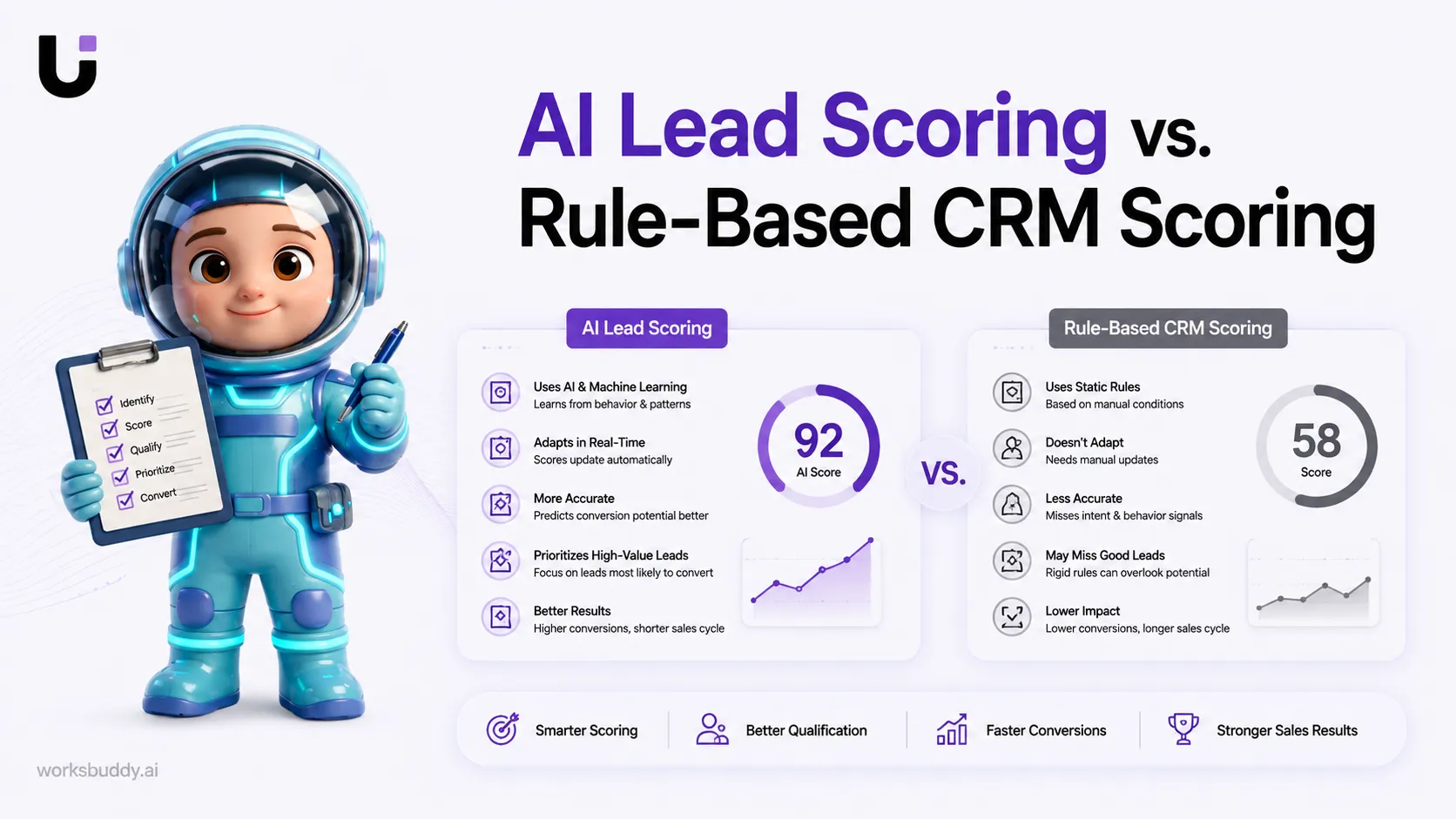

Every sales team eventually runs into the same problem: too many leads, not enough hours in the day to chase them all with equal energy. Lead scoring exists to solve exactly that — it tells reps which prospects are worth calling first. But the method behind the score matters a lot more than most teams realize. Broadly, there are two schools of thought: traditional rule-based CRM scoring, and the newer approach built around AI-CRM-lead-scoring models. Both aim to answer the same question — "who is most likely to buy?" — but they get there in very different ways, with very different levels of accuracy.
This article breaks down how each method actually works, where each one falls apart, and how to figure out which approach (or combination of approaches) fits your sales process.
What Is Rule-Based CRM Scoring?
Rule-based scoring is the original way CRMs handled lead prioritization, and it's still the default in most systems today. It works on a simple principle: a human decides in advance which attributes and actions matter, assigns point values to each, and the CRM adds them up automatically.
For example, a marketing team might set up rules like:
- +10 points if the lead downloaded a pricing PDF
- +15 points if the lead's job title contains "Director" or "VP"
- +5 points for every email opened
- -20 points if the lead unsubscribes or goes cold for 30 days
Add these up, and every contact in the database gets a numeric score. Once a lead crosses a set threshold — say, 50 points — it gets flagged as "sales qualified" and handed to a rep.
Why teams still use it: Rule-based scoring is transparent. Anyone on the team can look at a lead's score and know exactly why it's high or low. It's also cheap to set up, doesn't require historical data to function, and works fine for smaller pipelines where the sales team already understands its buyers intuitively.
Where it breaks down: The rules are static. They were written based on assumptions about what a good lead looks like at one point in time, and they don't adjust as buyer behavior shifts. A rule that worked well last year might be actively misleading this year. Rule-based systems also can't weigh combinations of behavior — they just add numbers linearly, so a lead who visited the pricing page once and a lead who visited it ten times in one day get treated almost identically unless someone manually writes a rule for that specific pattern. And because the point values are guesses, not measurements, the resulting score reflects what marketing believes matters, not what actually predicts revenue.
What Is AI-Based CRM Lead Scoring?
Ai-crm-lead-scoring flips the process around. Instead of a person deciding upfront which signals matter, a machine learning model studies historical data — closed-won deals, closed-lost deals, and everything in between — and works out which combinations of behaviors and attributes actually correlate with a sale.
This typically involves feeding the model data such as:
- Firmographic details (industry, company size, revenue band)
- Engagement history (email opens, site visits, content downloads, demo requests)
- Timing patterns (how quickly a lead responds, time between touches)
- Outcome data (which leads eventually converted, and which didn't)
From this, the model produces a probability score — often expressed as a percentage likelihood to convert — that updates continuously as new data comes in. Unlike static rules, the model can pick up on non-obvious patterns: for instance, that leads who visit the careers page before the pricing page convert at a notably higher rate, something no human would think to write a rule for.
Why it's gaining traction: Ai-crm-lead-scoring adapts. As market conditions change or new products launch, the model recalibrates based on fresh outcome data instead of waiting for someone to rewrite rule logic. It can also process far more variables simultaneously than a human ever could, and it tends to be better at spotting subtle, non-linear relationships between behaviors and conversions.
Where it struggles: The obvious limitation is data. Machine learning models need a meaningful volume of historical, labeled data (enough closed-won and closed-lost examples) to learn from. A company with a short sales history or a small deal volume may not have enough data for the model to find reliable patterns, which can produce a score that looks precise but is actually just noise. AI scoring can also become a "black box" — reps may see a score of 82 without an easy way to understand why, which can erode trust in the number if it isn't paired with explainability features. And if the historical data itself contains bias (for example, if a sales team historically ignored a certain segment), the model can inherit and reinforce that bias rather than correct it.
Side-by-Side: How the Two Actually Compare
| Factor | Rule-Based Scoring | AI-Based Scoring |
|---|---|---|
| Setup effort | Low — manual configuration | Higher — needs historical data and model training |
| Transparency | High — rules are visible and editable | Lower — often needs explainability tools |
| Adaptability | Static, needs manual updates | Learns and adjusts automatically |
| Accuracy at scale | Drops as data volume grows | Improves as more data accumulates |
| Best fit | Small teams, early-stage pipelines | Established teams with volume and history |
| Risk | Outdated assumptions baked in | Bias inherited from historical data |
So, Which One Actually Works?
The honest answer is: it depends on where a business sits, not on which technology is inherently "smarter."
Rule-based scoring works well when a company is early in its growth, has a limited number of leads flowing through the pipeline, and has a sales team with strong intuitive knowledge of its ideal customer. In that scenario, there simply isn't enough historical data for a machine learning model to learn from, and a transparent, editable rule system gives more control with less risk of a confusing black-box score.
Ai-crm-lead-scoring tends to outperform rule-based systems once a company has enough volume and history — typically hundreds or thousands of closed deals — for a model to find statistically meaningful patterns. At that stage, the ability to continuously recalibrate against real outcomes, rather than static assumptions, tends to produce measurably better prioritization. Sales teams often see this reflected in higher conversion rates on the leads flagged as "high priority," simply because the score is grounded in what has actually driven revenue rather than what someone guessed would.
In practice, many CRM platforms — including tools like Worksbuddy Lio that combine automation with scoring features — are increasingly blending both approaches: using clear, rule-based thresholds for basic qualification (company size, budget range, industry fit) while layering an AI-driven model on top to refine and re-rank leads based on behavioral patterns. This hybrid approach tries to capture the transparency of rules with the adaptability of machine learning, rather than forcing teams to pick one system exclusively.
Practical Signals for Choosing an Approach
A few questions can help clarify which model fits a specific sales operation:
- How much historical deal data exists? Fewer than a few hundred closed opportunities usually isn't enough for a reliable AI model.
- How often do buyer behaviors change? Fast-moving markets benefit more from adaptive scoring than static rules.
- How important is explainability to the sales team? If reps need to justify prioritization decisions to leadership, transparent rule logic may matter more than raw predictive accuracy.
- Is there a data science or ops resource available? AI scoring models need monitoring and occasional retraining; without that support, they can silently drift out of accuracy.
The Bottom Line
Neither method is universally "correct." Rule-based CRM scoring offers clarity and low overhead but grows brittle as data volume and buyer complexity increase. Ai-crm-lead-scoring offers adaptability and pattern recognition that rules simply cannot replicate, but only once there's enough historical data to make the model meaningful — and only with enough oversight to keep it explainable and unbiased.
For most growing sales organizations, the realistic path isn't choosing one over the other permanently, but starting with rules, tracking outcomes carefully, and layering in AI-based scoring once there's enough historical signal to make it trustworthy. The goal, either way, is the same: make sure the leads reaching a rep's inbox are the ones actually worth their time.



















Sign in to leave a comment.