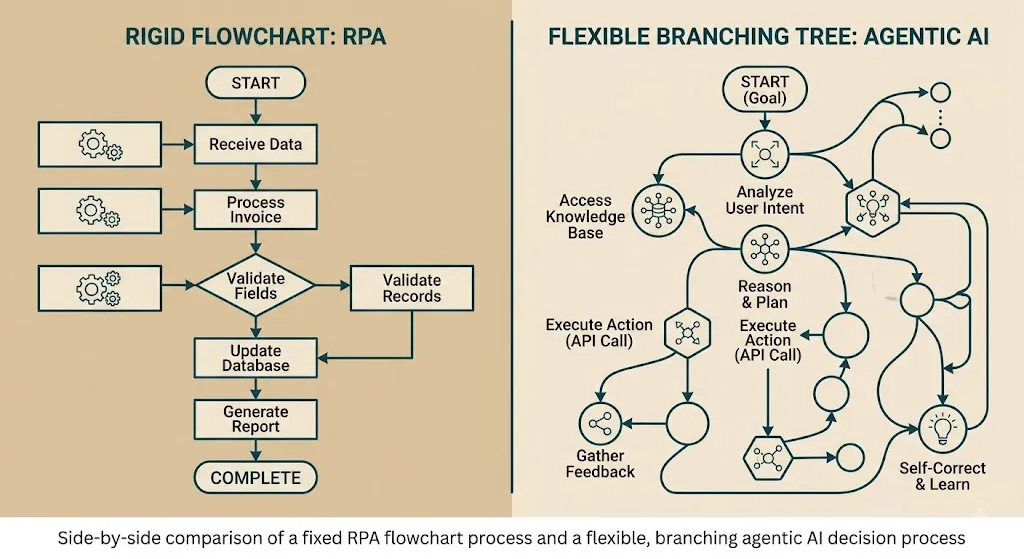

"Isn't this just RPA with extra steps?" It's a fair question, and one worth answering honestly rather than defensively, because the two technologies genuinely do overlap in what they're used for — even though they work in fundamentally different ways underneath.
RPA — robotic process automation — has been automating repetitive business processes for over a decade. Agentic AI is newer, gets more hype, and is often pitched as a wholesale replacement. It isn't, quite. The honest answer is that they're suited to different shapes of problem, and knowing which shape you're dealing with matters more than which technology sounds more current.
What RPA actually does well
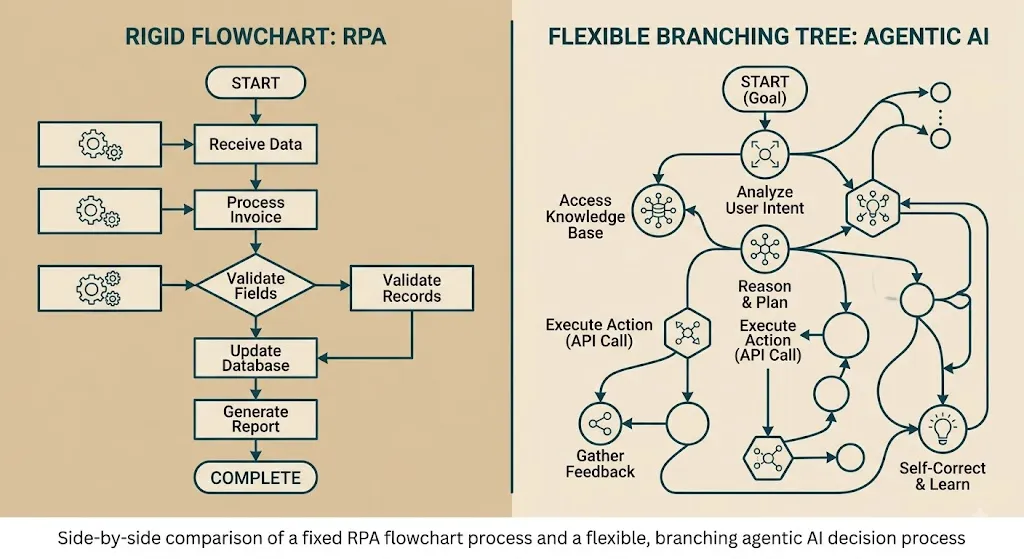
RPA excels at rule-based, structured, repetitive tasks where the steps don't vary: extract data from a fixed-format invoice, enter it into a specific field in an ERP system, move to the next invoice. The process is deterministic — the same input reliably produces the same output, following the same steps, every time.
This determinism is RPA's real strength, not a limitation. When a process genuinely doesn't need judgment — when "if field A equals X, do Y" fully describes the logic — RPA is often faster to build, cheaper to run, and more predictable than an agentic approach would be. There's a reasonable temptation to treat older automation approaches as obsolete once something newer shows up; that's not accurate here.
Where RPA breaks down
The trouble starts when the input isn't structured, or the "rules" actually require judgment that's hard to fully specify in advance. An invoice that doesn't match the expected format. A customer request that's almost like the templated ones but not quite. A decision that depends on context RPA's rigid rule engine wasn't built to weigh.
This is where traditional RPA implementations tend to accumulate exception queues — cases the bot couldn't handle, routed to a human, growing over time as the business encounters more edge cases than the original rules anticipated. Anyone who's maintained an RPA deployment for a few years has seen this queue grow into its own quiet maintenance burden.
What agentic AI actually adds
An agentic system reasons about unstructured input and decides what to do based on context, rather than following a fixed script. Given that invoice in an unfamiliar format, an agent can reason about what the fields probably represent, flag genuine ambiguity for review, and adapt without someone rewriting a rule set.
This flexibility is genuinely valuable for the right problems — and genuinely unnecessary overhead for the wrong ones. An agent applied to a fully deterministic, unchanging process doesn't add much beyond what RPA already handles well, and it introduces variability and higher per-transaction cost that a deterministic process didn't need in the first place.
A practical way to decide which one fits
Ask how often the "rules" for this process actually change, and how much judgment a human currently exercises when handling exceptions. If the process is genuinely stable and a human doing it today rarely has to think — just follow the steps — RPA is probably the better fit, and cheaper to boot.
If a human doing this task today is constantly making small judgment calls that don't reduce cleanly to a rule — deciding whether a customer's tone suggests escalation, weighing ambiguous information before acting — that's a much stronger signal for an agentic approach. The judgment that's hard to write down as a rule is exactly what agentic reasoning is suited to.
Volume and stakes matter too. High-volume, low-stakes, structured tasks are RPA's home turf, largely because the cost of running an agent per-transaction adds up fast at scale, and the flexibility isn't buying you much if there's nothing to reason about.
Where teams get this wrong in both directions
The more common mistake right now is over-applying agentic AI to genuinely structured problems, mostly because it's the more exciting technology to build with and pitch internally. Teams end up with an expensive, harder-to-debug system doing a job a well-built RPA bot would have handled more cheaply and more predictably.
The less common but equally real mistake is the opposite — sticking with RPA well past the point where a process has outgrown what fixed rules can handle, accumulating exception queues and workarounds rather than acknowledging the underlying task now needs judgment RPA can't provide. Organizations with a lot invested in an existing RPA program are especially prone to this, understandably, since the sunk cost makes switching feel harder than it needs to.
The two technologies also aren't mutually exclusive within a single workflow. It's common — and often the right call — to use RPA for the deterministic parts of a process and hand off to an agent specifically for the parts requiring judgment, rather than treating it as an either-or choice for the whole workflow. This is a pattern that comes up often enough working with an agentic AI development company that it's worth considering before assuming a process needs to be entirely one or the other.
FAQ
Can agentic AI and RPA work together in the same process? Yes, and it's a common and often sensible pattern — using RPA for structured, rule-based steps and an agent for the steps requiring judgment or handling unstructured input, within a single overall workflow.
Is agentic AI always more expensive to run than RPA? Generally yes, on a per-transaction basis, primarily due to model API costs. This is part of why applying agentic AI to a fully deterministic, high-volume process is often not the most cost-effective choice.
Does agentic AI replace the need for RPA entirely? No. Processes that are genuinely rule-based and stable are often still better served by RPA — it's more predictable, cheaper to run at scale, and simpler to audit.
How do you know if an existing RPA process has outgrown fixed rules? A growing exception queue is a strong signal — if the bot is routing an increasing share of cases to human review because they don't fit the original rules, that's a sign the underlying task now requires more judgment than RPA's rule engine can express.
Which is easier to maintain long-term, RPA or agentic AI? RPA rule sets are generally easier to audit and predict, but can require constant manual updates as edge cases accumulate. Agentic systems require different maintenance — mainly monitoring and evaluation rather than rule updates — and which is "easier" depends on which kind of upkeep a team is better equipped for.


























Sign in to leave a comment.