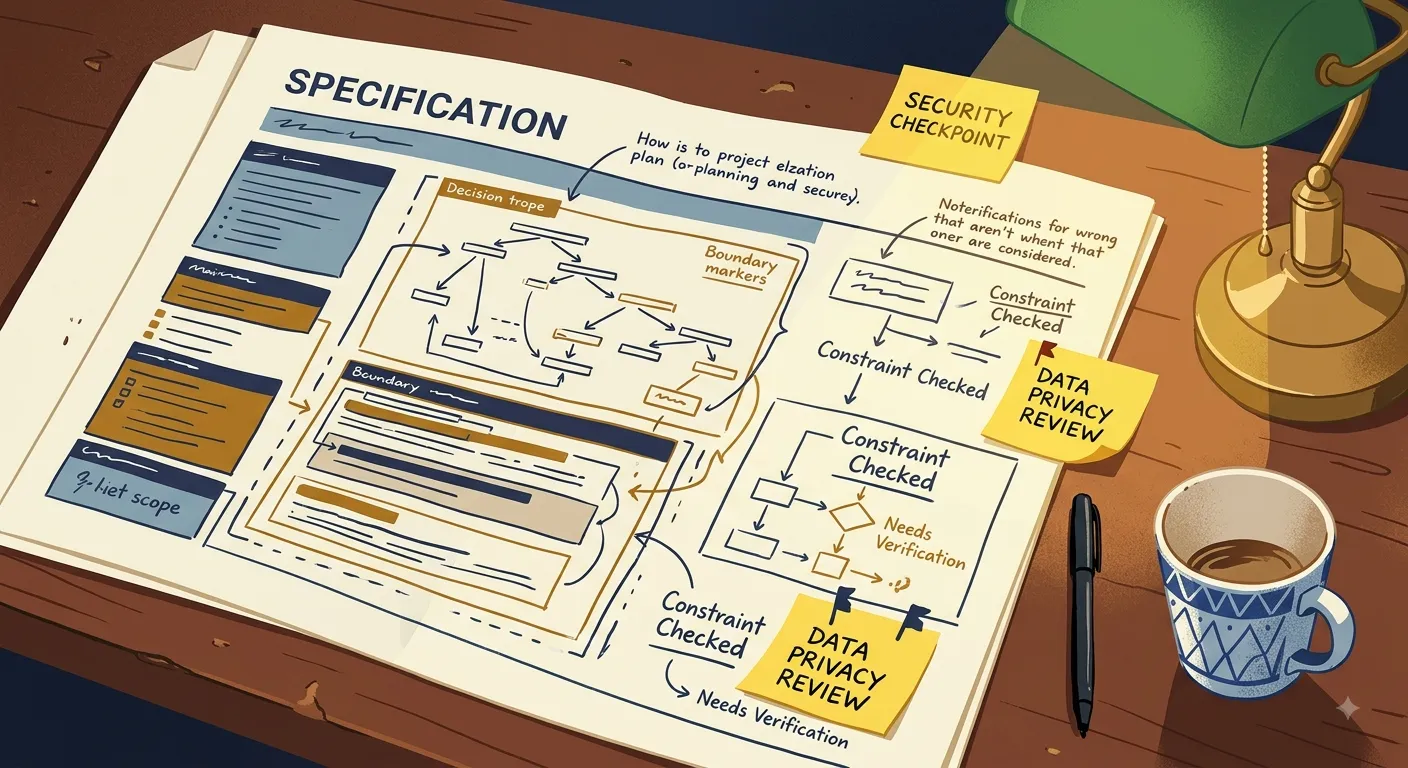

Most AI agent demos are convincing. That's the problem.
A prototype answers three test questions perfectly, someone screen-records it for the leadership deck, and everyone assumes the hard part is done. It isn't. Industry estimates put the share of enterprise AI agent projects that never reach production at around 80%. Not because the model was weak, but because nobody built the scaffolding around it. State management, tool governance, monitoring, failure recovery. The unglamorous stuff that never shows up in a demo.
An AI agent development company earns its fee in that gap. Not in the clever prompt that made the pilot look good, but in the months of unremarkable engineering that turn a clever prompt into something a bank, a hospital, or a logistics firm can actually run unattended.
The Proof of Concept Is Supposed to Fail (Just Not the Way You Think)
A good POC exists to answer one question: is this problem actually solvable with an agent, or were we chasing a hallucination of our own? That's it. It isn't supposed to be production code. It isn't supposed to handle edge cases. It's supposed to be fast, cheap, and disposable.
Here's where a lot of internal teams get it wrong. They treat the POC's success as the finish line rather than the starting gun. The prototype works in a demo with curated inputs, a five-minute session, and a friendly audience, and someone declares victory. Then it gets handed to an implementation team who asks the obvious question: where's the specification? Where are the edge cases, the acceptance criteria, the actual implementation instructions? Often there isn't one. Just a Slack thread and a Loom recording.
A structured POC phase, the kind a specialist team runs, is deliberately narrow. One workflow, one data source, one measurable outcome. Nothing more. Trying to make the POC "production-ready" usually wastes the exact speed that makes a POC useful in the first place.

Rebuilding, Not Polishing
This is the part people underestimate. Moving from POC to production isn't a matter of tightening a few bolts. It's closer to a rebuild, because a POC and a production agent solve fundamentally different problems.
A prototype answers a question once. A production agent has to answer it correctly a thousand times a day, remember context across sessions it never sees end to end, call external systems it doesn't control, and degrade gracefully when something upstream breaks.
The failure patterns that show up at this stage are consistent:
- Agents lose context across sessions and start behaving inconsistently in ways that are hard to trace
- Infrastructure that felt snappy with five pilot users buckles under three hundred concurrent sessions because nobody built session isolation
- Agents given broad, ungoverned access to internal APIs turn into a security review nightmare the moment legal finds out
- Without structured logging of what the agent actually decided, not just what it output, diagnosing a bad outcome six weeks later becomes archaeology
None of this is exotic. It's the same category of problem enterprise software has dealt with for decades. State, scale, access control, observability. Except now the thing making the decisions is non-deterministic, which makes every one of those problems slightly meaner.
AgentOps: The Operational Layer Nobody Budgets For
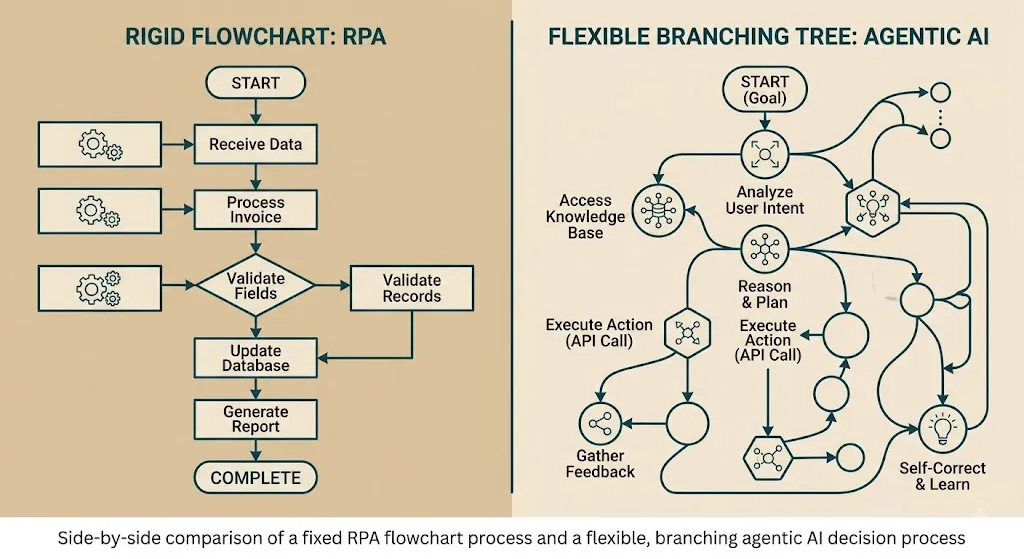
Teams that have already invested in MLOps sometimes assume that muscle carries over. It mostly doesn't. MLOps was built for models with a defined input, a fixed output, and reasonably bounded behavior. A fraud score, a churn prediction, a recommendation. An autonomous agent isn't that. It makes a chain of decisions, calls tools, holds multi-turn context, and sometimes takes real-world actions without a human checking each step.
That's given rise to what's increasingly called AgentOps. Tracking not model accuracy but agent behavior: which tools it called and why, where its reasoning chain broke down, whether an output stayed inside acceptable boundaries.
A mature build includes:
- Session-level observability that traces full reasoning chains rather than just input-output pairs
- Structured logs of every external system the agent touches
- Deliberate red-teaming against adversarial and out-of-distribution inputs
- Human-in-the-loop checkpoints placed only on the handful of high-risk actions where a mistake is actually expensive
Skipping this layer is the single most common reason a technically sound agent still gets pulled from production three weeks after launch.
Specifications: The Boring Artifact That Actually Determines Success
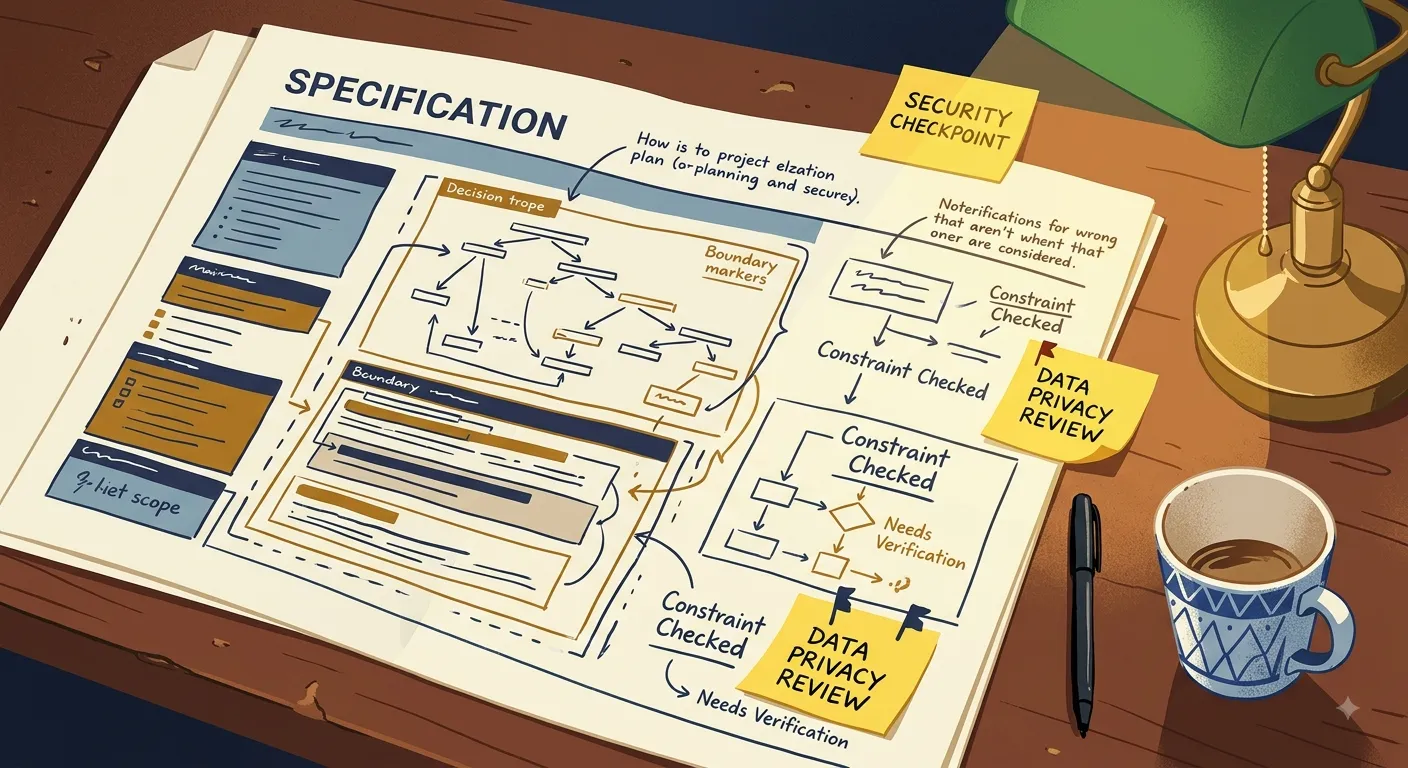
Here's an underrated detail. Once a business problem and a working prototype exist, the bottleneck usually isn't code. It's the specification. Someone has to translate a narrated business problem and a rough prototype into something an engineering team, or increasingly a coding agent, can implement without guessing. Teams that skip this step end up rebuilding half the logic during implementation because nobody wrote down what "done" actually meant.
The specification is also where security, data privacy, and governance decisions have to get made. Not bolted on afterward as a compliance checklist, but designed in from the start. That's the difference between an agent that sails through a security review and one that stalls there for two months.
This is roughly where Toadster's agentic AI team spends a disproportionate amount of its early engagement time. Not writing agent logic, but making sure the specification, the guardrails, and the data boundaries are settled before a single production line of code gets written. It's unglamorous work. It's also the work that determines whether everything after it goes smoothly or badly.
Governance and Red-Teaming: Treat It Like Software That Touches Money
If your agent can execute an irreversible action (issue a refund, send an email to a customer, modify a record), skipping structured safety testing before launch is the equivalent of skipping QA on a payments system. Nobody would sign off on that for traditional software. Somehow it happens constantly with agents, because the testing culture hasn't caught up to what these systems can actually do.
Red-teaming an agent means more than checking for wrong answers. It means testing what happens when a tool returns malformed data, probing for prompt injection where external content tries to hijack the agent's instructions, and stress-testing decision boundaries with inputs specifically designed to break them. None of this is optional once the agent has real permissions.
Human-in-the-loop controls do the rest. Not as a blanket approval gate on every action (that defeats the point of automation), but as a targeted checkpoint on the subset of decisions where a mistake genuinely costs something. Get that balance wrong in either direction and you either ship something unsafe or something so slow nobody wants to use it.
Deployment Isn't the End of the Work
Launch day is a milestone, not a finish line. A production agent needs monitoring dashboards that surface anomalies before customers notice them, a rollback plan for when a model update quietly changes behavior, and a feedback loop where real usage data feeds back into refining the agent's guardrails and prompts.
Teams that treat go-live as "done" tend to be the same ones firefighting six weeks later, wondering why the agent that tested perfectly is suddenly giving weird answers to a query pattern nobody anticipated.
The organizations that get real, durable value out of agents tend to budget for this phase explicitly, usually 20 to 30% of the project timeline, rather than treating post-launch support as an afterthought squeezed out of whatever budget is left.
Where Companies Actually Get Stuck
Two failure points come up again and again.
First: teams pick the wrong problem to automate. Something too ambiguous, too high-stakes for an early agent, or too dependent on messy legacy data. No amount of good engineering saves a poorly chosen use case.
Second: teams pick the right problem but underinvest in the boring middle. The specification, the observability, the governance. Because none of it demos well.
If you're evaluating an AI agent development company, ask less about their model choices and more about how they handle exactly this middle stretch. Anyone can wire up an LLM to answer questions. What separates a team worth hiring is whether they can show you, concretely, how they've handled state management under load, how they structure red-teaming before a client-facing launch, and what a rollback actually looks like when something goes wrong at 2 a.m. If those answers are vague, that's the signal. Not the pitch deck. Not the demo.
Toadster's approach leans hard into that middle stretch rather than rushing past it, on the theory that most agent failures are actually process failures wearing a technical costume.
FAQ
How long does it typically take to move an AI agent from POC to production?
It depends heavily on the use case, but a reasonable range for a moderately complex enterprise agent is three to six months from a validated POC to a governed production launch. Simple, narrow use cases can move faster. Anything touching regulated data or irreversible actions usually takes longer because of the governance and red-teaming work involved.
Do we need to rebuild the agent from scratch after the POC?
Often, yes, at least significant portions of it. The reasoning logic might survive, but the surrounding infrastructure (session handling, tool access controls, observability, error recovery) usually has to be built properly rather than patched onto whatever scaffolding held the demo together.
What's the biggest reason AI agent projects stall before production?
Under-investment in the operational layer. State management, governance, monitoring. Rather than any weakness in the underlying model. The model is rarely the bottleneck. The infrastructure and process around it usually is.
Is human-in-the-loop review necessary for every agent action?
No, and treating it that way usually kills adoption. The better pattern is identifying the smaller set of high-risk or irreversible actions where a mistake is genuinely costly, and routing only those through human approval, leaving lower-risk actions fully automated.
How do we know if our use case is even ready for an agent?
A reasonable test: is the problem well-defined enough to specify clearly, does the data needed to make decisions actually exist and is it accessible, and can you tolerate the agent being wrong occasionally while you tune it? If any of those is shaky, it's worth spending more time in the POC phase before committing to a production build.



























Sign in to leave a comment.