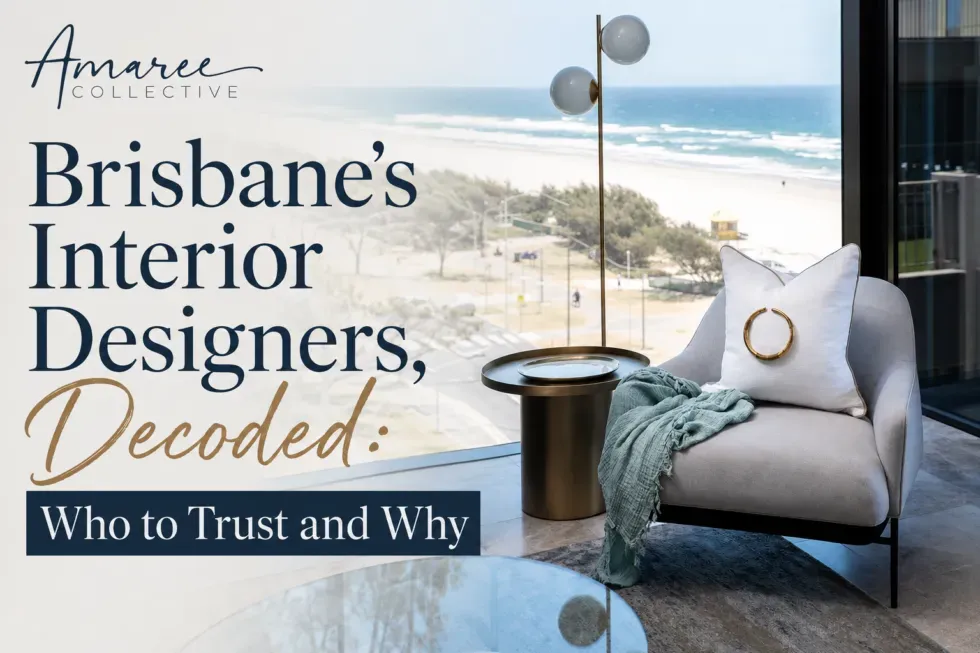

Search “interior designer near me” in Brisbane, and you’ll get a wall of near-identical websites, all promising timeless, luxury, bespoke design. The way to cut through that isn’t a bigger portfolio; it’s asking what a studio actually does, step by step, and checking that against real projects they’ve delivered. This piece walks through how Amaree Collective, a Brisbane studio founded by Amy Pakinga, works, and two real jobs that show what the difference between an “interior designer” and an “interior decorator near me” actually looks like on the ground.
None of what follows is theory. It’s built from how one studio actually runs a project, from the first phone call to the day the furniture goes in, and from two specific jobs, one for a family styling a holiday home and the other for a developer selling apartments off the plan.
Interior Designer vs. Interior Decorator: What’s the Real Difference?

People search these two terms as if they’re interchangeable, but they’re not quite the same job.

Amaree Collective falls firmly into the second column. The studio’s own description puts it plainly: full-home furnishing and concept design, covering everything from the first conversation through to sourcing, procurement, logistics, and installation. If you’re comparing quotes, it’s worth knowing which of these two services you’re actually asking for before you pick up the phone.
Amy Pakinga’s Path to Starting Amaree Collective
Amy Pakinga founded Amaree Collective in 2019, after more than 20 years working in furnishing and styling, long enough to have worked on homes, commercial developments, and international projects before building her own studio around what she’d learned.
The name is personal. “Amaree” comes from Amy and Maree, and “Collective” points to how the studio works, as a partnership with each client rather than a designer dictating a finished look. Amy also built the business to give herself more flexibility as a parent, which shows up in a practical way in how projects run today: the process is designed so clients only need to be involved for around eight hours across an entire project, start to finish. It’s not a business built on lengthy meetings and endless back-and-forth; the aim is to carry the workload so the client doesn’t have to.
That only works with the right industry relationships behind it. Amy’s background includes working with Calvin Klein furniture in New York, plus commercial projects across Southeast Queensland; the sales display and communal areas for Optimus Developments in Broadbeach; sales displays for Velocity Property Group at One Bulimba Riverfront and Parque on Oxford; and the South Point Emporium Apartments sales displays and penthouse fit-out. That’s the kind of history worth weighing more heavily than a polished homepage when you’re choosing someone for your own home.
It’s also worth noting how broad that experience is. Working on sales displays for a developer requires a completely different skill set to a residential penthouse fit-out, and having done both consistently, across multiple projects rather than as a one-off, tends to show up in how smoothly a studio handles the unexpected parts of any job: a supplier delay, a floor plan change, or a tight installation window.
Inside the Process: How a Project Actually Runs

Plenty of studios describe a “process” online in vague terms, three steps that could apply to almost any creative business. Here’s what Amaree Collective’s actually looks like:

The trade-only supplier access in step three is worth pausing on; it’s furniture and furnishings the public can’t buy directly, and it’s a large part of how a project can move fast without cutting quality. Installation and styling then happen as one focused stage rather than being drawn out over weeks, which lines up with the studio completing full installs in a single day.
If you’re weighing this against another designer, ask them the same three questions: How many stages are there? Who’s sourcing the furniture? And how long does install actually take? The answers will tell you more than a portfolio ever will.
What’s Worth Checking Before You Hire Anyone
A handful of practical things separate a solid interior designer from one who just talks a good game:
- How long they’ve actually been operating, separate from years of individual experience listed in a bio
- Whether they have real trade supplier access, or whether you’re seeing the same furniture available in stores
- Commercial project history, even for a home job, shows they can handle deadlines and logistics under pressure
- How much of your own time the process takes up, since this varies enormously between studios
- Whether their project examples are real and named, not stock styling photography
Amaree Collective’s recent projects page is a decent example of that kind of transparency, naming properties and clients rather than generic before-and-after staging.
Why the Studio Itself Is Worth Knowing About

Amaree Collective’s studio sits at Shop 1, 459 Old Cleveland Rd in Camp Hill, and it operates by appointment only rather than as a walk-in showroom. That’s a deliberate setup for a business built around client projects rather than retail foot traffic; most of the work happens off-site, at the property being styled, rather than in a shopfront.
It’s a small detail, but it says something about how the business actually runs day to day. A studio built on scheduled consultations tends to spend its time on active projects rather than managing a retail floor, which fits with a model designed to get a client from first conversation to finished install with minimal back-and-forth.
A Real Project: A Sydney Couple’s Holiday Home at Palm Beach
The Siarn Palm Beach Penthouse project is a good illustration of what full-service styling looks like in practice. The clients live in Sydney and bought a holiday home in Palm Beach, Queensland, a fairly common situation for a studio servicing South-East Queensland, where the buyer can’t be on-site for most of the project.
A holiday home also needs different thinking than a primary residence. It has to work for guests as much as owners and hold up to intermittent use rather than daily wear while still feeling like a considered space rather than a rental. Managing that kind of brief for an interstate client is part of why Amaree Collective’s service area stretches across Brisbane, the Gold Coast, the Sunshine Coast, and Northern NSW rather than staying local to one suburb.
A Real Project: One Bulimba Residential, Styled to Sell
One Bulimba Residential ran on a completely different brief. Delivered for Velocity Property Group, the job involved updating a sales display apartment with new furniture, not styling a home for one family to live in, but styling a space to help sell other apartments in the same development.
That’s a different kind of thinking than residential work. The goal isn’t reflecting one household’s taste; it’s creating a space a wide range of prospective buyers can picture themselves living in, which means understanding the buyer profile for the whole development rather than one client’s preferences. It’s also a useful reference point even for homeowners reading this: a studio that can deliver reliably on commercial deadlines tends to be just as reliable on a residential timeline.
Does Residential vs. Commercial Change What You Should Ask?
Less than you’d think. The fundamentals stay the same either way: a defined process, genuine trade access to furniture, and a track record you can actually see. What changes is the brief: a homeowner is styling for daily life, while a developer or agent is styling to shape how a buyer values the property in the first thirty seconds through the door.
Amaree Collective works across both, from residential styling for homeowners through to furniture procurement and installation for commercial and development projects, which is worth knowing if your search started with “interior designer near me” but your actual job is closer to styling a property for sale.
The Values That Actually Show Up in the Work

Most studios list values on an about page and never refer to them again. Amaree Collective names five: quality, trust, creativity, communication, and inspiration, and each one lines up with a specific part of how the studio operates, rather than sitting there as decoration.
Quality comes through in the supplier relationships: manufacturers the team has worked with directly and repeatedly, not one-off sourcing per project. Trust matters because so much of the work, procurement, logistics, and installation happens without the client in the room, so it has to be built early. Creativity is less about chasing trends and more about translating what a client describes wanting into a workable floor plan and furniture list. Communication is what makes a low-time-commitment process possible at all; without clear updates, a compressed timeline falls apart fast. And inspiration is drawn from the client’s own preferences and the property itself, rather than a fixed style the studio repeats on every job.
None of that is unusual to claim on a website. What’s worth checking with any designer is whether you can trace each value to something concrete they actually do.
Key Takeaways
- An interior designer manages the full project, concept, sourcing, and installation. A decorator generally works within an existing layout.
- Real trade supplier access is one of the clearest signs of a studio with genuine industry relationships.
- A clearly staged process beats a polished portfolio as a way to judge reliability.
- Residential and commercial styling solve different problems: living well versus selling well.
- Studios experienced with interstate or holiday-home clients can manage a project without needing you on-site throughout.
- A studio’s day-to-day setup, appointment-only, project-based, retail showroom , tells you something about how they’ll actually run your job.
Frequently Asked Questions
- What’s the difference between an interior designer and an interior decorator near me? A designer typically manages the whole project, concept, sourcing, procurement, and installation. A decorator generally works within an existing layout, refreshing furnishings and styling.
- Do Brisbane interior designers only work on homes? No. Many, including Amaree Collective, work across residential homes and commercial projects like development sales displays and communal areas.
- How much of my own time will a project actually take? It depends entirely on the studio. Amaree Collective’s process is built so clients are involved for around eight hours across the whole project.
- Can a designer manage my project if I don’t live nearby? Yes, this comes up regularly with holiday homes and interstate investment properties and requires a studio used to managing procurement and installation without the client on-site.
- Which areas does Amaree Collective cover? Brisbane, the Gold Coast, the Sunshine Coast, and Northern NSW, with additional commercial project experience across Southeast Queensland.
- Can I visit the studio directly? The Camp Hill studio operates by appointment only rather than as a walk-in showroom, so it’s best to book a consultation first rather than dropping by.
About the Author:

Amy Pakinga is the founder and lead designer of Amaree Collective, a Brisbane interior styling and design studio she started in 2019 after more than 20 years in furnishing and styling. Her work spans residential homes and large commercial developments across QLD and NSW. Get in touch here, or follow the studio on Instagram and Facebook.



























Sign in to leave a comment.