

Every second product demo these days claims to run on "AI." Dig a little deeper and you'll find two very different things hiding under that label: chatbots and agents. They get used interchangeably in sales decks, and that's a problem, because picking the wrong one for your business can waste months of dev time and a chunk of budget.
Let's clear it up.
What a chatbot actually does
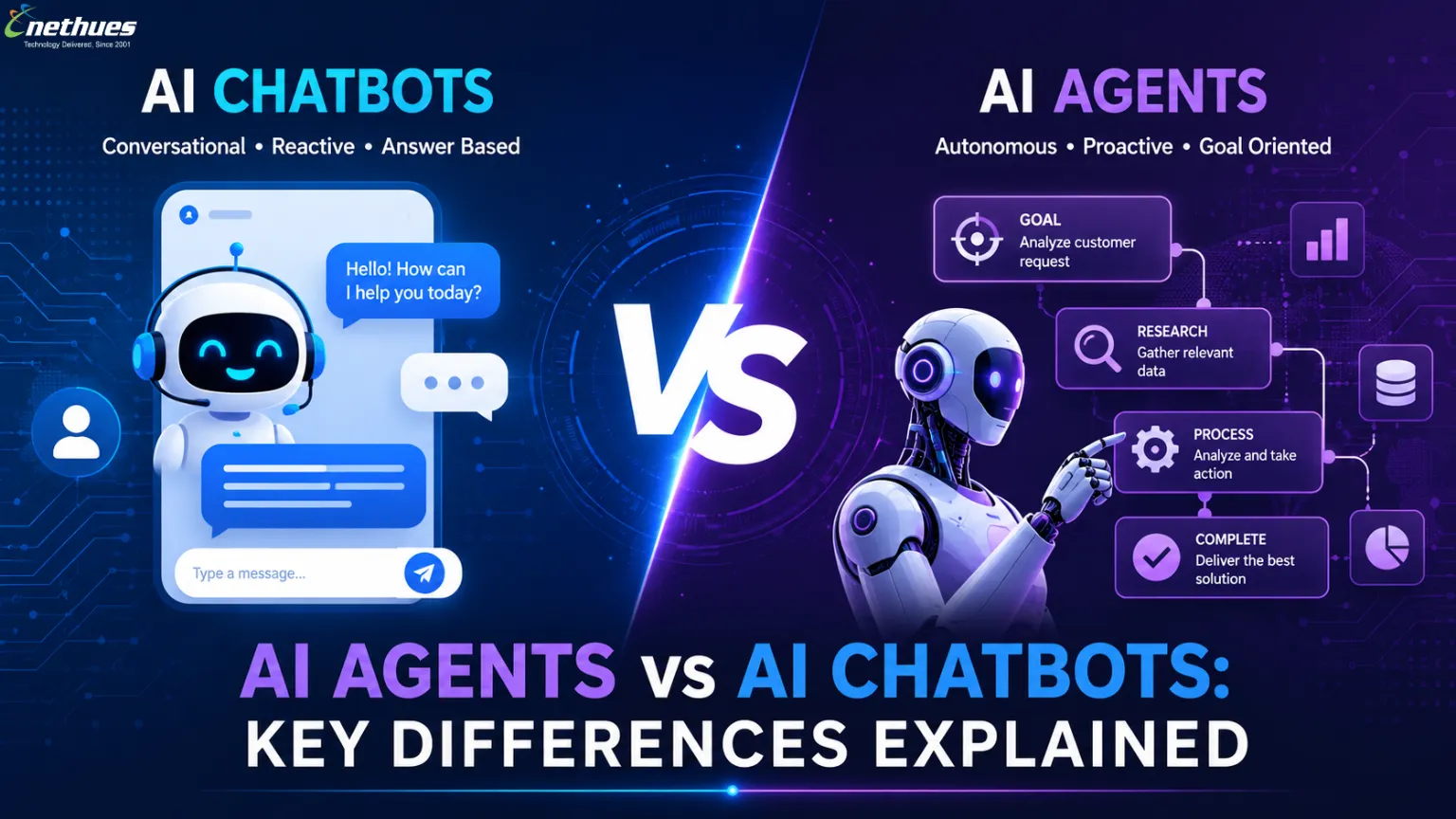
A chatbot is primarily designed to hold conversations, answer questions, and guide users through defined interactions. Traditional chatbots are built on scripted flows, decision trees, or a set of pre-trained intents, and they respond within those boundaries. Ask one something outside its script, and it either loops back to "I didn't understand that" or hands you off to a human.
Chatbots have been around since ELIZA in the 1960s, and honestly, the core idea hasn't changed that much. What's changed is the language layer. Modern chatbots use NLP, retrieval systems, and, in some cases, large language models to sound more natural and maintain context. However, many still operate within defined boundaries. They're reactive. They wait for input, interpret it, and respond.
That's not a knock on chatbots. For FAQ pages, order status lookups, or appointment scheduling, businesses often turn to AI chatbot development services for a fast, low-cost build. Predictability is actually a feature here; a bank doesn't want its support widget improvising answers about loan eligibility.
What an AI agent does differently
An AI agent doesn't just answer; it acts. It can reason through a multi-step problem, pull data from connected systems, make a decision, and execute a task without someone approving each step.
Say a customer wants to reschedule a delivery. A chatbot will tell them the delivery windows available. An agent will check the customer's order history, cross-reference warehouse inventory, rebook the slot, update the CRM, and send a confirmation, all in one pass, with no human in the loop unless something falls outside its guardrails.
That's the real dividing line. Chatbots primarily handle conversations and information retrieval. Agents complete outcomes.
Agents are often built using large language models with access to tools such as APIs, databases, CRMs, and internal business software. They use planning, contextual reasoning, memory, and tool orchestration to connect multiple actions toward a defined goal. They adapt mid-conversation. They don't need every possible user input mapped out in advance, because they're reasoning through novel situations rather than matching against a script.
Where the two overlap (and where people get confused)
Both have a conversational interface. Both can live in a chat window on your website. That surface-level similarity is exactly why the two get lumped together in marketing copy—and why buyers end up disappointed when a "chatbot" project was actually scoped like an agent project, or vice versa.
Here's a quick way to separate them:
Chatbot: primarily conversational, usually reactive, focused on answering questions or guiding users through a defined task
AI agent: goal-driven, tool-enabled, capable of planning and completing multi-step actions within defined guardrails
One more distinction worth flagging for B2B buyers specifically: chatbots are usually deployed for customer-facing FAQ-type interactions. Agents are increasingly used for employee-facing and operational workflows too, prioritizing leads, summarizing meetings, drafting outreach, and managing multi-step approvals. The use case isn't limited to "talking to customers" anymore.
Why this distinction actually matters for your business
If your team is fielding a high volume of repetitive, low-complexity questions, store hours, shipping status, and password resets, a chatbot will do the job at a fraction of the cost and complexity of building an agent. There's no reason to over-engineer that.
But if your workflows involve multiple systems, judgment calls, or tasks that currently require a human to check three different tools before responding, a chatbot will hit its ceiling fast. That's where agentic AI earns its keep. It can chain reasoning across systems in a way scripted bots simply can't.
A lot of agentic AI projects fail not because the technology doesn't work, but because the scoping was rushed. Teams get excited about "AI agents," skip the groundwork on what data the agent needs access to, what guardrails it needs, and what happens when it hits an edge case, and then wonder why the pilot stalls. A working demo is easy to fake. A production-ready agent that handles real customer data and real business logic reliably is a different level of engineering.
Before greenlighting either option, it's worth asking a few blunt questions internally:
Does this use case need judgment and multi-step execution, or just accurate information retrieval?
How much system integration is realistically required, CRM, inventory, billing, ticketing?
What's the cost of a wrong decision made autonomously versus a wrong answer given by a bot?
Do you have clean, accessible data for an agent to reason over? Agents are only as good as the systems they're plugged into.
The bottom line
Chatbots and AI agents aren't competing technologies; they solve different problems.
A chatbot is usually the better choice for structured, repetitive interactions such as FAQs, appointment booking, order updates, and basic customer support. An AI agent is more suitable when the task requires planning, system access, judgment, and multi-step execution.
Businesses evaluating an AI chatbot development company or a broader AI development partner should start with the use case, not the buzzword. The right provider will ask what you're actually trying to solve before recommending a solution. Honestly, if a vendor pitches an "AI agent" for what's really a basic FAQ bot, or the reverse, that's a signal to keep asking questions.
Get the scoping right, and either a chatbot or agent can genuinely cut costs and response times. Get it wrong, and you'll end up maintaining an overbuilt system for a job a simple script could've handled, or underbuilding something that can't keep up with what your operations actually need.
Nethues Technologies helps businesses assess, design, and develop both AI chatbots and AI agents based on their actual workflows, integration requirements, and business goals.
























Sign in to leave a comment.