
Artificial intelligence is changing how businesses communicate with customers, manage workflows, and make decisions. Two technologies that are often discussed together are AI agents and AI chatbots. Although they may appear similar on the surface, they are designed to perform different roles.
Understanding AI Agents vs AI Chatbots is important for businesses deciding how to use artificial intelligence for customer service, automation, internal operations, or digital products.
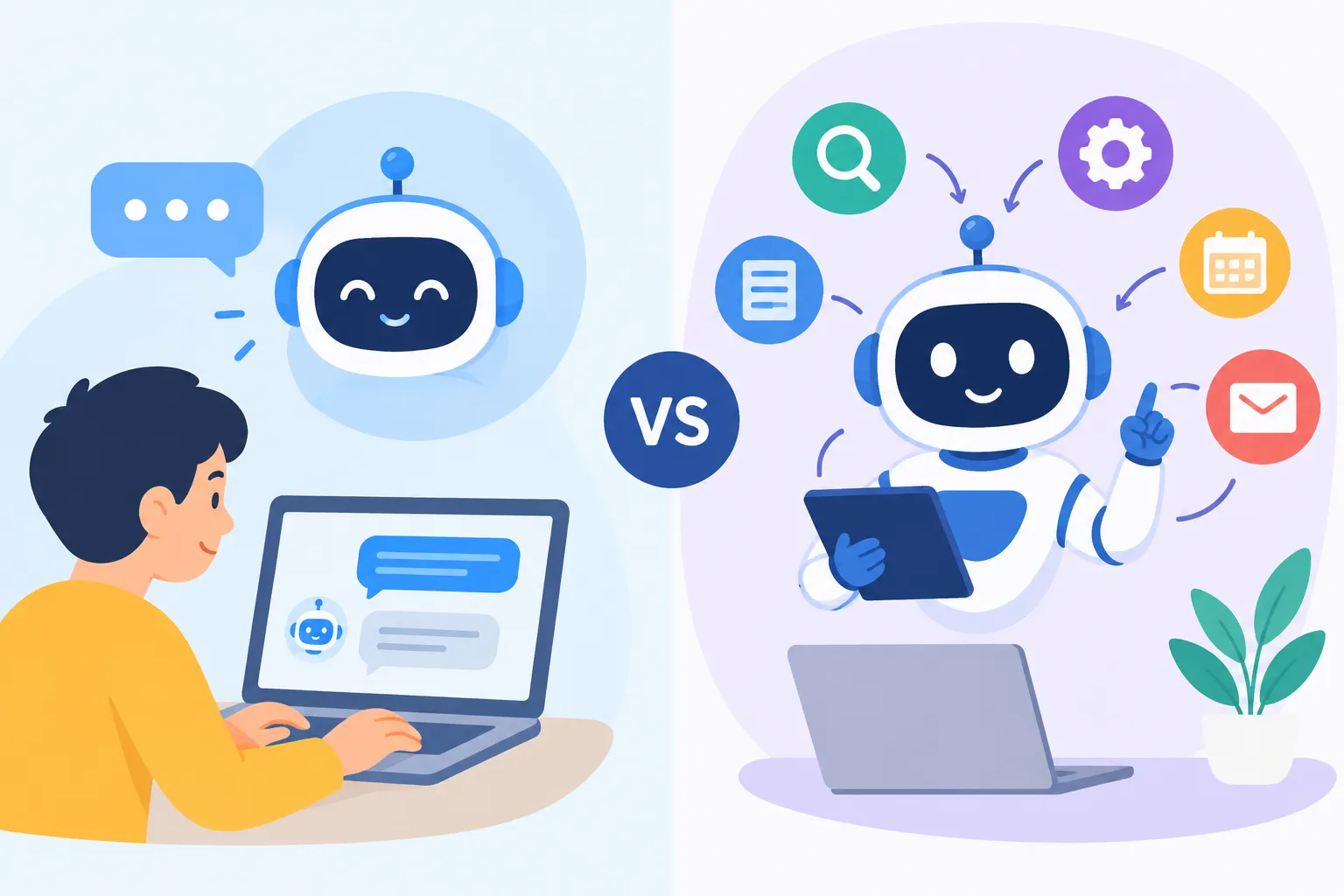
An AI chatbot primarily focuses on communicating with users through conversations. An AI agent can go a step further by understanding a goal, planning actions, using external tools, and completing tasks with varying degrees of autonomy.
What Is an AI Chatbot?
An AI chatbot is a software application designed to interact with people through natural-language conversations. Users can communicate with a chatbot using text or, in some cases, voice.
Modern AI chatbots can use natural language processing and large language models to understand questions and generate relevant responses.
Businesses commonly use chatbots for:
- Answering frequently asked questions
- Providing product or service information
- Handling basic customer-support requests
- Guiding website visitors
- Collecting customer information
- Helping users navigate digital platforms
- Providing basic troubleshooting assistance
For example, an ecommerce chatbot might answer a question such as, “What is your return policy?” It can retrieve or generate the relevant information and provide an answer without requiring a human support representative.
The primary purpose of a chatbot is therefore conversation and information delivery.
What Is an AI Agent?
An AI agent is designed to accomplish a goal rather than simply respond to a question.
Depending on its architecture and permissions, an AI agent can interpret a user's objective, determine the steps required, interact with external systems or tools, and take actions to complete the task.
For example, instead of simply answering a customer's question about an order, an AI agent could potentially:
- Identify the customer's order.
- Check the order status.
- Review available delivery information.
- Determine whether an action is required.
- Update the appropriate system.
- Notify the customer about the result.
This makes AI agents particularly useful for task automation and workflow execution.
AI agents can be connected to APIs, databases, business applications, knowledge bases, and other software systems. Their capabilities depend on how they are designed, what tools they can access, and what permissions they receive.
AI Agents vs AI Chatbots: Key Differences
The simplest way to understand the difference is to think about their primary objectives.
AI chatbots are generally conversation-focused, while AI agents are task- and goal-oriented.
| Feature | AI Chatbots | AI Agents |
|---|---|---|
| Primary purpose | Conversation | Goal completion |
| User interaction | Primarily conversational | Conversational and action-oriented |
| Answer questions | Yes | Yes |
| Follow multi-step processes | Limited or predefined | Can be designed to handle multi-step workflows |
| Use external tools | Sometimes | Commonly |
| Make decisions | Usually within defined boundaries | Can evaluate steps toward a defined goal |
| Perform actions | Limited | Can perform actions when authorized |
| Autonomy | Generally lower | Potentially higher |
| Workflow automation | Limited to specific workflows | Strong use case |
| Best suited for | Support and information | Automation and complex tasks |
These are general distinctions rather than strict technical definitions. Modern AI systems can combine chatbot and agent capabilities, so the boundary between the two is becoming less rigid.
How AI Chatbots Work
A traditional chatbot follows predefined conversation flows. More advanced AI chatbots can use machine learning, natural language processing, retrieval systems, or large language models to produce more flexible responses.
A typical AI chatbot workflow looks like this:
User question → Language understanding → Knowledge retrieval or model processing → Response → User
For example:
Customer: “Do you offer international shipping?”
The chatbot interprets the question, finds the relevant information, and responds with the available shipping details.
The chatbot's main responsibility is to provide a useful response.
How AI Agents Work
AI agents generally involve a more complex workflow.
A simplified process can look like:
User goal → Goal interpretation → Planning → Tool selection → Action → Evaluation → Result
Suppose a user says:
“Find my recent invoice and send it to my email.”
An appropriately configured AI agent might identify the user, access an invoicing system, locate the relevant invoice, and use an email service to send it.
The agent is not simply generating a response. It is coordinating multiple steps to achieve an objective.
This distinction becomes especially important when AI is connected to business systems.
Do AI Agents Replace AI Chatbots?
Not necessarily.
In many applications, AI chatbots and AI agents can work together.
A chatbot can serve as the conversation layer, while an AI agent can operate behind that interface to perform tasks.
For example, a customer might interact with a conversational interface and say:
“I want to change my delivery address.”
The conversational system can understand the request and pass it to an agent capable of checking the order, validating whether the address can be changed, updating the appropriate system, and confirming the result.
In this type of architecture:
Chatbot = communicates with the user
AI Agent = performs the task
This combination can create more capable AI-powered customer experiences.
When Should a Business Use an AI Chatbot?
An AI chatbot may be appropriate when the primary requirement is communication, information access, or customer assistance.
Common use cases include:
Customer Support
Chatbots can answer common questions, explain policies, provide product information, and help customers find relevant resources.
Lead Generation
A chatbot can engage website visitors, collect basic information, qualify inquiries, and direct prospects to the appropriate sales channel.
Knowledge Assistance
Internal chatbots can help employees find information from company documentation, policies, manuals, and knowledge bases.
Website Assistance
A chatbot can help visitors navigate services, products, pricing information, and frequently asked questions.
For these applications, the ability to provide fast and consistent communication can be more important than autonomous task execution.
When Should a Business Use an AI Agent?
AI agents become particularly useful when a business wants AI to interact with multiple systems or automate multi-step processes.
Potential applications include:
Business Workflow Automation
- An AI agent can be designed to coordinate several steps within a business process.
Data Retrieval and Analysis
- Agents can potentially retrieve information from approved databases or applications and use that information to support specific tasks.
Customer Service Operations
- Instead of only answering questions, an agent can be connected to systems that allow it to perform authorized customer-service actions.
Sales Operations
- AI agents can assist with tasks such as researching prospects, organizing information, preparing summaries, and triggering approved workflows.
Software and IT Operations
- Depending on the implementation, agents can assist with monitoring, troubleshooting, documentation, and other technical workflows.
- The key consideration is that an agent should only have access to the systems and actions necessary for its intended purpose.
AI Agents vs AI Chatbots: Which Is More Complex?
AI agents generally require more sophisticated architecture when they are expected to perform autonomous or semi-autonomous tasks.
A chatbot may primarily require:
- A conversational interface
- An AI model
- A knowledge source
- Prompt and response management
- Safety controls
- Conversation history
An AI agent may additionally require:
- Tool integrations
- API connections
- Planning mechanisms
- Memory or state management
- Workflow orchestration
- Permission controls
- Action validation
- Monitoring and logging
- Error handling
The complexity ultimately depends on the use case. A simple AI agent may be relatively straightforward, while an enterprise agent connected to several business systems can require significant engineering and governance.
What About Generative AI?
Generative AI plays an important role in both chatbots and AI agents.
Large language models can help chatbots understand natural-language questions and generate responses. The same models can also help agents interpret objectives, determine appropriate actions, and interact with tools.
However, generative AI and AI agents are not the same thing.
Generative AI refers broadly to systems capable of generating content such as text, images, audio, or code.
An AI agent is a system designed to pursue a goal and take actions, often using AI models as one component of its architecture.
Therefore, an AI agent can use generative AI without being synonymous with generative AI.
Security and Governance Matter
The ability to take action introduces additional considerations.
A chatbot that only provides information has a different risk profile from an AI agent that can modify records, send emails, create transactions, or access business systems.
Businesses implementing AI agents should therefore consider:
- Authentication
- Authorization
- Data privacy
- Access controls
- Human approval for sensitive actions
- Audit logs
- Input validation
- Output validation
- Monitoring
- Rate limits
- Failure recovery
- Protection against prompt injection and other AI-specific threats
The more autonomy an AI system has, the more important it becomes to establish clear boundaries around what the system can and cannot do.
How Businesses Can Get Started With AI
Businesses don't necessarily need to start with a highly autonomous AI agent.
A practical approach is to identify a specific business problem first. The organization can then determine whether a chatbot, AI-assisted workflow, agent, or another AI solution is appropriate.
A typical process could include:
- Identify the business problem : Start with a measurable business requirement rather than choosing a technology simply because it is popular.
- Evaluate available data: Determine what information the AI system needs and whether the data is accurate, accessible, and appropriately protected.
- Select the right AI architecture: Depending on the use case, this could involve a chatbot, retrieval-augmented generation system, AI agent, predictive model, or combination of technologies.
- Integrate necessary systems: Connect the AI solution with approved applications, APIs, databases, or business tools where required.
- Establish security controls: Define permissions, authentication, monitoring, and human oversight before allowing AI to perform sensitive actions.
- Test and measure: Evaluate accuracy, reliability, response quality, task completion, security, and business outcomes.
- Scale gradually: Once the solution performs reliably within a controlled environment, businesses can consider expanding its capabilities.
AI Agents vs AI Chatbots: The Bottom Line
The key difference between AI Agents vs AI Chatbots is their intended role.
An AI chatbot is primarily designed to communicate, answer questions, and assist users through conversation. AI agents, on the other hand, are designed to work toward specific goals by reasoning through tasks, using available tools, and taking actions within defined boundaries.
This distinction also helps explain the growing interest in Generative AI vs Agentic AI. While generative AI focuses largely on creating content and responding to prompts, agentic AI focuses on taking actions and completing multi-step objectives. Understanding these differences can help businesses and aspiring AI professionals identify which technology is better suited to a particular use case or learning path.
An AI agent is designed to pursue a goal, make decisions within defined boundaries, interact with tools, and perform tasks.
Neither technology is universally suitable for every business problem. The right choice depends on the desired outcome, level of automation, available data, system integrations, security requirements, and acceptable level of autonomy.
For businesses exploring different ways to apply artificial intelligence—from conversational AI and generative AI to automation, integration, and custom solutions—exploring comprehensive AI services and solutions can help identify approaches that align with specific business requirements.
























Sign in to leave a comment.