

If your engineering team is still estimating MEAN stack projects the way you did three years ago, you’re budgeting for a world that doesn’t exist anymore. AI-assisted development has quietly become routine infrastructure: roughly 22% of enterprise code is now written by AI, and 84% of developers use AI coding tools regularly. Layer that shift on top of MongoDB, Express.js, Angular, and Node.js — a stack that’s already unified around one language — and you get compounding speed gains that add up fast.
Here’s where that 40% actually comes from, how it plays out across each layer of the MEAN stack, and what you need in place before you chase it.
What “AI-Assisted MEAN Stack Development” Actually Means
It’s not one tool bolted onto your IDE. It’s AI assistance at every level of the development process—helping with schema design in MongoDB, setting up routes in Express.js creating components in Angular and writing tests in Node.js. It’s not about autocomplete in a single file anymore. Tools, like GitHub Copilot, Cursor and Claude Code now understand codebases. They can make changes across files generate tests and even spot bugs before a developer opens the file. This changes how we build software.
The Productivity Numbers Behind the 40% Claim
A 40% delivery-speed improvement sounds aggressive until you look at what’s already been measured in production enterprise settings:
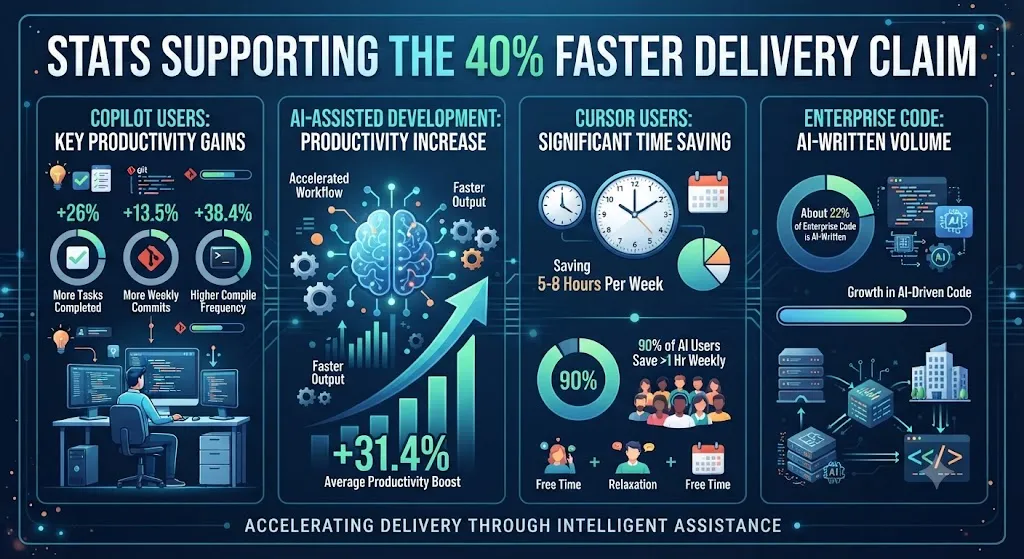
• A study of over 4,800 developers at Microsoft, Accenture, and a Fortune 100 company found Copilot users completed 26% more tasks on average, with weekly code commits up 13.5% and compile frequency up 38.4%.
• A broader empirical analysis of AI-assisted development puts the average productivity increase at 31.4%.
• Developers using tools like Cursor report saving 5–8 hours per week, with 90% of AI users saving at least an hour weekly.
• About 22% of enterprise code is now AI-written, up from a small fraction just a couple of years ago.
• 52% of developers now use AI assistants daily and 28% weekly, according to JetBrains’ 2026 Pulse Survey.
None of those numbers alone gets you to 40%. But stack them: faster scaffolding on the backend, faster component generation on the frontend, AI-generated tests running in parallel with development, and fewer stalled PRs waiting on boilerplate. Enterprise teams running AI-assisted workflows across the full MEAN stack — not just one layer — are the ones reporting cycle-time reductions in that 30–40% range.
Why the MEAN Stack Pairs So Well With AI Tooling
One Language, One Model Context
JavaScript and TypeScript are used by MongoDB, Express.js, Angular and Node.js. This is more important than it may seem: AI models are trained on amounts of JavaScript code and when your entire stack uses one language the assistant maintains a single clear context across your database your API and your user interface instead of switching between Python, Java and JavaScript in the same session. Fewer language boundaries mean chances, for AI suggestions to be incorrect or outdated.
A Large, Active Developer Base to Train and Validate Against
I find that Node.js remains one of the widely used runtimes with 52.2% of developers saying they admire working with Node.js. Also 17.6% of developers express interest in MongoDB according to the 2025 Stack Overflow Developer Survey. Angular stays steady at 18.2% usage among developers – the most-used frontend framework, after React. That scale means AI coding assistants have been trained and fine-tuned on a deep well of real MEAN stack code, not a niche stack with thin training data.
Where AI Actually Speeds Up Each Layer of MEAN
MongoDB: Schema and Query Design
• Drafting document schemas and suggesting indexes based on expected query patterns
• Generating aggregation pipelines from a plain-language description of the report you need
• Flagging queries likely to scan too many documents before they hit production
Express.js: API Scaffolding
• Generating route handlers, middleware, and validation logic from an API spec
• Writing consistent error-handling patterns across dozens of endpoints
• Drafting authentication and rate-limiting middleware from a short description
Angular: Component and Test Generation
• Scaffolding components, services, and RxJS observables from a UI description
• Generating unit tests alongside new components instead of as an afterthought
• Refactoring older Angular modules toward current best practices
Node.js: Testing and Performance
• Writing integration tests that cover edge cases a developer might not think to write manually
• Spotting blocking operations or memory leaks in server-side code
• Generating documentation for internal APIs as they’re built, not months later
AI tooling accelerates every one of those tasks, but it doesn’t replace the judgment needed to architect a MongoDB schema correctly or decide which Angular patterns actually fit your app. That’s still a human skill. If you need that expertise without spending months building an internal team from scratch, you can Hire MEAN Stack Developers who already know how to pair these AI tools with production-grade architecture decisions, instead of just generating code faster and shipping the mistakes faster too.
The Trade-off Enterprise Teams Can’t Skip: Review Discipline
Here’s the uncomfortable part of the data: usage and trust are moving in opposite directions. More developers use AI coding tools every year, but fewer say they fully trust the output to be accurate. The most common frustration isn’t obviously broken code — it’s code that looks correct, passes a glance-review, and hides a subtle bug that surfaces three sprints later.
• Time saved on writing code doesn’t automatically mean time saved overall once debugging and rework get added back in
• Teams still treat deployment, monitoring, and project planning as human-owned decisions, not AI-delegated ones
• The sustainable gains come from AI as an accelerator with human review built in, not as an unsupervised replacement for engineering judgment
Real-World Enterprise Patterns Showing Up in MEAN Stack Projects in 2026
Beyond individual coding speed, AI is reshaping how MEAN stack applications get architected at the enterprise level:
• Microservices architectures that split MEAN applications into independently deployable services
• Serverless and containerized deployments using Docker and Kubernetes to reduce infrastructure overhead
• AI gateways connecting Node.js backends to model-serving layers for predictive features in finance, logistics, and operations
• GraphQL layers added on top of Express.js APIs to support more flexible, AI-driven client queries
• Progressive Web Apps built with Angular that behave like native mobile apps while staying on the web
How to Capture the Speed Gain Without the Risk
• Define upfront which tasks AI can own outright (boilerplate, tests, docs) versus which need a human decision (schema design, security-sensitive logic)
• Keep code review mandatory for AI-generated pull requests, not optional because “the AI already checked it”
• Track cycle time and defect rate together — a speed win that doubles your bug backlog isn’t actually a win
• Standardize which AI tools your team uses stack-wide so context and coding patterns stay consistent across MongoDB, Express, Angular, and Node
• Invest in developers who understand both the AI tooling and the underlying MEAN stack architecture, since neither one compensates for a gap in the other
Conclusion
The 40% speed gain isn’t marketing hyperbole — it’s what happens when you apply AI assistance consistently across a stack that was already built for speed. MongoDB, Express.js, Angular, and Node.js share one language, a massive developer base, and now a generation of AI tools trained specifically on that code. The teams pulling ahead aren’t the ones that adopted AI coding tools first. They’re the ones that paired those tools with real MEAN stack expertise and kept human review in the loop. Get both pieces right, and shipping products dramatically faster stops being an aspiration and starts being your normal release cadence.





















Sign in to leave a comment.