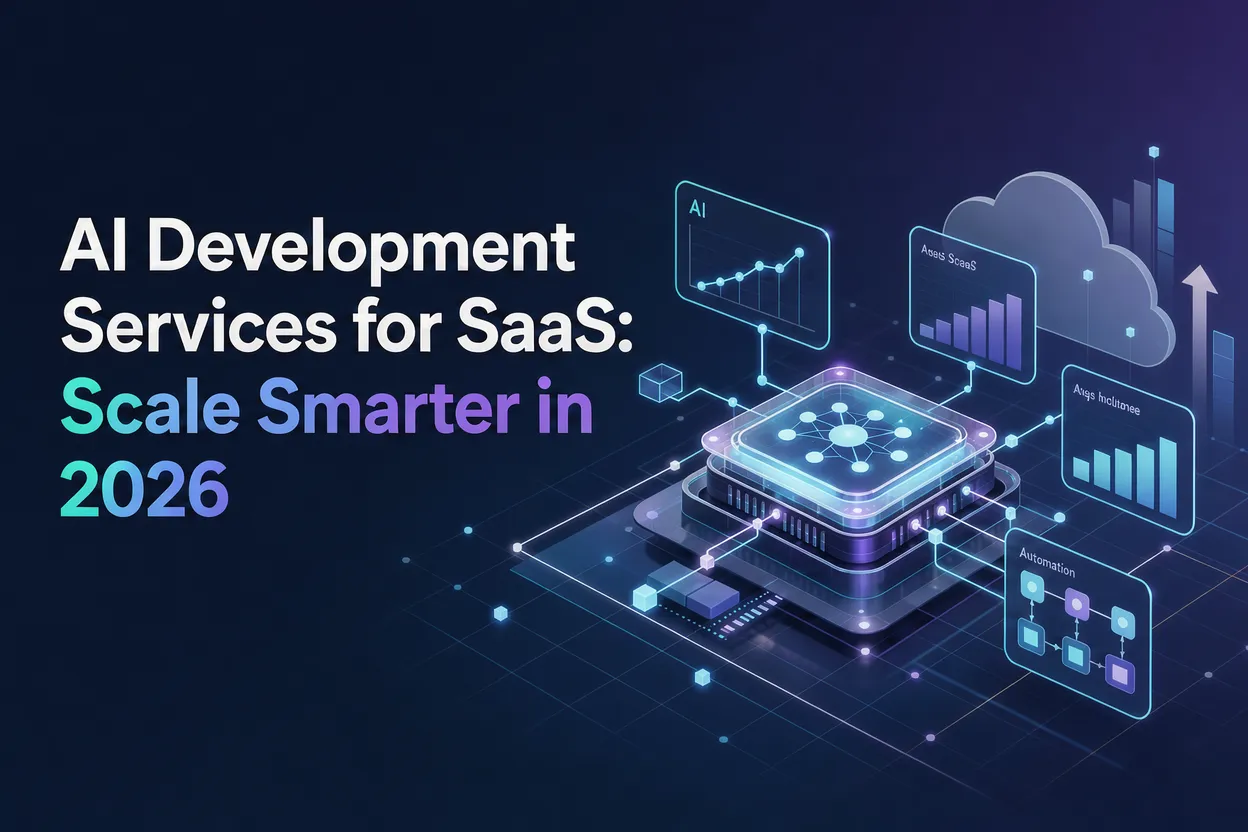

Ask a SaaS founder what keeps coming up on sales calls this year, and AI is usually near the top. Customers want to type a question and get an answer. They want the boring parts of their job handled. And they'd rather get that inside a tool they already pay for.
Here's the short answer. AI development services for SaaS help software companies plan, build, and maintain AI features inside their product, like smart assistants, better search, usage predictions, and automated support. A good AI development company also handles the unglamorous parts: getting your data ready, connecting the AI to your app, and watching it after launch.
Deciding how to get there is the harder bit. That's most of what this post covers.
What Are AI Development Services for SaaS?
Strip away the sales talk and it's fairly simple. You're paying a team to work out where AI makes sense in your product, build it, plug it into what you already have, and keep it working once real customers start using it.
That usually means choosing which features to build first, cleaning up the data the AI will rely on, picking a model (off the shelf or custom), and checking on it after launch so answers stay accurate and costs don't creep up.
One thing that's specific to SaaS: lots of customers share the same system, so their data has to stay separate. If one client's assistant ever shows another client's information, that's not a bug report. It's a lost account.
Where AI Fits Inside a SaaS Product
You don't need AI everywhere. The features people actually use save them time on something they already do every week. A handful come up again and again.
In-app AI assistants and agents
At the simple end, it answers "how do I" questions or writes a first draft. Push it further and it does the task itself, like building a monthly report or updating twenty records at once, while the user checks the result.
Natural-language search
Most in-app search still needs the exact keyword. AI search lets someone ask "which invoices are overdue for clients in Texas?" and get an answer from their own account data, with a link to where it came from.
Predictive analytics
Basically, spotting trouble early. Which accounts are going quiet. Who's likely to upgrade. Usage that suddenly looks off. Your customer success team gets a heads-up instead of a surprise.
Support automation
AI can sort incoming tickets, suggest replies, and answer the repetitive questions by itself. Your team still handles the tricky cases. They just spend less of the day on password resets.
Personalized onboarding
A finance manager and a sales rep want very different things on day one, yet most products give them the same tour. AI can adjust the setup based on someone's role and what they click, so they reach that "oh, this is useful" moment sooner.
Why AI for SaaS Became a Priority in 2026
Partly because the money is moving. Gartner's May 2026 AI spending forecast puts global AI spending at $2.59 trillion this year, up 47% on 2025. AI software alone grows from roughly $283 billion to about $453 billion.
The more useful part for SaaS is where Gartner expects business buyers to spend: mostly on AI built into apps they already use, plus agents that take care of steps in everyday work. They'd also rather fund practical projects with clear time savings than big, risky bets.
Read that as a SaaS vendor and a few things stand out. If a competitor ships a useful AI feature and you don't, you'll hear about it at renewal time. Buyers want proof, like hours saved, not a chatbot stuck on the dashboard. And because AI features cost a little every time someone uses them, you need to know that cost before you set a price.
Hire AI Developers, Build In-House, or Partner With an AI Development Company?
Honestly, there's no single right answer. It comes down to how central AI is to what you sell, how fast you need something live, and whether you can keep AI talent once you've hired it. (That last one is harder than it sounds.)
Building in-house makes sense when AI is the product, not a feature on top of it. You get full control, but expect to spend months hiring before much gets built.
Hiring AI developers, dedicated or on contract, works well if you already have a strong technical lead to steer them. Without that person, good developers can still end up building the wrong thing.
Partnering with an AI development company is usually the fastest way to get a first feature live, especially if nobody on your team has shipped AI before. Just make sure the contract says you own what they build.
Plenty of SaaS teams mix these. A partner builds version one, then in-house hires take it over with a proper handoff.
How to Choose an AI Development Company for SaaS
Demos are easy to make look good. What you really want to know is whether a team has shipped AI inside a live SaaS product and kept it running. A few blunt questions help:
- What have you built that SaaS customers use today, and what changed for them?
- Will you look at our data before quoting a price?
- Why this AI model over another one, and what will each cost us per use?
- How will you know if the answers get worse after launch?
- Who owns the code and everything else you build?
Ask about data security too. Teams that have worked with standards like SOC 2 or GDPR answer quickly and in plain words. If you get a pile of buzzwords instead, that tells you something.
One last thing that's easy to forget: what does support look like six months after launch, and who's actually watching the system?
Common Mistakes SaaS Teams Make With AI Projects
Most AI features that flop don't fail because of the tech. They fail because nobody asked the right question at the start.
The classic mistake is picking the technology first. "We should do something with AI agents" isn't a plan. "Our support team is buried in billing questions" is.
Messy data comes next. If your product data is scattered or out of date, the AI will give wrong answers with total confidence, and users stop trusting it after two or three of those.
Then there's cost. Each AI answer costs a little, and with thousands of users it adds up quietly, so set limits early. And finally, teams launch with no way to tell whether an update made things better or worse, then treat the whole thing as finished. It's never really finished.
FAQs: AI Development Services for SaaS
What does an AI development company do for SaaS businesses?
It plans, builds, and looks after the AI features inside your product. That covers getting your data ready, choosing a model, connecting it to your app, and checking quality once customers start using it.
Should I hire AI developers or outsource AI development?
Hire AI developers if AI is central to your product and someone senior can guide them. If you need a working feature soon and nobody in-house has done this before, an outside team usually gets there faster. Many companies end up doing both.
How long does it take to add AI to a SaaS product?
A simple feature, like an assistant that answers questions from your help docs, can often reach a pilot in a few weeks to a couple of months. Features that take actions across several systems need more testing, so they take longer.
How much do AI development services cost?
It depends on what you're building, how clean your data is, and which model you use. Most teams pay for a short discovery phase, then a fixed-price pilot, then a monthly fee for upkeep. Ask for a rough cost per use so you can price the feature properly.
What are the top AI use cases for SaaS in 2026?
Built-in assistants that can finish tasks for the user, search that understands normal questions, early warnings about churn, support automation, and onboarding that adapts to each person.
Scaling Your SaaS Product With AI: Final Thoughts
Customers aren't really asking whether your product has AI anymore. They're asking whether it saves them time. The SaaS teams getting this right in 2026 mostly started small: one feature, one number to move, clean data, and someone responsible for keeping it on track.
If you're still comparing options for that first build, it's worth seeing what full-scope AI development services actually include, from a quick proof of concept to AI agents and support after launch. You'll walk into partner calls knowing exactly what to ask for.
























Sign in to leave a comment.