
International trade requires businesses to classify products under the appropriate Harmonized System (HS) codes. This process supports customs documentation and tariff assessment, but it can become complicated when product descriptions lack detail or businesses manage extensive product catalogs.
Artificial intelligence can help organize this research by analyzing product characteristics and identifying potential classifications for further review. The key is understanding what AI can contribute and where careful validation remains necessary.
Why HS Code Classification Can Be Challenging
Product classification involves more than identifying a product by name. Materials, composition, function, technical specifications, and intended use may all influence the classification assessment.
For businesses handling a large number of products, reviewing these details individually can require substantial research. Inconsistent product descriptions can add another layer of difficulty, making it harder to identify the characteristics that matter.
AI-assisted classification offers a way to process product information more systematically.
How AI-Assisted HS Code Classification Works
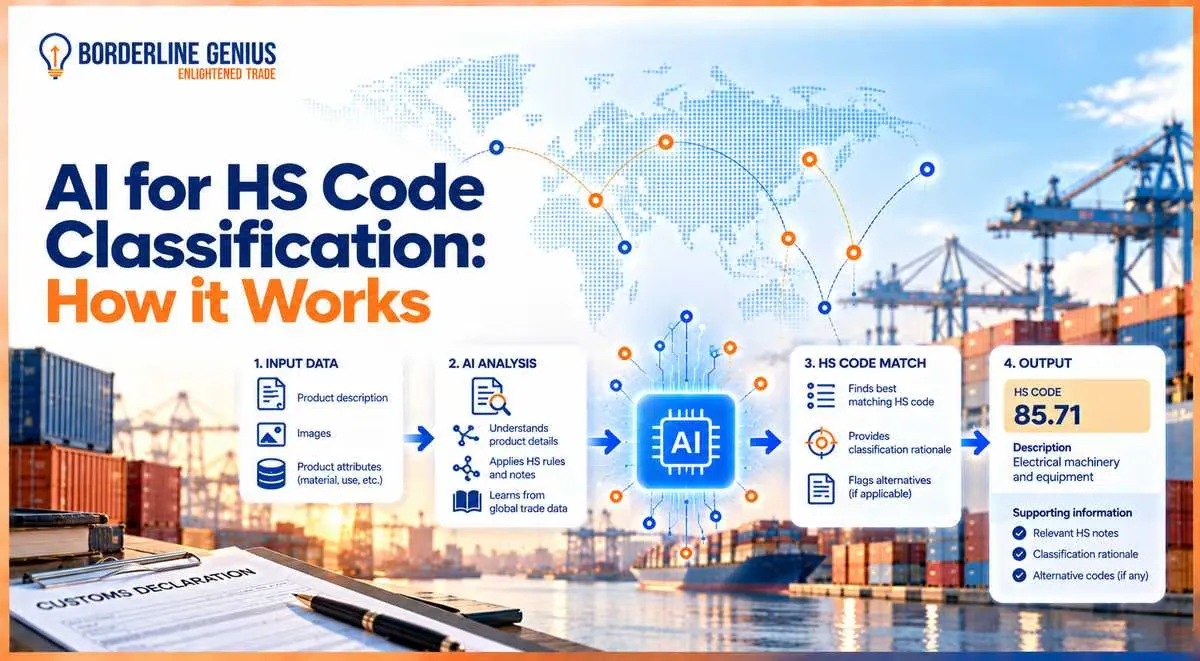
AI-powered classification workflows generally involve several stages.
1. Analyzing product information
The system examines available product descriptions, technical specifications, materials, functions, and other relevant attributes. The completeness and accuracy of this information can influence the suggested results.
2. Identifying important characteristics
AI can help identify product attributes that may affect classification, narrowing the range of potentially relevant tariff categories.
3. Comparing potential HS codes
The system compares product characteristics with available tariff information to identify possible headings and subheadings for further assessment.
4. Considering classification rules
Potential classifications must be evaluated against applicable General Rules of Interpretation, Section Notes, Chapter Notes, and relevant tariff requirements. A potential match alone does not establish the correct classification.
5. Reviewing and validating results
Trade compliance professionals can assess suggested codes against the actual product details and applicable rules, investigating cases that require additional analysis.
For a step-by-step explanation, read how AI works in HS code classification.
What Businesses Can Gain From AI-Assisted Classification
When implemented with reliable data and appropriate review, AI can help trade teams reduce repetitive research and organize classification activities more efficiently.
Potential benefits include:
- Processing product information more systematically.
- Identifying relevant product characteristics.
- Surfacing potential HS classifications for review.
- Supporting consistent workflows across large product catalogs.
- Helping teams organize classification research.
These benefits depend on the capabilities of the software, the quality of its reference data, and the validation process used.
Why Human Review Still Matters
AI-generated suggestions should not automatically be treated as final classification decisions. Missing technical details or differences in product composition and function can affect the assessment.
Applicable classification rules must also be interpreted in context. Human review is particularly important when several classifications appear plausible or when a decision has significant regulatory or financial implications.
A practical approach combines technology-assisted research with appropriate professional oversight.
Choosing HS Code Classification Software
Businesses evaluating classification software should consider how it processes product information, supports access to tariff references, presents potential classifications, and manages review workflows.
Confidence scores and expert validation can help reviewers assess suggested results when those capabilities are available. The broader objective is to reduce repetitive work while maintaining appropriate control over classification decisions.
Conclusion
AI for HS code classification can help businesses analyze product information, identify relevant characteristics, compare potential classifications, and organize review activities. It can improve research efficiency, but reliable data, applicable classification rules, and human validation remain essential.
Explore the complete guide to AI for HS Code Classification: How It Works for a closer look at the classification process.
Borderline Genius Inc. brings trade expertise, regulatory content, proprietary AI, and enterprise technology together to support trade compliance workflows. Visit Borderline Genius Inc. for more insights.



















Sign in to leave a comment.