Introduction
Legacy application transformation is often discussed as though it were primarily a matter of replacing an old programming language with a modern one. In enterprise environments, the reality is considerably more complex. A legacy application may contain decades of business rules, custom integrations, database interactions, batch processes, dependencies, and operational knowledge that have evolved alongside the organization itself.
This creates a significant modernization dilemma. Businesses need applications that can support cloud platforms, modern architectures, automation, and faster development cycles, but they cannot afford to lose the proven functionality embedded within existing systems.
Manual conversion can require engineering teams to inspect extensive codebases, understand undocumented dependencies, recreate functionality, and repeatedly validate whether the modernized application behaves like the original system. The larger the application portfolio, the more difficult this process becomes.
An AI Legacy Conversion Tool introduces intelligence into this transformation process. By supporting code analysis, migration, and modernization activities, AI can help enterprises reduce repetitive engineering effort while maintaining the human oversight required for business-critical applications.
The objective is not merely to generate newer code. It is to modernize applications while protecting the business behavior that makes those applications valuable.
Why Legacy Code Conversion Is Difficult at Enterprise Scale
A legacy system rarely consists of isolated source-code files that can simply be translated line by line.
Applications developed over many years often contain layers of modifications introduced by different engineering teams. Some components may be well documented, while others depend heavily on institutional knowledge held by experienced employees.
The complexity becomes particularly visible when modernization teams encounter:
- Large interconnected codebases
- Undocumented application dependencies
- Embedded business rules
- Obsolete programming technologies
- Custom database interactions
- Tightly coupled application components
- Limited automated testing coverage
- Specialized legacy development skills
A direct language conversion may technically produce modern code while still failing to address architectural complexity or maintainability.
This is why enterprise code migration must begin with understanding rather than conversion.
Start with the Application, Not the Target Language
One of the most important modernization decisions occurs before new code is generated.
Engineering teams need to determine what the existing application actually does.
Which components support critical business processes? Which modules are still actively used? Where are the dependencies? Which business rules must remain unchanged? Which areas contain unnecessary technical complexity?
These questions establish the context required for responsible modernization.
An Enterprise AI Code Migration Tool can support this discovery process by helping engineering teams analyze legacy code and organize information about existing application structures before migration progresses.
This creates a more informed starting point.
Instead of treating every component identically, organizations can classify application elements according to business importance and modernization requirements.
The result is a transformation strategy based on application understanding rather than assumptions.
AI Can Reduce the Manual Burden of Code Migration
Traditional migration programs can require significant manual engineering effort. Developers examine existing code, interpret functionality, create equivalent implementations, test the output, and resolve differences between old and new systems.
When thousands or millions of lines of code are involved, this work can consume substantial resources.
AI-assisted conversion introduces opportunities to automate portions of this workload.
Code Understanding
AI can assist engineers in interpreting existing application structures and identifying patterns across large codebases.
Conversion Assistance
Repeatable legacy constructs can be transformed into modern equivalents more efficiently, reducing the amount of code that must be rewritten manually.
Consistency Across Migration
Large modernization programs may involve multiple teams. Intelligent assistance can support more standardized conversion practices across different application components.
Developer Productivity
By reducing repetitive conversion activities, experienced engineers can dedicate more attention to architecture, business validation, performance, and complex application behavior.
Capabilities such as AI SDLC Framework, AI Fullstack SDLC, and Enterprise AI Development Platform can further position migration within the broader software engineering lifecycle rather than treating conversion as an isolated activity.
Code Conversion and Application Modernization Are Not the Same
This distinction is important.
Code conversion changes how software is implemented. Application modernization changes how effectively that software can support future business needs.
Simply translating legacy code into a newer language may leave many original architectural limitations intact.
For example, converted code could still contain:
- Tightly coupled components
- Outdated processing patterns
- Unnecessary dependencies
- Difficult-to-maintain structures
- Limited scalability
- Technical debt inherited from the original application
Organizations should therefore evaluate whether individual components require direct conversion, refactoring, re-engineering, architectural redesign, or another modernization approach.
AI can accelerate engineering work, but modernization strategy still requires architectural judgment.
Preserving Business Logic Must Remain a Priority
Legacy applications frequently contain business knowledge that is difficult to reconstruct.
A financial application may contain calculation rules developed over decades. An insurance platform may encode complex underwriting processes. A manufacturing system may include operational logic that reflects years of production experience.
Losing or incorrectly interpreting this functionality during migration can create significant business risk.
Modernization teams should therefore treat business logic as an asset that needs to be identified, understood, preserved, and validated.
This requires close collaboration among:
- Legacy application specialists
- Business stakeholders
- Solution architects
- Modern development teams
- Quality engineers
- Modernization program leaders
Artificial intelligence can assist with analysis and conversion, but subject-matter expertise remains essential for determining whether modernized functionality accurately reflects business requirements.
Testing Becomes a Modernization Control Mechanism
Migration cannot be considered successful merely because converted code compiles or executes.
The modernized application must demonstrate that it continues producing the expected business outcomes.
Testing therefore becomes one of the most important control mechanisms within a modernization program.
Teams should validate:
- Functional equivalence
- Business-rule accuracy
- Integration behavior
- Data processing
- Application performance
- Error handling
- Security requirements
- Critical end-to-end workflows
Where possible, organizations should establish baseline behavior before migration begins. This provides a reference against which the modernized application can be evaluated.
Modernization quality should be measured by preserved business behavior and improved engineering outcomes—not simply by the percentage of code converted.
A Phased Migration Strategy Can Reduce Transformation Risk
Large enterprise applications are rarely ideal candidates for an all-at-once transformation.
A phased approach allows organizations to modernize selected components, validate the results, refine migration practices, and apply those lessons to subsequent phases.
A practical sequence may involve:
1. Application assessment
Understand business value, architecture, dependencies, and technical condition.
2. Modernization prioritization
Identify components that create the greatest operational constraints or business opportunities.
3. Controlled conversion
Use intelligent migration capabilities where they provide clear engineering value.
4. Validation and refinement
Compare modernized functionality against expected application behavior.
5. Progressive expansion
Apply validated migration patterns to additional application areas.
This approach enables organizations to manage modernization as a controlled engineering program rather than a single high-risk technical event.
Connecting Migration with the Broader SDLC
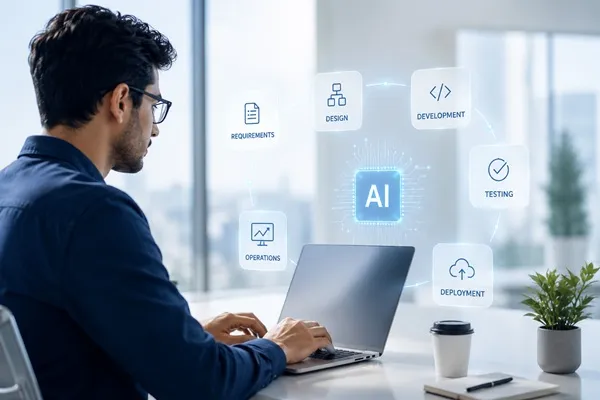
Code migration should not operate independently from requirements, development, testing, deployment, and governance.
Once applications begin moving toward modern architectures, they enter the same engineering lifecycle as newly developed enterprise software.
Using an AI Fullstack SDLC Platform can help position modernization within a broader development environment where transformed applications continue through structured engineering, testing, and delivery processes.
This matters because modernization does not end when conversion is completed.
Modernized applications must remain:
- Maintainable
- Testable
- Deployable
- Observable
- Scalable
- Governable
The long-term success of migration therefore depends on the engineering environment that supports the application after transformation.
Measuring the Business Value of AI-Assisted Migration
Enterprises should avoid measuring modernization success solely through technical output such as lines of code converted.
A more meaningful assessment considers whether modernization improves the overall economics and performance of the application.
Useful indicators can include:
- Reduction in migration effort
- Faster modernization cycles
- Lower application maintenance effort
- Improved developer productivity
- Reduction in technical complexity
- Improved release frequency
- Better application scalability
- Reduced dependency on specialized legacy skills
- Improved integration with modern platforms
These measurements connect technical modernization activities with business outcomes.
If an application has been converted but remains expensive to maintain and difficult to enhance, the modernization initiative has achieved limited strategic value.
Human Oversight Remains Essential
AI can substantially improve the efficiency of application analysis and code transformation, but enterprise modernization requires decisions that extend beyond automated conversion.
Architects must determine appropriate target architectures. Developers must review generated implementations. Business specialists must validate critical functionality. Quality teams must verify behavioral equivalence. Security professionals must evaluate new technology environments.
The strongest modernization model is therefore AI-assisted and human-governed.
Artificial intelligence handles scalable analysis and repetitive transformation activities. Experienced professionals remain accountable for architectural decisions, business accuracy, software quality, and production readiness.
This combination allows enterprises to accelerate modernization without weakening engineering discipline.
Building a Repeatable Modernization Capability
One of the most valuable outcomes of AI-assisted migration may not be the modernization of a single application.
It may be the creation of a repeatable enterprise modernization capability.
Large organizations frequently maintain portfolios containing dozens or hundreds of aging applications. Approaching each system as an entirely separate transformation project creates duplicated effort.
By establishing standardized assessment methods, conversion patterns, validation practices, governance controls, and engineering workflows, organizations can reuse modernization knowledge across their application portfolio.
This turns modernization from a sequence of isolated projects into a scalable enterprise engineering discipline.
Conclusion
Enterprise code migration is significantly more complex than translating source code from one programming language to another. Successful transformation requires application understanding, business-logic preservation, architectural planning, rigorous validation, and disciplined engineering governance.
AI Legacy Conversion Tool capabilities can reduce the manual burden associated with analyzing and transforming large legacy applications while helping engineering teams execute migration more consistently.
However, the greatest value emerges when intelligent conversion is combined with human expertise and a broader modernization strategy. Enterprises that approach migration this way can reduce transformation complexity, protect critical business functionality, and create applications that are easier to maintain and evolve.
The objective is not simply modern code. It is sustainable enterprise software capable of supporting the next generation of business requirements.




















Sign in to leave a comment.