

Improving requirement clarity, change visibility, traceability, and stakeholder alignment to prevent costly development corrections later in the SDLC
Introduction
Software rework is one of the most persistent sources of hidden cost in enterprise development.
A development team may complete a feature correctly according to the information available, only to discover during testing that an important business condition was missing. A requirement may change after implementation begins without every affected team receiving the update. Testers may interpret acceptance criteria differently from developers. In other situations, technically correct functionality may be rejected because the original business objective was misunderstood.
These problems are often categorized as development or testing issues, but their origin can occur much earlier in the lifecycle.
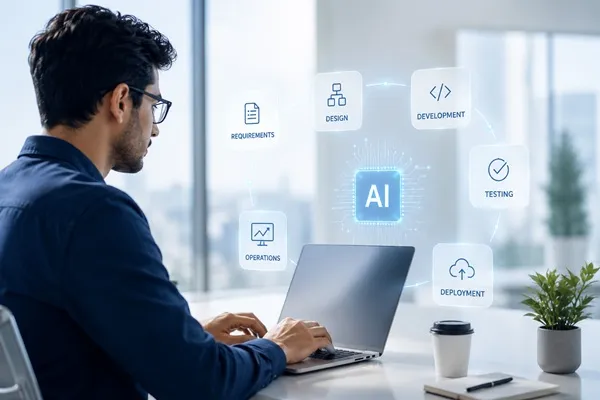
AI Requirements Management can help organizations improve how requirements are created, analyzed, maintained, and connected with downstream engineering activities.
The objective is not simply producing better documentation. It is creating a more reliable flow of business intent throughout software delivery so teams spend less time correcting work that could have been aligned correctly from the beginning.
Why Requirement Problems Create Expensive Rework
The cost of resolving uncertainty generally increases as software progresses through development.
Clarifying a business rule during requirements analysis may require a short stakeholder discussion.
Discovering the same missing rule after development can require code modifications and additional reviews.
Finding it during system testing may also require regression changes and retesting.
Discovering it after production deployment can involve operational incidents, emergency fixes, customer impact, and additional governance.
This creates a straightforward principle:
Requirement problems should be identified as close to their origin as possible.
Requirement Extraction Can Improve the Starting Point
Business requirements rarely originate from one perfectly structured document.
Relevant information may exist across process descriptions, policies, stakeholder discussions, existing system documentation, and historical specifications.
Requirement Extraction can help analysts identify potential business rules, actors, conditions, workflows, dependencies, and expected outcomes from these information sources.
This provides a stronger foundation for formal requirement development.
Human analysts should still verify extracted information because older documentation may contain outdated or conflicting business rules.
AI accelerates discovery.
Business professionals establish what is authoritative.
AI Requirements Generation Can Reduce Missing Information
Incomplete requirements frequently create downstream assumptions.
A requirement might describe the normal workflow while ignoring permissions, exceptions, validation rules, or integration failures.
AI Requirements Generation can help analysts examine requirements across multiple dimensions before development begins.
For example, teams can consider:
- Primary behavior
- Alternative workflows
- Business rules
- Validation conditions
- User permissions
- Dependencies
- Failure scenarios
- Expected outcomes
The purpose is not creating unnecessarily long specifications.
A good requirement should contain enough information to prevent avoidable interpretation while remaining practical for engineering teams.
Ambiguity Should Be Identified, Not Automated
AI systems can produce highly convincing language.
This creates a particular risk in requirements engineering.
When business information is missing, AI should not quietly invent a plausible answer.
Suppose a requirement states:
"Large transactions require additional authorization."
The missing definition of "large" represents a business decision.
An Agentic AI Requirements Assistant should help surface that uncertainty for stakeholder clarification rather than manufacture a threshold.
This distinction is essential.
The most useful AI requirements system is not necessarily the one that generates the most answers. It may be the one that identifies the most important unanswered questions.
Change Management Prevents Teams from Working with Old Information
Requirements naturally evolve.
Stakeholders refine business needs, regulatory conditions change, technical limitations become visible, and market priorities shift.
The problem is not requirement change itself.
The problem is uncontrolled change.
When a requirement changes, organizations need to understand what else may be affected.
A structured change process should examine:
Requirement change → Development impact → Testing impact → Release impact
If these relationships remain disconnected, teams can unknowingly continue working from outdated assumptions.
AI-assisted requirements management can help maintain visibility into these relationships and support faster impact assessment.
Traceability Connects Business Intent with Engineering
Requirements should remain connected with the software created to satisfy them.
A useful traceability structure is:
Business Objective → Requirement → Use Case → Implementation → Test → Validation
This provides several advantages.
Developers can understand why functionality exists.
Testers can identify which requirement a scenario validates.
Business stakeholders can determine whether requested functionality has been implemented.
When changes occur, teams have a stronger starting point for identifying affected engineering work.
Traceability therefore reduces both misunderstanding and manual investigation.
AI Use Case Generation Can Expose Rework Before Development
Individual requirements may appear correct until teams examine how they behave within a complete user workflow.
AI Use Case Generation can help translate requirements into scenarios containing primary flows, alternative paths, exceptions, and expected outcomes.
This often reveals unanswered questions.
For example, an order-cancellation requirement may appear straightforward until the use case considers:
- Orders already shipped
- Partially fulfilled orders
- Refund processing
- Promotional discounts
- Inventory restoration
- Customer notifications
- Payment-provider failures
Identifying these conditions during analysis is substantially less expensive than discovering them after implementation.
Better Requirements Strengthen Testing
Testing cannot compensate completely for unclear requirements.
If expected behavior is undefined, testers may simply validate a different interpretation from the one developers implemented.
Strong requirements provide measurable acceptance conditions.
This enables QA teams to create scenarios that reflect actual business expectations.
A stronger lifecycle becomes:
Requirement → Acceptance Criteria → Development → Test → Business Validation
The clearer these relationships are, the lower the probability of late-stage disagreement over whether functionality is correct.
Enterprise Requirements Management Improves Cross-Team Consistency
Large enterprises may have many analysts, product owners, engineering teams, and external partners working across different initiatives.
Requirement practices can vary considerably between teams.
Enterprise Requirements Management can support more consistent approaches to requirement structure, review, traceability, change management, and validation.
Consistency reduces the amount of interpretation required when professionals move between projects.
It can also improve governance because organizations gain clearer visibility into whether critical requirements have been appropriately reviewed and validated.
Standardization should not create unnecessary bureaucracy.
Its purpose is to establish enough consistency to improve software delivery.
Measure Rework Instead of Requirement Volume
Generating more requirements is not evidence of better requirements management.
Organizations should measure whether requirement quality improves downstream outcomes.
Useful indicators include:
- Requirement-related defects
- Development clarification requests
- Changes after coding begins
- Acceptance-criteria defects
- Development rework
- QA rework
- Stakeholder rejection
- Production issues caused by misunderstood requirements
These measures connect requirements practices directly with software delivery performance.
Human Collaboration Remains Central
Requirements ultimately represent business decisions.
AI can help analyze information, identify gaps, structure requirements, generate scenarios, and maintain relationships.
It cannot independently determine organizational priorities or resolve competing stakeholder interests.
Business analysts remain responsible for requirement quality.
Stakeholders remain responsible for business intent.
Developers evaluate technical feasibility.
Quality professionals evaluate testability.
AI becomes most valuable when it strengthens collaboration between these roles rather than attempting to replace them.
Conclusion
Software rework is frequently treated as an unavoidable consequence of complex development.
A significant portion of it can be reduced by improving how business intent is captured and maintained before and during implementation.
AI Requirements Management can help enterprises identify missing information, improve requirement structure, surface ambiguity, maintain change visibility, strengthen traceability, and develop more complete behavioral scenarios.
The strategic value extends beyond faster documentation.
When requirements remain clear and connected throughout the SDLC, developers make fewer assumptions, testers gain stronger validation criteria, stakeholders receive functionality that more accurately reflects expectations, and changes can be evaluated before they create unnecessary downstream work.
Used within a disciplined requirements process, AI can therefore help enterprises shift from correcting misunderstandings after development toward preventing those misunderstandings before expensive rework begins.




























Sign in to leave a comment.