

Ask ChatGPT or Claude a question about a business, a product, or a topic, and it often answers from the open web. But how does it read those websites? Not the way you do. AI chatbots never see your design, your animations, or your carefully laid out pages. They read a stripped down, machine version of your site, and most websites were never built with that reader in mind.
Over the past year, AI chatbots have quietly become a major new audience for websites. Here is what is actually happening when an AI chatbot reads your site.

Your site has new visitors
Alongside Googlebot, your server logs now show a new crowd: GPTBot, ClaudeBot, PerplexityBot, CCBot, and others. These are AI crawlers, each with its own user agent string and its own behavior. Some fetch pages to train models. Some fetch pages to answer a user question in real time. Either way, they are reading your content, and they decide what your business looks like to millions of AI users.
The first thing to check on any site: look at the server logs this week. You will probably find at least one of them already visiting. Most site owners have no idea.

How they read: the machine version of your page
An AI crawler fetches your page much like a browser, but a simpler one. It pulls the HTML, strips out the navigation, the ads, the cookie banners, and the design, and keeps what looks like the main content. Then it works from that extracted text.
That is where most sites fail. The same problems come up again and again:
First, key content trapped in images. If your pricing, your menu, or your service descriptions are baked into image files with no alt text, the machine reader sees nothing. Humans see a beautiful page. The AI sees a blank.
Second, JavaScript only content. Many modern sites render their real content in the browser after the page loads. Some AI crawlers run a full browser and cope. Many do not, or do it badly. If your content only exists after JavaScript runs, assume a chunk of AI readers never see it.
Third, accidental blocks. Sites sometimes block AI crawlers in robots.txt without knowing it, usually through a wildcard rule someone copied years ago. The site then becomes invisible to AI answers entirely, and the owner has no idea why competitors keep getting cited instead of them.
Fourth, walls before the content. Paywalls, login gates, and aggressive interstitials stop AI readers the same way they stop impatient humans, except the AI reader never clicks "accept" or logs in. It just moves on to a competitor's page that is open.
What a readable site looks like
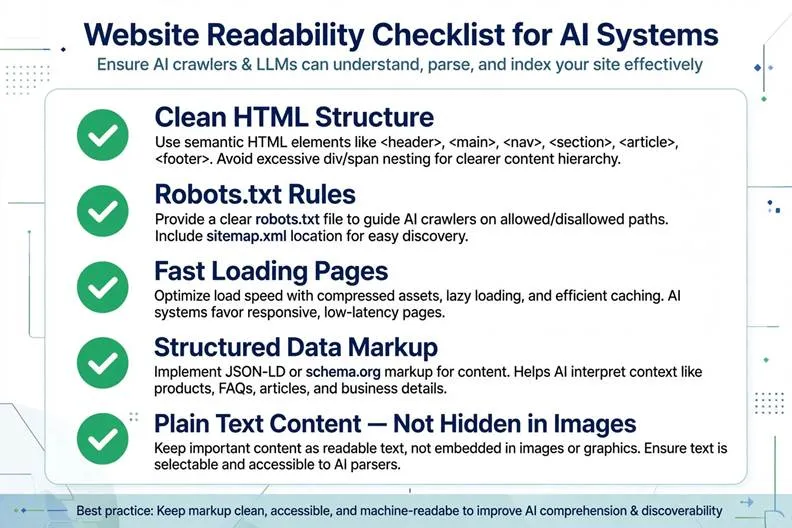
None of this requires exotic technology. A site that AI systems read well looks like this:
1. Clean semantic HTML: one H1, real headings in order, real paragraphs. The structure you learned for accessibility helps machines too.
2. Deliberate robots.txt rules: decide per AI crawler, on purpose, instead of inheriting whatever a template shipped with.
3. Server rendered content: the important text is in the HTML the server sends, not assembled later by scripts.
4. Fast pages: crawlers have budgets, and slow pages get partially read or skipped.
5. Structured data where it fits, so facts like prices, hours, and products are unambiguous.
Do this and you are ahead of most of the web. Most sites still fail at least two of these.
The same problem, inside companies
This is not only a public web story. Companies building their own chatbots over internal documents hit the same wall at a larger scale. A company assistant is only as good as the material it can read, which is why serious projects invest in a proper enterprise knowledge base before they invest in the chatbot itself. The chatbot, often an enterprise virtual assistant, answers from whatever the knowledge base serves it. Garbage structure in, confident wrong answers out. The public web and the company intranet rhyme here: readability of the source material decides everything.
The short version
Your website now has two audiences: people and AI readers. People want design and experience. AI readers want clean, complete, openly available text. The sites that win the next few years will be the ones built for both. Go check your logs, read your own pages the way a machine would, and fix what you find. It is some of the highest leverage SEO work you can do right now.























Sign in to leave a comment.