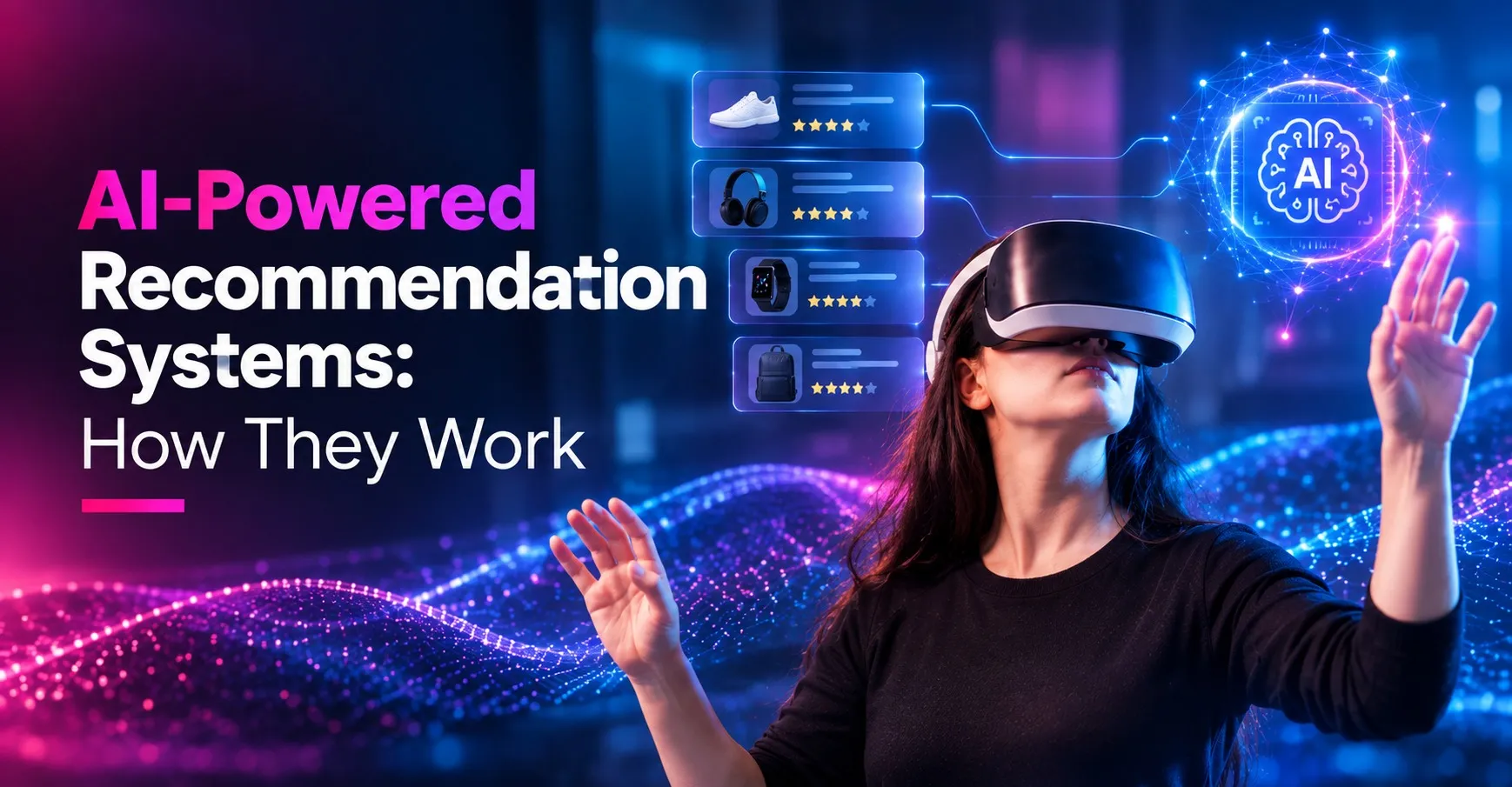

What Is an AI-Powered Recommendation System?
An AI-powered recommendation system is software that analyzes user behavior, preferences, context, and other data to suggest products, content, services, or actions that may be relevant to a person. Businesses use these systems across ecommerce, streaming, banking, education, travel, healthcare, and SaaS platforms.
Unlike simple “customers who bought this also bought” rules, modern recommendation engines can learn from large datasets and continuously adjust suggestions. With the right AI development services, businesses can build recommendation systems that work with their own data, business rules, and customer journeys.
Why Do Businesses Need Recommendation Systems?
Customers often face too many choices. A recommendation engine helps reduce that choice overload by bringing relevant options closer to the user.
For a business, better recommendations can support:
- Product discovery
- Customer engagement
- Repeat purchases
- Content consumption
- Cross-selling and upselling
- Customer retention
- Personalised experiences
- Faster decision-making
Consider an online fashion store. A visitor looking at running shoes could receive recommendations for performance socks, fitness clothing, or similar shoes based on browsing behavior and product relationships.
The value is not simply showing more products. It is showing more relevant products at the right point in the customer journey.
How Do AI Recommendation Systems Work?
At a basic level, a recommendation system collects signals, identifies patterns, predicts relevance, and presents ranked suggestions.
The process usually looks like this:
User activity → Data collection → Feature processing → Recommendation model → Ranking → Personalised results → Feedback
For example, suppose a customer frequently watches short technology videos, skips cooking content, and completes several videos about mobile development. The system can use these signals to estimate which content the customer is likely to engage with next.
Several technical approaches can be combined to produce these predictions.
1. Data collection
The system first gathers relevant information.
This may include:
- Search queries
- Product views
- Purchases
- Ratings
- Clicks
- Watch history
- Time spent on content
- Cart activity
- Location or device context, where appropriate
- Customer profile information
The quality and relevance of these signals matter. Poor or incomplete data can produce weak recommendations regardless of how sophisticated the model is.
2. Feature engineering
Raw data is transformed into useful signals that a recommendation model can understand.
For instance, instead of simply storing that a customer purchased a product, the system may consider purchase frequency, product category, price range, recency, and relationships between products.
3. Model training
Machine learning algorithms identify patterns in historical interactions.
Depending on the application, businesses may use collaborative filtering, content-based filtering, deep learning, ranking models, embeddings, or hybrid recommendation approaches.
4. Ranking
The system may generate hundreds of possible recommendations, but showing all of them would overwhelm the user.
A ranking layer scores candidates according to factors such as relevance, predicted engagement, business rules, availability, freshness, or customer preferences.
5. Feedback loop
The system learns from subsequent interactions.
If a user repeatedly ignores certain recommendations but engages with another category, those signals can influence future results.
This creates a continuous cycle of prediction → interaction → feedback → improvement.
Which Types of Recommendation Systems Are Common?
There is no single recommendation architecture that works for every business.
Collaborative filtering
Collaborative filtering recommends items based on similarities between users or interactions.
For example, if users with similar purchasing patterns frequently buy products A and B, someone who purchased A may receive B as a recommendation.
Content-based recommendation
This approach focuses on the characteristics of items and the user's previous preferences.
A movie platform, for example, may recommend films sharing genres, actors, themes, or other attributes with titles a viewer already enjoyed.
Hybrid recommendation
Hybrid systems combine multiple approaches. This can help businesses handle more complex customer journeys because the system does not depend on a single source of intelligence.
Context-aware recommendation
Context can influence what makes a recommendation useful.
A travel application might consider destination, travel dates, weather, budget, previous searches, and current activity rather than relying only on historical preferences.
Can Generative AI Improve Recommendation Systems?
Yes, but generative AI should usually complement—not automatically replace—the recommendation engine.
A traditional recommendation model can determine what products or content are relevant. A generative AI layer can help explain why a recommendation may be useful or turn several signals into a natural conversation.
For example, a shopping assistant could understand:
“I need a lightweight laptop for programming and travel under my budget.”
The system can combine conversational understanding with product-ranking logic to narrow the catalogue and present suitable options.
Generative AI can also support:
- Natural-language product discovery
- Conversational shopping
- Personalised descriptions
- Recommendation explanations
- Intelligent search
- Content summarisation
The underlying recommendation and ranking logic still needs careful evaluation.
What Are the Real-World Uses of AI Recommendations?
Recommendation systems are useful far beyond online stores.
Ecommerce
Recommend related products, personalised collections, replenishment items, or alternatives based on customer behavior.
Media and entertainment
Streaming platforms can recommend films, music, podcasts, games, or videos based on viewing and listening patterns.
Travel
Travel companies can suggest hotels, destinations, activities, flights, or packages according to preferences and trip context.
Banking and fintech
Financial platforms can recommend relevant services, educational content, or financial actions while applying appropriate compliance and risk controls.
Education
Learning platforms can suggest courses, lessons, practice questions, and learning paths based on progress and performance.
SaaS products
Software platforms can recommend features, workflows, reports, integrations, or next actions based on how customers use the product.
When Should a Business Build a Custom Recommendation Engine?
A custom system becomes attractive when recommendations are strategically important and generic tools cannot adequately handle the company's data or customer journey.
Consider custom development when:
- You have substantial first-party interaction data.
- Recommendations directly affect revenue or engagement.
- Your catalogue or content is highly specialised.
- You need integration with proprietary systems.
- You require control over recommendation logic.
- Privacy or data governance requirements are significant.
- Generic recommendation platforms limit experimentation.
For a small catalogue or early-stage product, however, an existing recommendation API or simpler rules-based approach may be more practical.
How Much Does an AI Recommendation System Cost?
The cost varies widely because recommendation systems range from relatively simple product suggestions to large-scale real-time personalisation platforms.
Key cost drivers include:
- Number of users and recommendations
- Data volume and quality
- Model complexity
- Real-time versus batch recommendations
- Number of integrations
- Cloud infrastructure
- Data engineering requirements
- Personalisation depth
- Security and privacy controls
- Testing and monitoring
A sensible development strategy is to start with one high-value recommendation use case. Once performance is measured, the system can expand to additional customer journeys.
How Can an AI Development Company Build a Better Recommendation System?
An experienced AI development company can help connect data engineering, machine learning, application development, and product strategy rather than treating the recommendation model as an isolated component.
A typical engagement may include:
- Use-case discovery – Identify where recommendations can create measurable value.
- Data assessment – Review available customer, product, content, and interaction data.
- Architecture planning – Design data pipelines, model infrastructure, APIs, and application integration.
- Model development – Select and develop suitable recommendation approaches.
- Ranking and business rules – Balance personal relevance with inventory, pricing, availability, or other constraints.
- Testing – Compare recommendation quality using offline and real-user evaluation.
- Deployment – Integrate the engine into web, mobile, or SaaS products.
- Monitoring – Track performance, latency, engagement, and recommendation quality.
- Continuous improvement – Retrain and refine models as customer behavior changes.
This end-to-end approach is often more valuable than simply purchasing an AI model.
Should Every Business Use AI Recommendations?
No. Recommendation technology makes sense when there is enough user or item data, a meaningful choice problem, and a measurable business outcome.
A recommendation engine may not be worthwhile when:
- The product catalogue is extremely small.
- Users rarely return to the platform.
- There is insufficient interaction data.
- Recommendations have little influence on business outcomes.
- Simple business rules already solve the problem effectively.
The right question is not “Where can we add AI?” It is “Where can better recommendations improve a decision or experience?”
Conclusion
AI-powered recommendation systems can turn large amounts of customer and product data into more relevant experiences. They help businesses personalise discovery, improve engagement, support cross-selling, and make digital products easier to navigate.
The strongest implementations begin with a focused business objective, reliable data, suitable recommendation techniques, and continuous measurement. With professional AI development services, companies can build recommendation capabilities that fit their products, customers, technology stack, and long-term growth plans.
























Sign in to leave a comment.