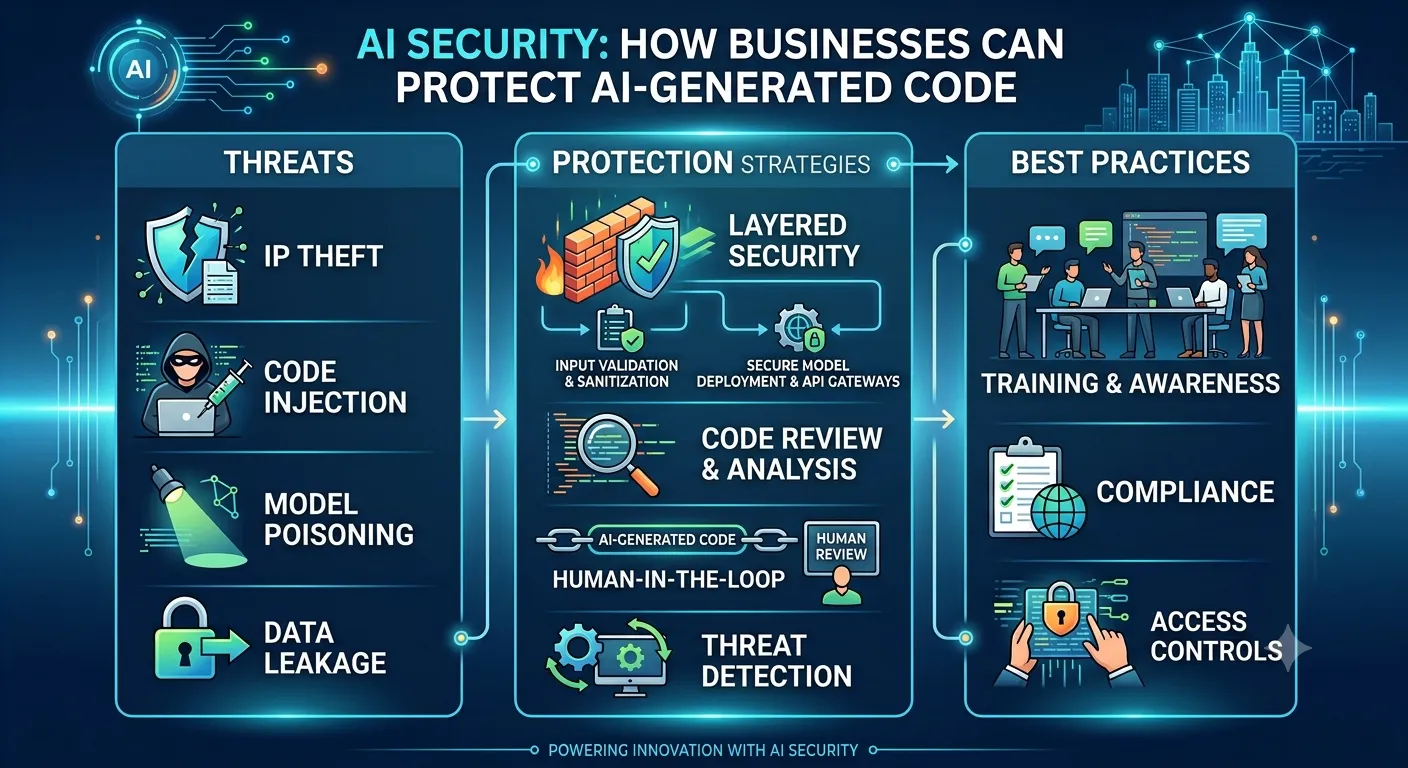

AI coding assistants are changing how software is built. Developers can now generate functions, APIs, tests, database queries, and even complete application components in minutes. This speed can reduce development time, but it also creates a new challenge: how can businesses make sure AI-generated code is secure before it reaches production?
AI-generated code can contain common security weaknesses such as SQL injection, cross-site scripting (XSS), insecure APIs, weak authorization, exposed secrets, and vulnerable third-party dependencies. The problem becomes more serious when development teams generate code faster than security teams can review it. Recent research and industry guidance increasingly point toward securing AI-generated code throughout the software development lifecycle rather than relying only on a final security scan.
For businesses investing in AI/ML development, security should therefore be part of the development process from the beginning. Companies such as API DOTS can help businesses build AI-powered applications with scalable APIs, intelligent automation, real-time data processing, and secure cloud deployment in mind.
What Is AI-Generated Code?
AI-generated code is software code created partly or entirely by artificial intelligence tools.
Developers can describe what they need using normal language, and an AI coding assistant can generate the required code.
For example, a developer might ask an AI tool to:
- Create a login API.
- Connect an application to a database.
- Build a payment function.
- Generate a REST API.
- Write authentication logic.
- Create automated tests.
- Develop a recommendation feature.
- Build an AI chatbot backend.
This makes development faster. However, working code is not always secure code.
An AI model may generate code that looks correct but does not understand the complete security requirements of a particular business application.
Why AI-Generated Code Creates Security Risks
AI coding tools learn patterns from large amounts of existing code and technical information. As a result, they can reproduce both good and bad coding patterns.
The main challenge is that AI does not automatically understand your organization's complete security policies, architecture, business logic, or compliance requirements.
Research and security guidance have identified several important risks associated with AI-generated code, including vulnerable dependencies, missing validation, exposed credentials, insecure permissions, and business-logic flaws.
1. AI Can Generate Vulnerable Code
AI may generate code containing familiar vulnerabilities.
For example, an AI-generated database query may fail to properly validate user input. The application could then become vulnerable to SQL injection.
Other examples include:
- SQL injection
- Cross-site scripting (XSS)
- Command injection
- Path traversal
- Weak authentication
- Missing authorization
- Insecure API endpoints
- Improper input validation
The code may still compile and pass basic functional testing.
That is why "it works" should never mean "it is secure."
2. Outdated Dependencies Can Become a Problem
AI tools may recommend libraries or packages based on patterns found in their training data.
Some dependencies may be outdated or vulnerable.
There is also a newer supply-chain concern: AI models can sometimes suggest package names that do not actually exist. If an attacker registers such a package name, a developer could accidentally install a malicious package.
This type of risk makes dependency verification an important part of AI code security.
3. Hardcoded Secrets
Developers sometimes ask AI tools to generate configuration files or connection examples.
If secrets are handled incorrectly, generated code could contain:
- API keys
- Database passwords
- Access tokens
- Cloud credentials
- Private keys
A secret accidentally committed to a repository can become a serious security incident.
Businesses should use secure secret-management systems instead of placing credentials directly inside source code.
4. Missing Authorization
Authentication answers:
"Who are you?"
Authorization answers:
"What are you allowed to do?"
AI-generated applications may correctly create a login system but fail to properly restrict access to sensitive functions.
For example, imagine an employee management application.
A normal employee should be able to view their own profile. An administrator may be allowed to view or edit everyone else's information.
If authorization rules are missing, a normal user might access administrative data simply by changing an ID in a URL or API request.
This is a business-logic security problem, not just a coding error.
Common Security Vulnerabilities in AI-Generated Code
Businesses should pay particular attention to these areas when reviewing AI-generated code.
SQL Injection
AI-generated database queries may use unsafe input handling.
Better approach: Use parameterized queries, prepared statements, and proper validation.
Cross-Site Scripting
Generated frontend code may incorrectly handle user-controlled content.
Better approach: Validate input and safely encode output according to the application's context.
Insecure APIs
An AI-generated API might work correctly but lack:
- Authentication
- Authorization
- Rate limiting
- Input validation
- Proper error handling
Because APIs connect different systems, these weaknesses can expose important business data.
Excessive Permissions
AI-generated applications or agents may request broader permissions than necessary.
For example, an AI service that only needs to read customer information should not automatically receive permission to delete the entire customer database.
This is where the principle of least privilege becomes important.
Vulnerable Open-Source Packages
AI-generated code may include third-party packages without sufficiently checking their security status.
Developers should verify:
- Package authenticity
- Package version
- Known vulnerabilities
- Maintenance activity
- License requirements
- Package source
How Businesses Can Protect AI-Generated Code
Securing AI-generated software requires more than asking developers to "check the code."
Businesses need a repeatable security process.
1. Treat AI-Generated Code Like Human-Written Code
Do not assume AI-generated code is safe because it came from a popular AI assistant.
Every piece of generated code should go through the same security standards as manually written code.
A simple rule is:
AI can write the code, but your security process must approve it.
2. Use Secure Coding Standards
Create clear coding rules for developers using AI tools.
Your internal guidelines can define requirements for:
- Authentication
- Authorization
- Input validation
- Encryption
- Error handling
- API security
- Logging
- Secrets management
- Dependency management
Developers can then use these rules when writing prompts and reviewing generated code.
3. Scan Code Automatically
Manual code review is important, but it becomes difficult when AI dramatically increases development speed.
Automated security testing can help identify problems earlier.
Businesses should consider using:
- SAST for source-code security analysis
- SCA for third-party dependency analysis
- DAST for testing running applications
- Secret scanning
- Container security scanning
- Infrastructure-as-code security scanning
These tools can become security checkpoints inside the development pipeline.
OX Security similarly recommends SAST and software composition analysis as part of protecting AI-generated code.
4. Review AI-Generated Dependencies
Never blindly install a package simply because an AI assistant recommends it.
Before adding a dependency, check:
- Does the package actually exist?
- Is it published by a trustworthy source?
- Is it actively maintained?
- Does it have known vulnerabilities?
- Is the version appropriate for your project?
- Does its license meet your business requirements?
This small verification step can prevent major supply-chain problems.
5. Keep Secrets Out of Source Code
Use dedicated secrets-management solutions for sensitive credentials.
For example, instead of:
API_KEY = "my-secret-key"
the application should retrieve the credential securely from an appropriate environment or secrets-management system.
Also scan repositories regularly for accidentally exposed credentials.
6. Apply Least-Privilege Access
Every AI application, service, API, and agent should receive only the permissions it actually needs.
For example:
Customer-support AI
- Read customer information: Yes
- Create support tickets: Yes
- Delete customers: No
- Access payment credentials: No
This reduces the potential damage if an AI component or its generated code is compromised.
Build Security Into the AI Development Lifecycle
One of the biggest mistakes businesses can make is treating security as the final step.
Instead, security should be included throughout the development lifecycle.
Step 1: Plan
Define:
- Business requirements
- Data sensitivity
- User roles
- Security requirements
- Compliance requirements
Step 2: Generate
Developers can use AI assistants to create code faster.
However, prompts should include relevant security requirements.
Step 3: Review
Developers and security teams should review generated code for:
- Vulnerabilities
- Business-logic errors
- Permissions
- Dependencies
- Secrets
- Data exposure
Step 4: Test
Run automated security tests alongside functional tests.
Step 5: Deploy
Use CI/CD security gates so high-risk vulnerabilities do not automatically reach production.
Step 6: Monitor
Security does not end after deployment.
Monitor applications, APIs, cloud infrastructure, dependencies, and AI systems continuously.
This approach supports a secure-by-design development process, where security is considered from the beginning rather than added after the software is finished.
AI Security Is Especially Important for AI/ML Applications
AI applications often process sensitive information and connect to multiple systems.
For example, an AI-powered healthcare platform may work with patient information. A financial AI application may process transaction data. A customer-service chatbot may access customer records.
This means businesses need to think beyond traditional source-code security.
Important areas include:
- Data privacy
- Model security
- API security
- Access control
- Secure cloud infrastructure
- Data encryption
- Model monitoring
- Prompt security
- Dependency security
- Runtime monitoring
API DOTS focuses on AI/ML solutions that can integrate with existing applications through APIs while supporting scalable cloud deployment, real-time processing, predictive analytics, and intelligent automation.
For organizations building AI-powered products, this type of architecture makes it important to consider security, scalability, and integration together rather than treating them as separate concerns.
Practical AI Code Security Checklist
Before deploying AI-generated code, businesses can use this simple checklist:
- Has the code been reviewed by a developer?
- Has automated security scanning been completed?
- Are user inputs properly validated?
- Are authentication and authorization implemented?
- Are API endpoints protected?
- Are secrets removed from source code?
- Have dependencies been verified?
- Are outdated packages removed or updated?
- Are permissions limited to what is necessary?
- Has the application been tested for common vulnerabilities?
- Are production systems continuously monitored?
- Are security updates applied regularly?
This checklist is simple, but it can prevent many common mistakes.
Should Businesses Stop Using AI Coding Tools?
No.
The goal should not be to stop developers from using AI.
AI-assisted development can provide significant productivity benefits. The better approach is to create controlled and secure AI-assisted development workflows.
Think of AI as a very fast coding assistant.
It can produce code quickly, but developers and security processes still need to determine whether that code is appropriate for production.
The most effective strategy is therefore:
AI-assisted development + human expertise + automated security + continuous monitoring.
How API DOTS Can Help With Secure AI/ML Development
Building an AI-powered application requires more than selecting an AI model.
Businesses need a complete technical foundation that connects AI capabilities with their existing applications and infrastructure.
API DOTS provides AI/ML development solutions designed around business requirements, including intelligent automation, predictive analytics, real-time data processing, AI-powered APIs, and scalable cloud deployment.
A business working on an AI-powered application can benefit from focusing on:
- Secure API integration
- Scalable AI/ML architecture
- Data processing
- Intelligent automation
- Predictive analytics
- Cloud deployment
- Application integration
- Real-time insights
The right development approach can help businesses use AI faster while keeping security and scalability in focus.
Final Thoughts
AI-generated code is becoming an important part of modern software development. It can help teams build applications faster, automate repetitive development tasks, and experiment with new ideas.
But speed should not come at the cost of security.
AI can generate code that looks correct while containing vulnerabilities, insecure dependencies, weak authorization, exposed secrets, or business-logic mistakes. Industry guidance increasingly recommends combining secure development practices, automated testing, dependency checks, continuous monitoring, and stronger governance around AI-assisted development.
For businesses building AI-powered products, the goal should not be "AI or security."
It should be "AI with security built in."
With a secure development process and the right AI/ML development partner, businesses can take advantage of AI innovation while creating software that is safer, scalable, and ready for long-term growth.
Frequently Asked Questions
1. Is AI-generated code secure?
Not automatically. AI-generated code can contain the same types of vulnerabilities found in human-written code. Every generated component should be reviewed, tested, and scanned before production.
2. What are the biggest risks of AI-generated code?
Common risks include SQL injection, XSS, insecure APIs, weak authorization, hardcoded secrets, vulnerable dependencies, missing input validation, and business-logic vulnerabilities.
3. How can companies secure AI-generated code?
Companies should combine human code review with automated security scanning, dependency checks, secret detection, secure coding standards, least-privilege access, CI/CD security controls, and continuous monitoring.
4. Should developers stop using AI coding assistants?
No. Businesses should establish clear rules for safe AI-assisted development instead of banning AI tools completely. AI can improve productivity when appropriate security controls are in place.
5. Why is API security important for AI applications?
AI applications often communicate with databases, mobile apps, websites, cloud services, and third-party platforms through APIs. Poorly secured APIs can expose sensitive information or allow unauthorized actions.





















Sign in to leave a comment.