
Artificial intelligence is helping businesses work faster than ever before. Employees use AI to draft reports, developers build AI-powered applications, and customer support teams rely on intelligent chatbots to improve response times. AI has become a competitive advantage across nearly every industry.
But there's a problem that many organizations don't recognize until it's too late.
While businesses are investing heavily in AI, many are overlooking the security risks that come with it.
Every new AI model, chatbot, or autonomous agent creates another entry point that cybercriminals can exploit. Sensitive business data can leak through prompts, AI models can be manipulated into producing harmful outputs, and employees may unknowingly expose confidential information by using unauthorized AI tools.
The result?
A technology designed to increase productivity can quickly become one of an organization's biggest cybersecurity challenges.
That's why AI security has become one of the most important conversations happening across the technology industry today. It's also why AI and Cybersecurity Conference events are attracting growing attention from CISOs, security architects, AI engineers, and business leaders looking to understand how to deploy AI responsibly without increasing organizational risk.
AI Adoption Is Growing Faster Than Security Strategies
Most organizations didn't spend years preparing for enterprise AI.
Instead, AI adoption happened almost overnight.
One department began experimenting with generative AI. Another integrated an AI chatbot into customer support. Developers started embedding large language models into applications. Marketing teams began using AI to generate content, while employees turned to public AI tools to simplify everyday tasks.
Each individual decision seemed harmless.
Collectively, they created an entirely new attack surface.
Traditional cybersecurity solutions were designed to protect networks, devices, and applications. They weren't built to monitor AI prompts, analyze model behavior, detect prompt injection attacks, or prevent confidential information from flowing into public AI systems.
As organizations embrace AI, attackers are adapting just as quickly.
Cybercriminals no longer focus solely on servers or endpoints. Increasingly, they target AI systems themselves because compromising an AI model can provide access to sensitive information, influence business decisions, or automate larger attacks.
The New Generation of AI Threats
Unlike traditional software, AI behaves differently.
It learns from data, generates new content, and makes decisions based on user interactions. Those capabilities also introduce risks that most organizations have never managed before.
Some of today's most common AI security threats include:
- Prompt injection attacks that manipulate AI into ignoring safety instructions.
- Data poisoning, where attackers corrupt training data to influence model behavior.
- Model theft through repeated API queries or insider attacks.
- Privacy attacks that expose confidential training information.
- Shadow AI, where employees use unauthorized AI applications without security oversight.
- Supply chain risks involving third-party AI models or open-source components.
Each of these threats can lead to financial losses, regulatory penalties, operational disruption, and reputational damage.
The challenge isn't simply protecting data anymore.
It's protecting the intelligence that now powers business operations.
Why Traditional Security Isn't Enough
Many organizations assume existing cybersecurity tools will automatically protect AI systems.
Unfortunately, that's rarely the case.
Firewalls don't understand AI prompts.
Endpoint security can't determine whether an AI model is leaking confidential customer information.
Traditional monitoring tools weren't designed to inspect AI-generated responses or detect malicious prompt manipulation in real time.
This security gap has created demand for a completely new category of technology: AI security platforms.
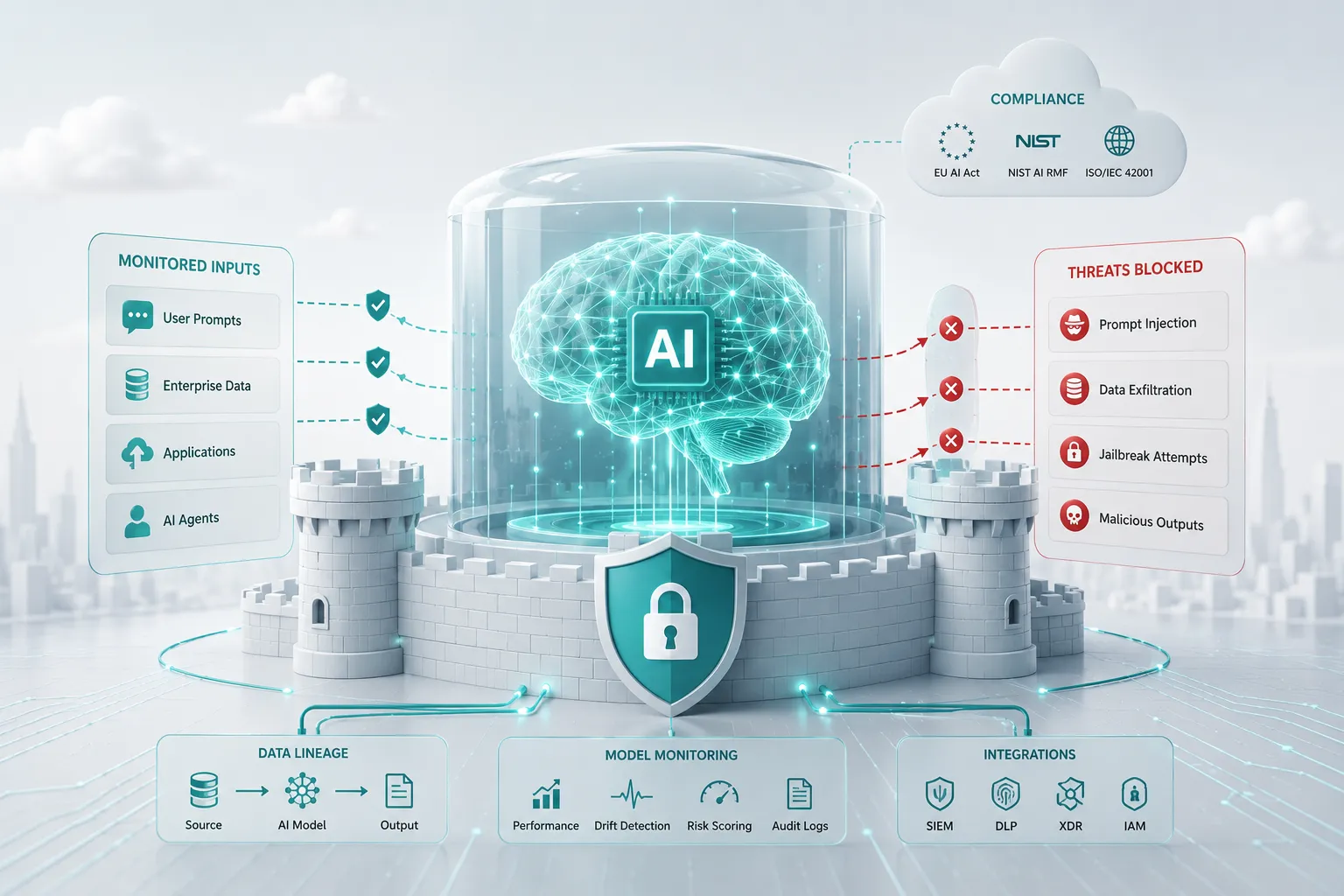
These solutions provide continuous visibility into AI environments by monitoring models, tracking sensitive data, identifying unauthorized AI usage, enforcing governance policies, and detecting suspicious behavior before it turns into a serious incident.
Rather than replacing existing cybersecurity infrastructure, AI security platforms strengthen it by adding intelligence specifically designed for AI-powered environments.
What Modern AI Security Platforms Actually Do
A mature AI security platform gives organizations the ability to understand and secure every stage of the AI lifecycle.
Instead of treating AI as another application, these platforms monitor how AI systems operate, who uses them, what data flows through them, and whether those interactions comply with organizational policies.
Core capabilities often include:
- Automatic discovery of AI models and AI-powered applications
- Detection of unauthorized or "shadow AI" usage
- Real-time monitoring of prompts and responses
- Sensitive data classification and protection
- Continuous vulnerability testing through AI red teaming
- Governance policies for autonomous AI agents
- Compliance reporting for evolving AI regulations
This comprehensive visibility allows organizations to innovate confidently while reducing security and compliance risks.
Security and Governance Must Grow Together
Technology alone isn't enough.
Organizations also need clear governance frameworks that define how AI should be used, who owns AI risk, and how sensitive information should be protected.
As governments introduce new AI regulations and industry standards continue to evolve, businesses can no longer treat AI governance as an optional initiative.
Security teams, compliance leaders, developers, and executive leadership must work together to establish responsible AI practices before problems occur.
This growing need for collaboration explains why many professionals are attending an AI and Cybersecurity Conference to learn directly from security experts, technology vendors, and enterprise leaders implementing AI at scale.
These events provide practical insights into emerging threats, governance strategies, regulatory changes, and real-world implementation experiences that organizations can apply immediately.
Learning from the Experts Matters More Than Ever
The AI threat landscape changes almost daily.
Attack techniques evolve rapidly, regulations continue to develop, and new AI capabilities introduce risks that didn't exist even a year ago.
Reading reports and following industry blogs is valuable, but nothing replaces direct conversations with practitioners facing these challenges every day.
That's one reason Cybersecurity conferences 2026 are expected to focus heavily on AI governance, model security, Zero Trust architectures, runtime monitoring, and secure AI deployment.
These conferences give organizations an opportunity to learn from successful implementations, compare security platforms, understand vendor capabilities, and prepare for future threats before they become widespread.
For many businesses, the insights gained from these events can help avoid costly mistakes and accelerate secure AI adoption.
Building a Secure AI Future
AI isn't slowing down.
Organizations will continue integrating intelligent systems into customer service, software development, finance, healthcare, manufacturing, and countless other business functions.
The question is no longer whether businesses should adopt AI.
The real challenge is whether they can do so safely.
Organizations that combine innovation with strong governance, continuous monitoring, employee awareness, and specialized AI security platforms will be far better positioned to earn customer trust and remain resilient against emerging cyber threats.
Those that ignore AI security may discover that the technology driving their growth also becomes their greatest vulnerability.
As AI continues reshaping every industry, investing in security is no longer just an IT responsibility—it's a business imperative.
If your organization is preparing its AI roadmap or strengthening its cybersecurity strategy, staying informed is essential. Following expert insights, evaluating modern AI security platforms, and participating in leading AI and Cybersecurity Conference events and Cybersecurity conferences 2026 can help you make smarter decisions, reduce risk, and confidently embrace the future of enterprise AI.



























Sign in to leave a comment.