

Insurance companies are under immense pressure to deliver quality customer service and stay regulatory compliant without letting operational costs spiral out of control. They need speed and flexibility to effectively adapt to economic, geopolitical, and climate-related uncertainties. Not to forget the technological advancements that are creatively disrupting the insurance industry.
Manual, paper-based workflows have long helped insurers; however, these prove ineffective today. Insurance carriers, brokers, and adjusters need “intelligent” ways to continue being the source of financial security in a dynamic environment where uncertainty looms large. That said, adopting AI-based insurance solutions is the right move!
From reducing risks to optimizing operations, AI-powered insurance solutions can handle it all. That's why global AI software spending in the insurance market is forecasted to reach USD 15.9 billion by 2027 from USD 9.5 billion in 2024, with a five-year CAGR of 18.2%. These bring significant value, helping companies strive and thrive in the intensely competitive insurance market. Let's get started.
What Are the Key Benefits of AI in Insurance?
AI delivers measurable value in almost every domain and vertical, and insurance is no exception. It can efficiently handle tasks from claims to compliance, helping organizations remain agile and nimble. It makes the insurance services quicker and more efficient. Let's explore the benefits in detail:
1. Quicker Claim Handling
Processing claims traditionally required days. Thanks to AI-based systems, claims can be reviewed in minutes today. Automated tools scan papers using optical character recognition (OCR) technology and extract key details quickly. Image recognition models assess property damage from photos, enabling almost instant checking of auto or home insurance claims. Simple claims can be reviewed and approved instantly, eliminating the need of human intervention and significantly reducing customer waiting time.
2. Improved Risk Assessment
ML algorithms analyze vast volumes of past and present data to identify hidden patterns that the human eye might miss. This results in more accurate risk assessments. Insurance companies can set fair policy prices and avoid high-risk customers. What’s new is that insurers can now use data from wearable devices, smart homes, and connected cars to improve underwriting and personalize coverage.
3. Proactive Fraud Detection and Prevention
AI-based insurance solutions can identify suspicious patterns in claims data and flag potentially fraudulent activities immediately. They compare new claims against known fraud indicators. More advanced models can also identify previously unknown anomalies, saving companies a million dollars annually. The best part is that detection accuracy improves through ongoing learning and feedback loops. Thus, insurers can switch from a reactive to a proactive approach, thereby preventing losses.
4. Enhanced Customer Service
Chatbots and virtual assistants offer 24X7 customer support. They can answer common queries instantly without human help, boosting customer satisfaction and reducing service costs. In the case of complex issues, they direct those to human agents. Some insurers also utilize AI to assess customer sentiment and adjust service priorities in real time.
5. Personalized Policy Recommendations
AI analyzes each customer's data, including personal circumstances, online behavior, and recent life events such as marriage, relocation, and job changes, to recommend the most suitable policies. This leads to a more personalized insurance experience for every client. When customers get policies that meet their needs, conversion rates and profits skyrocket
In addition to all these benefits, insurance AI solutions also help save costs. Companies can automate repetitive insurance tasks, allowing agents and adjusters to focus on what matters the most: providing valuable services and strengthening policyholder relationships. However, adopting AI solutions is easier said than done. .Let’s understand the challenges to AI adoption in the insurance industry.
What Challenges Do Insurers Face When Adopting AI?
Adopting AI solutions in insurance companies is no easy feat. Common hurdles include financial limitations, technical issues, and employee resistance. The good thing is that all these issues can be addressed so that companies can make the most of insurance AI solutions:
I. High Setup Costs
Challenge – Implementing AI-based insurance solutions demands substantial initial investment. Insurance companies must purchase new software and hardware. Not forgetting that training expenses also add to the total cost. This is a challenge for businesses with tight budgets.
Solution – Even though the benefits of AI solutions for insurance companies are significant, businesses must not overwhelm themselves. Instead, a smart approach is to begin with small pilot programs to test AI effectiveness. For instance, insurers can initially focus on specific areas, such as chatbots for customer service and then gradually move to other departments. Before diving deeper, calculate the long-term savings to back up initial costs.
II. Data Quality and Integration Issues
Challenge – Different departments use separate databases that don't communicate effectively, creating silos. Connecting legacy and modern systems creates technical challenges. Moreover, the data stored is often inaccurate, inconsistent, and redundant. Poor data quality leads to inaccurate AI predictions.
Solution – Invest in data cleaning and standardization before AI implementation. To break silos, create unified data warehouses that integrate all systems and establish data governance rules to maintain consistent quality standards. Another good practice to ensure data accuracy is to perform regular audits.
III. Regulatory Compliance Concerns
Challenge - Insurance companies operate under strict regulatory rules in most countries. Their data privacy laws limit how customer details can be used. Most importantly, AI decisions must be transparent and explainable to regulators. Failing to do so leads to hefty fines and lawsuits.
Solution – One way is to work closely with legal teams to understand rules and regulations and operate accordingly. Another important move is to involve compliance experts when designing systems to ensure they can adapt over time. Organizations must use AI tools that provide clear reasons for decisions using XAI systems.
IV. Technical Complexity and System Integration
AI solutions for insurance brokers require a complex setup across many platforms. Existing systems might not be compatible with new AI tools. Moreover, integration issues can cause system outages and operational disruptions. Overseeing all these aspects and ensuring ongoing maintenance requires technical expertise.
Solution – Before selecting AI solutions, insurance companies must conduct thorough system assessments. Partnering with dedicated service providers can help. They ensure smooth transitions and create backup systems to cut business downtime. Besides, rolling out the implementation step-by-step helps reduce business disruption.
Overcoming these challenges requires careful planning and strategic thinking. Companies must commit resources and leadership support for successful AI adoption. The benefits far outweigh the initial difficulties when properly managed. Success depends on taking a systematic approach to implementation.
Where Is AI Making the Biggest Impact in Insurance?
Real-world applications of AI solutions for insurance companies prove their potential value. Each use case addresses specific business challenges while delivering measurable results. Understanding these applications enables insurers to identify the best opportunities for AI investment. Let's take a look:
Automated Underwriting and Risk Assessment
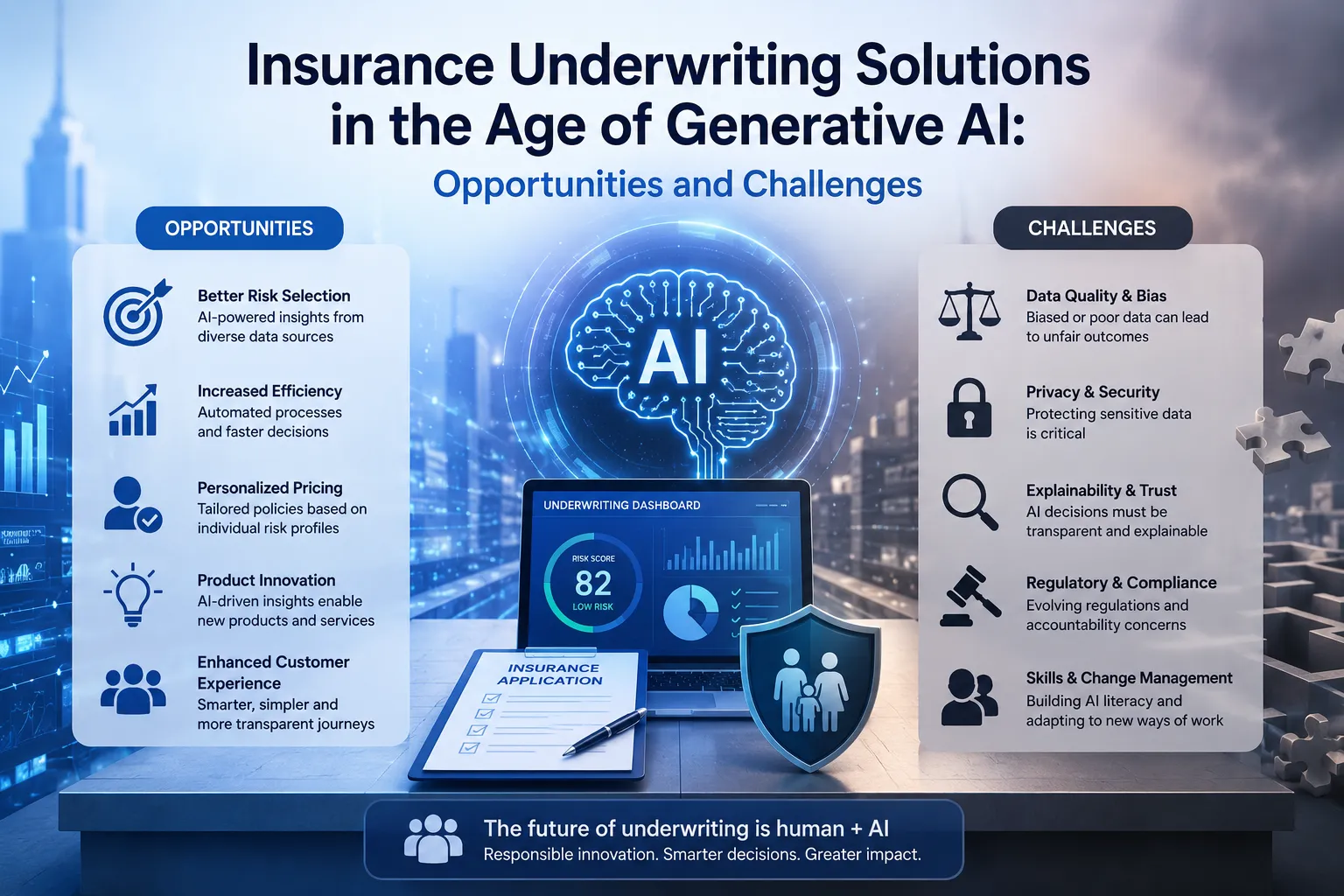
AI systems analyze applicant data to determine insurance eligibility. They review credit scores, medical records, and lifestyle factors simultaneously. ML models predict claim likelihood based on historical patterns, reducing underwriting time from weeks to hours.
Insurance companies can process more applications with fewer human underwriters. The system identifies high-risk applicants that require additional review. Consistent decision-making eliminates human bias from the underwriting process. Companies achieve better risk selection and improved profitability through automation.
Predictive Analytics for Dynamic Pricing
Advanced algorithms analyze market trends and customer behavior patterns in real time to adjust pricing strategies. They consider multiple factors, including weather patterns and economic conditions, to determine the appropriate premium. Thus, insurance companies can remain competitive while maintaining profitability.
Furthermore, predictive models help accurately forecast claim volumes and seasonal variations . This insight enables companies to prepare resources and set up appropriate reserves. Risk-based pricing ensures that customers pay fair premiums for their coverage. The technology enables more precise actuarial calculations than traditional methods.
Customer Behavior Analysis and Retention
AI systematically monitors customer interactions across all communication channels. The system identifies customers who are likely to cancel their policies. Behavioral analysis reveals preferences and satisfaction levels for each client. Companies can take proactive steps to improve customer retention rates.
Sentiment analysis tools can process conversations and feedback in real time to assess satisfaction. Personalized marketing campaigns effectively target specific customer segments. AI recommends cross-selling opportunities based on individual needs. Customer lifetime value predictions help prioritize service investments appropriately.
Telematics and Usage-Based Insurance
Smart devices track driving behavior and provide real-time feedback to policyholders. AI algorithms analyze acceleration patterns, braking habits, and speed variations. Safe drivers receive premium discounts based on their actual driving performance. This creates incentives for safer driving behaviors across the insured population.
The technology enables pay-per-mile insurance products for low-mileage drivers. Fleet insurers use aggregated driving data to adjust premiums and reduce loss ratio. Telematics data from the time of the incident helps verify claims. Insurance becomes fairer and more personalized through actual usage measurement.
Regulatory Reporting and Compliance Automation
AI systems generate required regulatory reports from operational data and ensure compliance with changing regulations. Automated monitoring identifies potential compliance issues before they become problems. This reduces the risk of regulatory penalties and improves operational efficiency.
Document management systems organize and store compliance records. AI-powered audit trails and version-controlled logs improve transparency and simplify regulator interactions. Companies can focus resources on strategic activities rather than manual compliance paperwork.
Closing Thoughts
To sum up, AI solutions for insurance help strive and thrive in the market, irrespective of the circumstances, and companies must act now to remain competitive. The ones who delay AI adoption are often left behind by more innovative competitors. The transformation has already begun across the industry globally. The future belongs to companies that integrate AI into their operations.































Sign in to leave a comment.