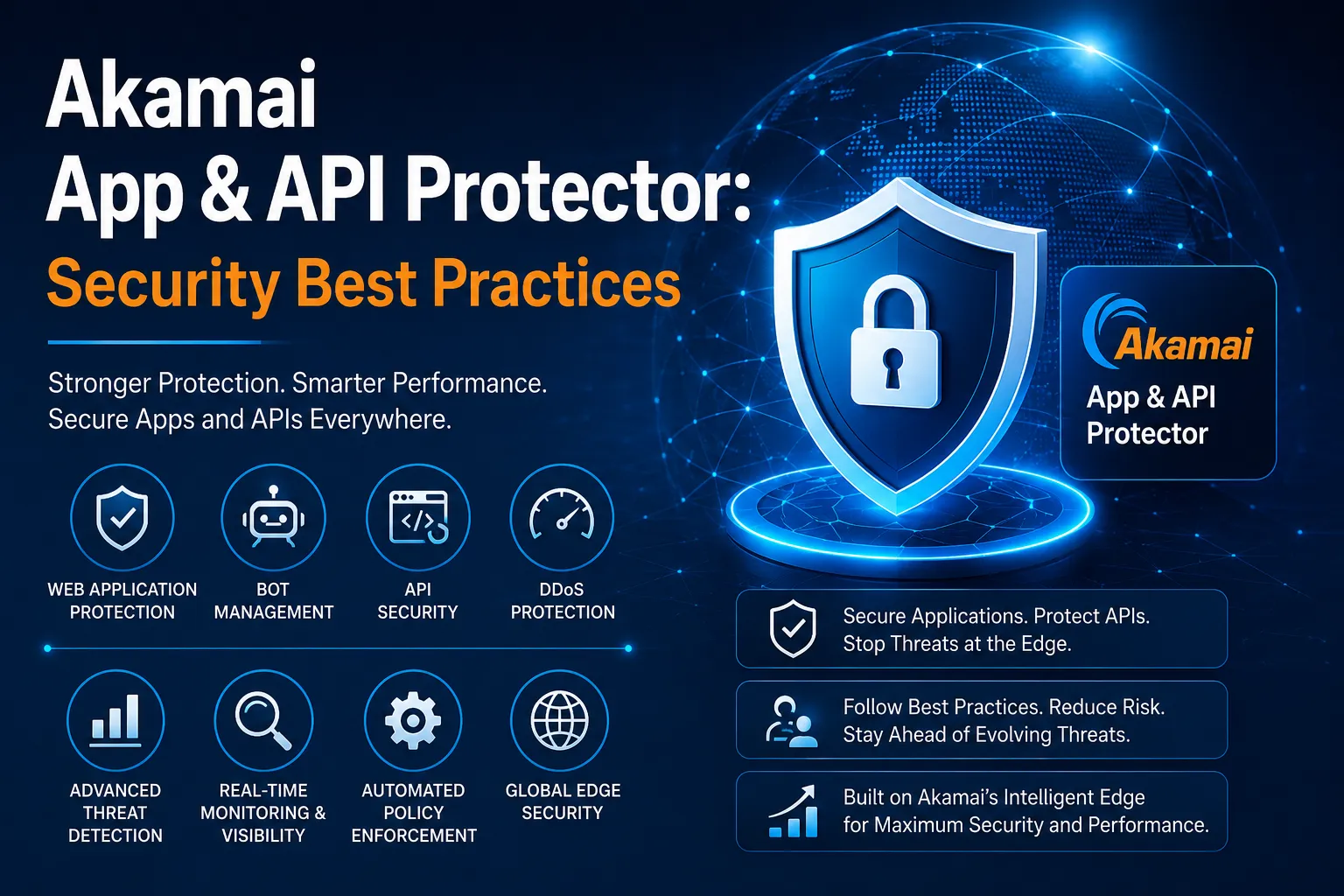

I've spent over a decade deploying Akamai security solutions for enterprises across the US and Canada. I've worked with financial institutions, healthcare systems, retailers, and SaaS companies.
And I'll tell you this plainly: the difference between a secure deployment and a breach is almost never the product itself. It's how you configure, tune, and manage it.
Akamai App & API Protector is one of the most powerful security platforms on the market. But raw power without proper implementation leaves organizations dangerously exposed. This guide shares the best practices I've learned, the ones that actually make a difference at 2 AM when an attack hits.
- 65% of organizations misconfigure their WAF on initial deployment
- 3× more API attacks in 2024 vs. the prior year
- 47% of web traffic is now bot-driven, not human
1. Why Proper Akamai App & API Protector Setup Is Critical
Out-of-the-box configurations are starting points. They are not finish lines. I've seen enterprises go live with default rulesets and spend the next six months drowning in false positives or worse, operating in detect-only mode while real attacks slip through.
Proper Akamai App & API Protector setup matters for three reasons:
- Your application is unique. Your login flows, parameter structures, and API schemas don't match a default template. The WAF needs to understand your traffic before it can defend it effectively.
- False positives kill adoption. Security teams get pressured to open exceptions when legitimate traffic gets blocked. Those exceptions accumulate. Your policy erodes silently.
- Attack surfaces shift constantly. A configuration that was right at go-live may be dangerously stale six months later as your app evolves.
The foundation of a strong Akamai security services deployment is a phased approach: detect, analyze, tune, then enforce. Skipping phases is the most expensive mistake an organization can make.
Pro Tip:- Always start in Alert mode, not Deny mode. Run in Alert for at least 2–4 weeks across all traffic environments, including staging and non-prod, before moving rules to Deny. Use that time to map your application's legitimate traffic signatures. You'll thank yourself later.
2. WAF Tuning: Getting Akamai WAF Best Practices Right
Akamai web application firewall tuning is an ongoing discipline, not a one-time task. Here's what I recommend consistently across every enterprise engagement:
Start With Your Attack Surface
Map every publicly accessible URL path, parameter, header, and content type. Akamai's security configuration allows rule groups to be applied at the path level. Use this. Apply strict rules to your login and payment flows. Apply lighter rules to low-risk paths like static asset serving.
Leverage Adaptive Security Engine
Akamai App & API Protector includes an Adaptive Security Engine that auto-tunes based on threat intelligence. Don't ignore it. Configure it, feed it context about your application, and review its recommendations quarterly. It learns - but only if you teach it.
Tune Exception Lists Carefully
- Scope every exception to the narrowest match condition possible.
- Document every exception with a business justification and a review date.
- Audit your exception list every 90 days. Unused exceptions are an attack surface.
- Never create wildcard exceptions for entire URL paths without time-limiting them.
Network Lists and Geo-Based Controls
Use Akamai's network lists to manage trusted IPs (internal offices, partners, monitoring tools) and to block known-bad geographies. Pair geo-controls with rate limiting, don't rely on either alone.
Pro Tip:- Pull your WAF alert logs weekly for the first three months after deployment. Look specifically for rules that trigger more than 1,000 times a day on clean traffic. Those are your tuning targets. Fix them fast - they train your team to ignore alerts, and that's how breaches happen without anyone noticing.
3. Akamai API Security Best Practices
APIs are the fastest-growing attack surface in enterprise environments. Akamai API security capabilities inside App & API Protector are among the strongest available, but they require deliberate configuration.
Define Your API Schema
Import your OpenAPI/Swagger specifications into Akamai's API Gateway integration. This enables positive security model enforcement, only requests that match your defined schema are allowed through. This alone eliminates a significant class of injection and enumeration attacks.
Enforce Rate Limiting Per Endpoint
Generic rate limiting is not enough. Different API endpoints have very different normal traffic patterns. Define per-endpoint rate limits based on observed baselines. A credential-stuffing attack against your /auth/login endpoint looks different from a scraping attack against your /products endpoint. Treat them differently.
Watch for Shadow APIs
This is one of the most dangerous and underappreciated risks I encounter. Organizations have APIs exposed in production that are undocumented, unmonitored, and unprotected. Akamai's API Discovery capability can surface these. Run it, review the output, and make shadow APIs a standing agenda item for your security reviews.
API Security Checklist
- Schema validation enforced for all production API endpoints
- Rate limiting configured per endpoint, not just globally
- API authentication tokens validated at the edge not just the origin
- Sensitive data types (PII, PCI fields) flagged and monitored in responses
- API discovery scans run monthly
Pro Tip:- Enable API discovery and run it immediately after any major release cycle. Dev teams add endpoints fast. Security teams find out about them slowly. Closing that gap is where Akamai API security earns its value most clearly.
4. Akamai Bot Protection That Actually Works
Almost half of internet traffic is non-human. But not all bots are threats. Misclassifying good bots (search crawlers, uptime monitors) as bad ones creates operational problems. Misclassifying bad bots (credential stuffers, scrapers) as good ones creates security incidents.
Categorize Before You Block
Akamai bot protection uses behavioral fingerprinting, device signals, and threat intelligence to categorize bots. Spend time on the categorization rules before you move to enforcement. Know what's hitting your site before you decide what to do about it.
Common Bot Threats I See
- Credential stuffing: Automated login attempts using leaked username/password lists. Block at the edge with Akamai's Bot Score thresholds on authentication endpoints.
- Content scraping: Competitors or data brokers harvesting your product data. Rate limit and serve decoy content to manipulate scraper behavior.
- Carding attacks: Testing stolen card data through your checkout flow. Layer bot protection with transaction rate limits and step-up challenges.
- Ad fraud bots: Inflating click counts on your ad placements. Akamai's bot telemetry can identify and report these without disrupting real users.
Challenge vs. Block Decisions
Not every bot response should be a hard block. Soft challenges (JavaScript challenges, invisible CAPTCHAs) can neutralize automated traffic without impacting human users who trigger false positives. Design your response hierarchy deliberately: rate limit → challenge → block.
Pro Tip:- Always allowlist your internal monitoring tools, synthetic testing agents, and SEO crawlers before enabling bot enforcement. I've seen organizations accidentally block their own uptime monitors on launch day. It's an avoidable, embarrassing problem with a five-minute fix.
5. Monitoring, Alerting & Ongoing Policy Optimization
Akamai edge security services generate enormous volumes of telemetry. The organizations that benefit most are the ones that build structured processes around that data, not the ones who treat it as a log archive.
Build a Security Operations Rhythm
- Daily: Review active threat dashboards. Verify no new denial rules have unexpected high false-positive rates.
- Weekly: Analyze WAF alert trends. Identify rules with unusual trigger spikes.
- Monthly: Full policy review exception lists, rate limit thresholds, API schema accuracy, bot categorization rules.
- Quarterly: Engage Akamai's threat intelligence advisories. Adjust policy based on emerging attack patterns in your industry vertical.
SIEM Integration Is Non-Negotiable
Akamai's log delivery service should feed directly into your SIEM - Splunk, Microsoft Sentinel, CrowdStrike, or whatever platform you run. Siloed logs are useless logs. Correlate WAF events with endpoint detection, identity logs, and network telemetry for meaningful threat context.
Incident Response Readiness
Have a documented runbook for common Akamai alert types. Know in advance who has authority to escalate rules from Alert to Deny during an active attack. Decisions made under pressure with no pre-agreed playbook are where organizations make mistakes that cost them.
6. Common Mistakes That Undermine Akamai Application Security
I've seen the same mistakes repeated across industries. Here are the ones worth calling out directly:
- Set-and-forget deployments. Akamai is not a fire-and-forget tool. Applications change. Attack patterns change. Policies must evolve with them.
- No ownership of the WAF policy. If no one owns the WAF configuration, everyone ignores it. Assign a named owner with quarterly review accountability.
- Blanket exception policies. When DevOps asks for an exception to unblock a feature, the answer is never "except this entire path." It's "except this specific parameter under these specific conditions."
- Skipping staging environment coverage. Security policies should be tested in staging before production changes. Many organizations skip this and discover problems the hard way.
- Not using Akamai's threat intelligence feeds. Akamai sees more internet traffic than almost any other provider. Their threat intelligence is one of the best signals available. Use it actively, not passively.
- Treating managed WAF services as a commodity. Who manages your WAF matters as much as which WAF you use. Experienced Akamai security consultants will catch things a generalist team misses.
Pro Tip:- Run a WAF health check every six months. Pull your current exception list, compare it against your current application architecture, and delete everything that no longer applies. Exception list sprawl is one of the most common security hygiene failures I find during Akamai security assessments, and one of the easiest to fix.
How Evolvous Helps Organizations Deploy & Optimize Akamai Security
At Evolvous, our team has deep, hands-on experience implementing and managing Akamai security solutions for enterprises across North America. As an Akamai consulting partner, we work alongside CISOs, security architects, and DevSecOps teams to translate Akamai's capabilities into real-world protection.
Here's specifically what we help organizations with:
- Akamai App & API Protector setup and deployment - From initial architecture review through phased go-live, we handle the complexity so your team doesn't have to learn it by trial and error.
- WAF policy tuning and false positive reduction - We analyze your application traffic, identify high-noise rules, and build exception logic that's tight, documented, and defensible.
- API security configuration - Schema import, endpoint discovery, rate limit design, and shadow API remediation, all aligned to your development lifecycle.
- Bot protection strategy - We design and implement bot management policies that protect against credential stuffing, scraping, and fraud without impacting legitimate users or SEO crawlers.
- Managed WAF services - For organizations that don't have the internal bandwidth to run a continuous WAF optimization program, we provide ongoing policy management, monitoring, and incident support as an extension of your security team.
- Akamai security assessments - We conduct structured reviews of existing Akamai configurations to identify gaps, misconfigurations, and optimization opportunities, especially valuable before a major audit, compliance deadline, or application launch.
- Akamai edge security services integration - We help organizations connect Akamai's edge telemetry into their SIEM, build correlation rules, and establish operational rhythms that make security data actionable.
We don't believe in handing over a configuration document and walking away. Akamai security is an ongoing practice. We work with clients on a continuous basis - tuning, reviewing, and improving policies as applications and threats evolve.
Pro Tip from Our Consulting Team
Before your next Akamai renewal or expansion, schedule a policy health check. In our experience, most organizations with 12+ months of runtime have accumulated exception sprawl, outdated API schemas, and unreviewed bot categories. A structured audit typically uncovers meaningful coverage gaps - and resolves them faster than an incident would.























Sign in to leave a comment.