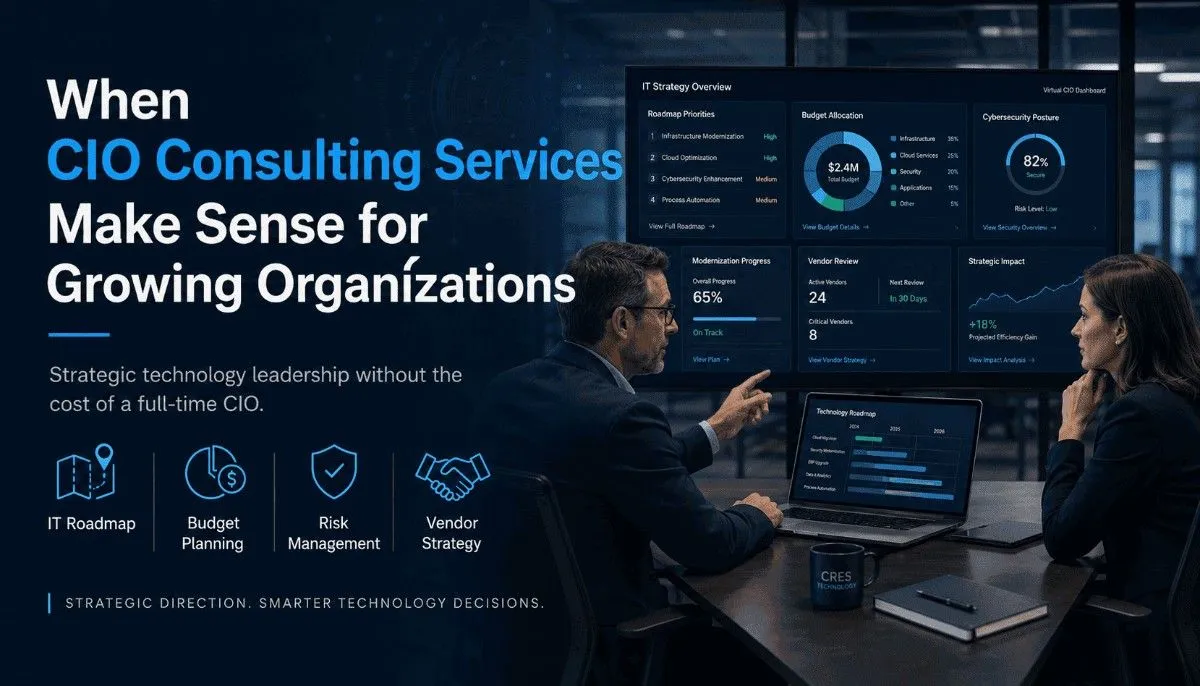

Technology decisions increasingly affect revenue, risk, customer experience, compliance, workforce productivity, and business continuity. Yet many growing organizations do not need, or cannot justify, a full-time chief information officer.
The absence of a CIO does not remove the need for technology leadership. It often means those responsibilities are distributed across the CEO, CFO, COO, office manager, IT manager, or external vendors. That arrangement may work for a period, but it can become difficult as the organization grows, adopts more systems, faces greater cybersecurity risk, or prepares for expansion.
CIO consulting provides senior-level technology guidance without requiring the organization to immediately build a full executive IT function.
Technology Strategy Should Follow Business Strategy
A technology roadmap should not begin with products. It should begin with business priorities.
If the organization plans to expand into new markets, acquire another company, introduce a new service, improve margins, strengthen compliance, or support remote teams, technology decisions should reflect those goals. Otherwise, IT investments become disconnected projects with unclear value.
An experienced CIO advisor helps leadership translate business objectives into technology priorities. This may include infrastructure modernization, application planning, cybersecurity improvements, data governance, automation, staffing, vendor strategy, and budget allocation.
Organizations evaluating CIO consulting services should look for advisors who can communicate with both executives and technical teams. The role requires business judgment as well as technology knowledge.
A Roadmap Creates Sequence and Discipline
Many organizations have a long list of technology needs but no clear order of execution. Security improvements compete with system upgrades, user complaints, automation projects, compliance requirements, and infrastructure replacement.
A CIO consultant can help assess the current environment, identify business and technical risks, and create a phased roadmap. The roadmap should distinguish between urgent actions, foundational improvements, and longer-term strategic initiatives.
This sequencing matters because technology projects often depend on one another. An organization may want advanced automation, but first need better data quality, identity controls, or process documentation. It may want to migrate systems, but first need to address integration, licensing, or business continuity concerns.
A realistic roadmap prevents the company from launching too many disconnected projects at once.
Budgeting Requires More Than Reviewing Vendor Quotes
Technology budgets are often built by renewing existing contracts and adding new requests. That approach can preserve unnecessary tools, overlapping services, and outdated assumptions.
CIO-level planning connects spending with business priorities, risk, lifecycle needs, and expected outcomes. It considers operating expenses, capital investments, staffing, licensing, cybersecurity, device replacement, cloud consumption, support contracts, and project costs.
The advisor should help leadership understand where cost reduction is reasonable and where underinvestment creates risk. The cheapest option may increase downtime, security exposure, or future migration cost. The most expensive option may include capabilities the organization does not need.
Good technology budgeting is not about minimizing spend. It is about allocating spend intentionally.
Vendor Management Needs Executive Oversight
Organizations often rely on multiple technology vendors for managed services, cybersecurity, cloud platforms, telecommunications, software, hardware, and specialized projects. Each vendor may perform its own scope well while the overall environment remains fragmented.
A CIO consultant can help define responsibilities, review service performance, challenge unclear recommendations, coordinate dependencies, and reduce gaps between providers. This is especially important when vendors have overlapping responsibilities or when no internal leader has the time to manage them closely.
Cybersecurity Requires Business Decisions
Cybersecurity is not only a technical topic. Leaders must decide which risks are acceptable, which controls are required, how much to invest, and how the organization will respond to an incident.
A CIO advisor helps translate technical findings into business impact. Instead of presenting a long list of vulnerabilities, the advisor should explain which issues affect critical operations, sensitive data, compliance obligations, or recovery capability.
The role may include developing a security roadmap, reviewing identity and access practices, evaluating endpoint protection, assessing backup readiness, supporting policy development, and coordinating incident response planning.
The advisor should not promise that risk can be eliminated. The objective is to make risk visible, reduce exposure, and improve preparedness.
Growth Often Reveals Governance Gaps
As companies grow, technology decisions become more decentralized. Departments purchase applications, teams create their own data processes, and users adopt tools without considering integration, security, or long-term ownership.
This creates shadow IT, duplicate systems, inconsistent data, and unclear accountability. CIO consulting can introduce practical governance without creating unnecessary bureaucracy.
Governance may include standards for purchasing, system ownership, access approvals, data retention, vendor review, project prioritization, and architecture decisions. The goal is to help the organization move faster with fewer avoidable problems.
CIO Consulting Can Strengthen Internal IT Leadership
An external CIO advisor should not undermine the internal IT team. In a healthy model, the advisor helps internal leaders gain executive alignment, secure budget, prioritize work, and connect technical needs to business outcomes.
The internal team often has detailed knowledge of systems and users. The advisor contributes broader planning, executive communication, vendor management, risk framing, and cross-functional coordination.
The Engagement Should Produce Tangible Outputs
CIO consulting should create more than meetings and high-level advice. Useful outputs may include a current-state assessment, prioritized roadmap, budget model, risk register, vendor review, cybersecurity plan, governance framework, project portfolio, and executive reporting cadence.
The exact deliverables depend on the organization, but responsibilities and outcomes should be clear. Leadership should know what decisions the advisor will support, how progress will be measured, and when priorities will be reviewed.
Final Perspective
CIO consulting makes sense when technology decisions have become too important, complex, or interconnected to manage informally. The organization may not need a full-time CIO, but it still needs someone to connect business strategy, technology investment, cybersecurity, vendors, governance, and execution.
For IT decision-makers and executive teams, the right advisor brings structure to decisions that otherwise remain reactive. The result should be a clearer roadmap, better accountability, more disciplined spending, and stronger alignment between technology and business growth.



























Sign in to leave a comment.