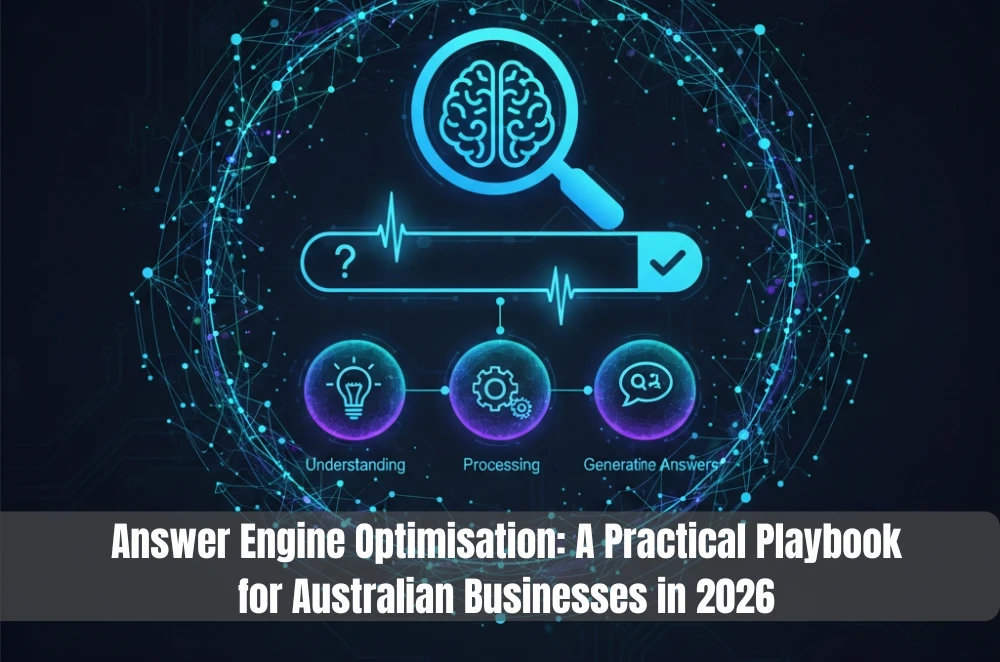

The fastest way to waste time with “AEO” is to treat it like a shiny new acronym that replaces the basics.
Answer Engine Optimisation is really about making it easy for modern search and AI-driven answer experiences to understand, trust, and reuse your content.
If the only thing that changes is the words on your proposal, nothing meaningful will change in results.
What does change is how you structure information, how you prove you’re a credible source, and how you measure what’s working.
What AEO is (and what it isn’t)
AEO is the practice of shaping your content so it can be selected, summarised, and cited in answer-style interfaces: search results that show direct answers, AI overviews, voice assistants, and chat-style tools.
It is not a shortcut around brand-building, product quality, or good customer experience.
It also isn’t “sprinkling AI keywords” into copy, or forcing FAQ blocks onto every page regardless of intent.
AEO sits at the intersection of classic SEO, helpful content design, and technical clarity: the goal is to be the page that can be confidently used to answer a specific question.
Where answers come from: content, entities, and trust signals
Answer systems typically assemble responses from sources that are both relevant and reliable.
Relevance is about matching the question: your page has to clearly indicate what it covers, who it’s for, and what problem it solves.
Reliability is about demonstrating credibility: clear authorship and expertise signals, consistent business details, accurate claims, and content that matches real-world expectations.
This is where “entities” matter in plain English: people, organisations, locations, services, and concepts need to be described consistently so systems can connect the dots.
If your business name, service descriptions, and location signals are inconsistent across your site, it’s harder for an answer engine to trust it’s understood you correctly.
Make pages answer-worthy, not just “optimised”
AEO-friendly content usually has a few traits that editors also like: it’s specific, structured, and easy to verify.
Start by picking one high-intent question per page and answering it cleanly near the top, then expand with supporting detail.
Use headings that mirror how people actually ask questions, and keep paragraphs short enough that a skimmer can still understand the point.
Include decision support: constraints, trade-offs, and when a solution is not a fit.
When you remove vague marketing language, you create room for the kind of concrete explanation answer engines prefer to reuse.
Common mistakes that stop pages being chosen as answers
AEO failures are often boring, not technical.
Mistake 1: One page tries to answer everything.
A “services” page that covers 12 topics rarely becomes the best answer to any single question.
Mistake 2: Copy hides the actual answer.
If the first 300 words are positioning statements, the system (and the human) struggles to extract a clean response.
Mistake 3: You don’t define terms.
If you use industry jargon without a plain-English definition, you miss the chance to be the page that clarifies the topic.
Mistake 4: Thin FAQs that repeat headings.
Questions that are just keyword variations with two-line answers look like filler and don’t help real intent.
Mistake 5: No proof you’re a real, reliable business.
Missing team info, unclear service areas, inconsistent contact details, or outdated policies quietly erode trust.
Mistake 6: You can’t tell what worked.
If measurement is only “rankings went up”, you can’t connect content changes to enquiries, calls, or qualified leads.
Decision factors: DIY vs agency vs hybrid (and what to check)
AEO is deceptively cross-functional: content, SEO fundamentals, and web implementation need to work together.
Here’s how to decide the approach without overthinking it.
DIY makes sense when…
You have someone who can write clearly, understand customer questions, and consistently ship improvements.
You’ll still need a basic technical check so your best pages aren’t undermined by crawl or index issues.
DIY works best for businesses with a narrow service set and a strong grasp of customer language (what people ask on calls, emails, and quotes).
Agency-led makes sense when…
You need speed, internal capacity is thin, or you’ve tried “content updates” without traction.
A good partner should be able to explain the why, not just the what, and map work to business outcomes.
If you want a structured reference before briefing an internal team or an external partner, the Nifty Marketing Australia AEO service guide is a useful baseline for scoping what to fix first.
Hybrid is often the most realistic
Many Australian businesses do best with a hybrid model: internal expertise for product truth and customer nuance, plus external support for strategy, technical execution, and ongoing iteration.
The key decision factor is not “who writes the content”, but “who owns the system”: question research, page standards, refresh cadence, and measurement.
The simplest AEO measurement that actually helps
AEO measurement gets messy when it becomes a hunt for one perfect metric.
In most cases, you want a small dashboard that answers three questions: are you being seen, are you being chosen, and is it turning into business?
- Seen: impressions and visibility for question-led queries (in Search Console-type data if available)
- Chosen: clicks, engagement, and whether the page matches intent (time on page can mislead; look at next actions)
- Business impact: enquiries, calls, quote requests, demos, bookings, or qualified lead rate by page/topic
The real unlock is tagging your content by “question theme” so you can see which questions produce the best leads, not just the most traffic.
A simple first-actions plan for the next 7–14 days
This is a tight plan designed for momentum, not perfection.
Days 1–2: Gather the real questions
Pull questions from sales calls, inbox enquiries, chat logs, and “how much does it cost” conversations.
Write them exactly as customers say them, including awkward phrasing and local context.
Group them into themes: pricing, process, timelines, risks, comparisons, and “is this right for me”.
Days 3–5: Pick three pages to become “best answers”
Choose one money-intent page (service), one trust page (about / credentials), and one explainer page (a question-led guide).
For each page, write a one-sentence purpose: “This page helps a person decide X by answering Y.”
Add a short “direct answer” section near the top, then build the supporting detail underneath with clear headings.
Days 6–9: Fix credibility signals and consistency
Check that your business name, address/service areas, contact details, and key claims are consistent across the site.
Refresh outdated statements and remove claims you can’t back up in plain language.
Make sure each important page can be understood without clicking around five times to learn what you actually do.
Days 10–14: Improve structure and extraction
Rewrite headings so they sound like questions or decisions, not internal marketing categories.
Add a small “How to choose” section where relevant, including trade-offs and constraints.
Create or expand FAQs only where they solve real follow-up intent, not as a template requirement.
Operator experience moment
When teams start chasing “AI visibility”, they often jump straight to rewriting everything at once.
In practice, the biggest wins usually come from turning a small set of pages into clear, structured answers and then tightening trust signals site-wide.
Once the content becomes easier to extract, internal debates shift from “what should we rank for” to “what questions should we be the best at answering”.
Local SMB mini-walkthrough: how an Australian service business can apply this
Start with the top 20 questions that come up in quotes and phone calls.
Split them into “before they contact you” and “after they contact you” questions.
Choose one suburb/city service area page and make it genuinely specific (coverage, typical timelines, common constraints).
Add plain-English pricing guidance where you can, even if it’s ranges and what changes the cost.
Create one “what to expect” process page so people can self-qualify before they call.
Make sure your ABN/business details and contact options are consistent across key pages.
Practical opinions
Prioritise the questions that lead to revenue, not the ones that make a traffic graph look good.
One excellent “best answer” page beats ten generic “SEO pages” every month of the year.
If you can’t measure outcomes, you’re guessing—even if rankings improve.
Key Takeaways
- AEO is about being the clearest, most trustworthy answer to specific customer questions.
- Structure matters: direct answers, decision-support headings, and scannable sections help both humans and systems.
- Credibility signals and consistency across your site can be the difference between being selected or ignored.
- Start small: upgrade three pages, measure impact, then expand with a repeatable workflow.
Common questions we hear from Australian businesses
How is AEO different from SEO?
Usually, SEO focuses on overall visibility and rankings, while AEO focuses on being selected as the direct answer to a specific question.
A practical next step is to pick one high-intent question and rewrite the top section of the relevant page as a clear “direct answer”.
In Australia, this often works best when you include local service constraints (travel radius, lead times, compliance requirements) in plain English.
Do we need to create content for every question customers ask?
It depends on how often the question comes up and whether it affects purchase decisions.
A practical next step is to group questions into themes and build one strong page per theme rather than dozens of thin posts.
For Australian SMBs, this is especially useful when seasonal demand shifts (tradies, health services, events) change what people ask month to month.
Will adding FAQs make us show up in AI answers?
In most cases, FAQs help only when they address real follow-up intent and the answers are genuinely useful.
A practical next step is to audit existing FAQs and delete or rewrite any that simply repeat keywords without adding clarity.
In Australia, editors and users tend to respond better to FAQs that include practical constraints like timing, availability, and what affects pricing.
What should we measure first if we’re new to AEO?
Usually, the first signals are visibility for question-led queries and whether those pages drive meaningful actions like calls or enquiries.
A practical next step is to tag your top pages by “question theme” and track leads or conversions from each theme over a fortnight.
In Australian markets where local competition is tight, this helps you invest in the topics that produce qualified enquiries, not just clicks.



























Sign in to leave a comment.