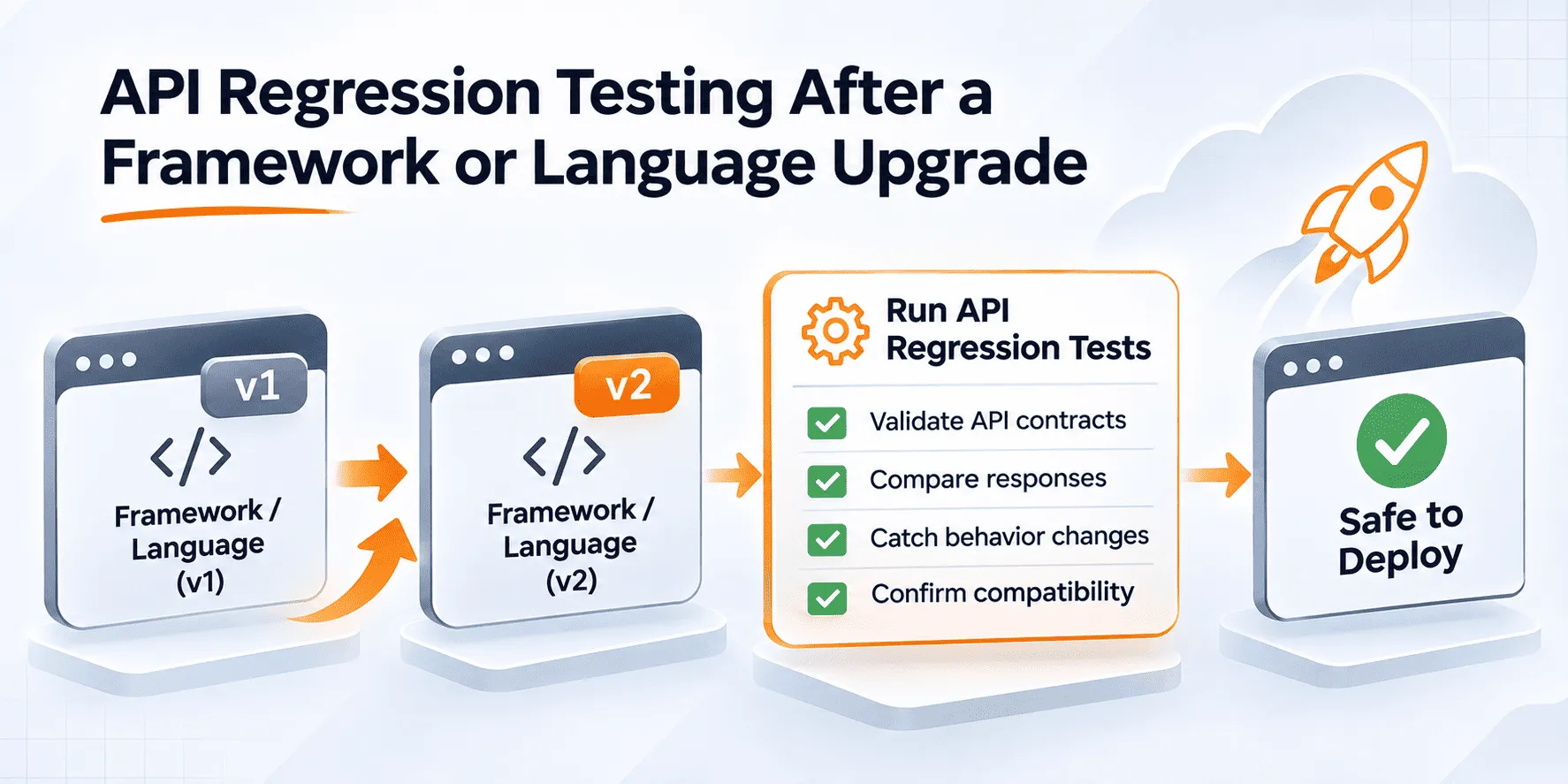

The ticket said “Upgrade to Spring Boot 3,” and someone estimated two days. The code compiled after a morning of renaming imports. The tests passed by lunch. Then a client integration started failing in staging, because requests to a path ending in a slash, which had always worked, now came back as 404s. Nobody had changed a single route. The framework had simply changed its mind about what counts as a match.
Framework and language upgrades are sneaky like that. Your code stays the same, but the stuff underneath it, how requests get routed, how data gets validated, how responses get serialized, quietly moves. And since none of those changes are in your diff, they’re easy to miss in review. API regression testing is about the most reliable way to see them before your clients do.
Why upgrades change API behavior without touching your code
Every framework makes hundreds of small decisions for you. How to parse a query string. Whether a missing field becomes null or vanishes. What a validation error looks like. Which date format gets used by default. Your API’s behavior is really your code plus all of those decisions.
Major versions are exactly when frameworks revisit those decisions. Defaults get tightened, deprecated behavior gets removed, edge cases get “fixed.” Each change is reasonable on its own. Together, they can change what your API returns in ways no compiler or linter will ever point out.
What recent upgrades actually changed
A few real examples show the pattern.
Spring Framework 6, the base for Spring Boot 3, turned off trailing slash matching by default. A route defined as /users no longer matches /users/ automatically. Clients that happened to send the slash started getting 404s after the upgrade, with zero changes to the controller.
Pydantic v2 tightened validation in a way that surprised plenty of Python teams. In v1, passing a number to a string field got quietly converted. In v2, that same request fails validation. An API that used to accept a loosely typed payload now rejects it.
Express 5 changed its route path syntax, so some patterns that worked in Express 4 behave differently or need rewriting. Apps that relied on older wildcard and optional-parameter styles found some routes no longer matched the way they used to.
None of these are bugs, exactly. They’re intentional changes, documented in migration guides that are long enough that nobody remembers every line.
Why your existing tests miss it
Most test suites check your logic. They call a function or a handler, often with the framework partly bypassed, and assert on the result. That’s useful, but it means the framework’s routing, validation and serialization barely get exercised in the way real requests experience them.
Even integration tests tend to send the tidy, well-formed requests their authors had in mind. The trailing slash, the number in a string field, the oddly shaped query parameter? Those come from real clients, and real clients are exactly who the upgrade breaks.
Capture a baseline on the old version first
The most useful thing you can do happens before you touch the upgrade. Record how the API behaves today, on the old version, using real traffic.
Capture a broad sample of actual requests and responses from staging or a scrubbed slice of production, including the messy ones. That recording becomes your baseline, a snapshot of exactly what clients get right now. Keploy is built for this kind of job: it records an API’s real traffic without code changes, along with the database and third-party calls behind each request, and saves them as regression tests. Because those downstream calls are recorded too, they can be replayed as mocks later, so the only thing that can differ between the old and new versions is your application stack itself.
Do this before upgrading, not after. Once the new version is in place, there’s no clean way to ask the old one what it used to say.
Replay against the upgraded build and read the diff
Now do the upgrade, build it, and replay the same recorded requests against it. Every response that differs from the baseline shows up as a diff. With Keploy, the replay runs with the recorded dependencies mocked and common noise like timestamps and generated IDs filtered out automatically, so a difference points to real behavior that moved.
A few kinds of diffs tend to show up after upgrades. Status codes shifting, like a 200 becoming a 404 or a 400 becoming a 422. Error bodies changing shape, which matters because clients often parse them. Fields appearing or disappearing, especially around nulls and empty values. Dates and numbers formatted differently. Each one is worth a look, even when it seems minor.
Decide what to keep
Not every difference needs undoing. Some are improvements, like a clearer error message, and you’ll want to keep them and update the baseline. Others would break clients, like that trailing slash or a newly rejected payload.
For the breaking ones, you’ve got two options. Many frameworks offer compatibility settings to restore old behavior temporarily, which buys time to warn clients. Or you can adjust your code to keep the old contract, for example by explicitly handling both path variants. Either way, the decision is now made on purpose, with the diff in front of you, rather than discovered later from an error report.
Make it part of every upgrade
Once the baseline exists, keep it. Run the same replay in CI on every pull request, and the next upgrade, framework or language runtime, starts with a safety net already in place. Minor version bumps get the same treatment for free.
Teams that do this tend to stop dreading upgrades. The work shifts from “upgrade and hope” to “upgrade and read the diff,” which is a much calmer way to spend a sprint.
Conclusion
Framework and language upgrades rarely break APIs in ways the compiler can see. They change defaults, tighten validation and adjust routing, and your code inherits every one of those changes silently. API regression testing with a baseline recorded on the old version turns those invisible changes into a readable list, before any client feels them.
That two-day Spring Boot ticket would have stayed a two-day ticket. The trailing-slash change would have shown up as one flagged 404 in a replay, with plenty of time to decide how to handle it.






















Sign in to leave a comment.