Continuous Testing in DevOps: What Changes When Tests Run on Every Commit

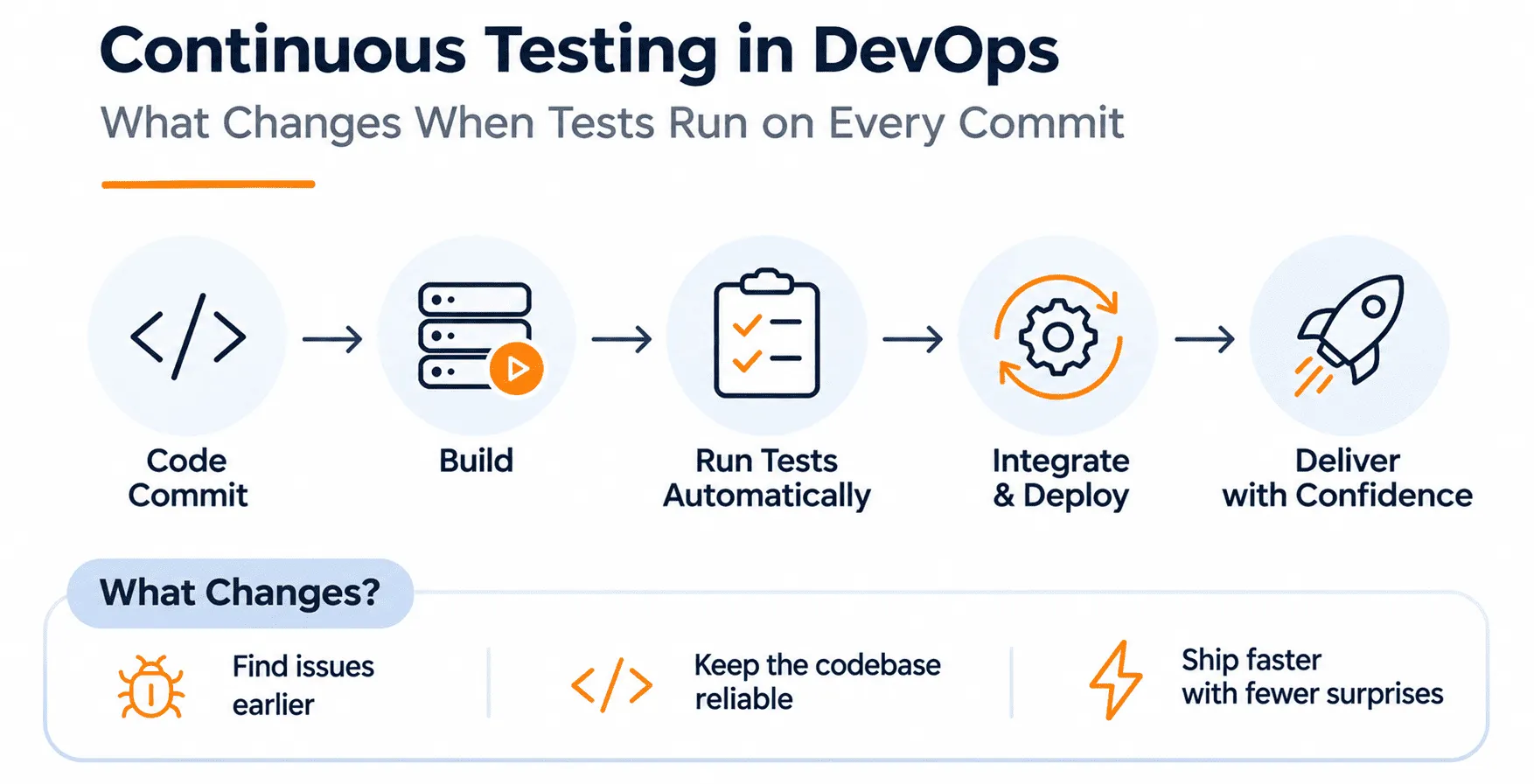
Most teams that adopt DevOps speed up how they ship long before they change how they test. Deployments go from monthly to daily, sometimes many times a day, while testing still happens in a big batch near the end. The result is predictable. Either releases wait for testing to catch up, or they go out with less testing than anyone is comfortable with.
Continuous testing is the fix for that mismatch. Instead of treating testing as a phase, it spreads checks across the whole delivery pipeline, so every change gets tested as soon as it's made. It sounds simple. In practice, it changes how tests are written, where they run and what a failing result means.
What continuous testing actually means
At its core, continuous testing means running automated tests at every stage of delivery, from the moment a developer pushes a commit to the point where a change reaches users. Each stage answers a different question. Early checks ask whether the code works on its own. Later checks ask whether it works with everything else. Checks after deployment ask whether it works for real users.
The goal isn't simply more tests. It's faster, more useful feedback. A bug found a few minutes after the commit that caused it is cheap to fix, because the developer still remembers the change. The same bug found three weeks later, buried under dozens of other changes, can take days to track down.
What runs where
Not every test belongs at every stage. The trick is matching each kind of check to the point in the pipeline where it gives the most value for the least waiting.
On every commit or pull request, teams usually run fast checks: unit-level tests, linting and API tests that confirm services still return the right responses. These need to finish in minutes, because developers are waiting on them.
After a change is merged and built, slower checks can run against the assembled application, such as integration tests across services and contract checks between them. These can take longer, since they don't block anyone's immediate work.
After deployment, smoke tests and synthetic checks confirm the most important flows still work in the real environment. They catch problems that only appear with real configuration, like a missing environment variable or a changed network rule.
Speed is the whole point
A continuous testing setup lives or dies on speed. If pull request checks take forty minutes, developers start batching changes to avoid waiting, which defeats the purpose. If they take five minutes, people push small changes often and get feedback while the work is fresh.
A few habits help. Tests that are independent of each other can run in parallel. Slow end-to-end tests can move to a later stage instead of blocking every pull request. Some teams go further and only run the tests affected by a change, though that takes more setup to get right.
Unstable environments break everything
The most common reason continuous testing fails isn't missing tests. It's unreliable ones. When tests depend on a shared staging database, a third-party sandbox or a downstream service another team is deploying, they fail for reasons unrelated to the code under test. After enough false alarms, developers learn to rerun failed builds until they pass, and real problems start slipping through with the noise.
The answer is making tests independent of things the team doesn't control. Disposable test databases help, as do mocked third-party services and careful handling of values that change on every run, like timestamps and generated IDs. Some tools make this easier for API tests specifically. Keploy, for example, records real API traffic along with the database and third-party calls behind it, then replays those calls as mocks when tests run in CI, so the same test gives the same result on every commit.
Who owns the tests
Continuous testing also changes who's responsible for quality. When testing happens at the end, a separate QA team often owns it. When tests run on every commit, developers see failures first, on their own pull requests, and fixing them becomes part of normal work.
That doesn't make QA engineers less important. Their role shifts toward deciding what deserves protection, designing the test strategy and building the checks that catch the most damaging problems. The work moves earlier and becomes more strategic, rather than disappearing.
Measuring whether it's working
A few signals show whether a continuous testing setup is healthy. How long do pull request checks take? How often do builds fail for reasons unrelated to the change? How many bugs still reach production, and at which stage could they have been caught?
The last question is especially useful. Every bug that reaches users points to a gap: a test that didn't exist, ran too late or was ignored because it was flaky. Closing those gaps one at a time gradually turns the pipeline into a reliable safety net.
Conclusion
Continuous testing brings testing up to the same pace as delivery. Fast checks on every commit, broader checks after merge and focused checks after deployment give teams feedback at the moment it's most useful. What holds it together is reliability: tests that run quickly, give consistent results and only fail when something has actually changed.
Teams starting out don't need a complete setup on day one. Pick the checks that protect your most important features, make them fast and stable, and run them on every pull request. Once developers trust those results, adding the next layer becomes much easier.








Sign in to leave a comment.