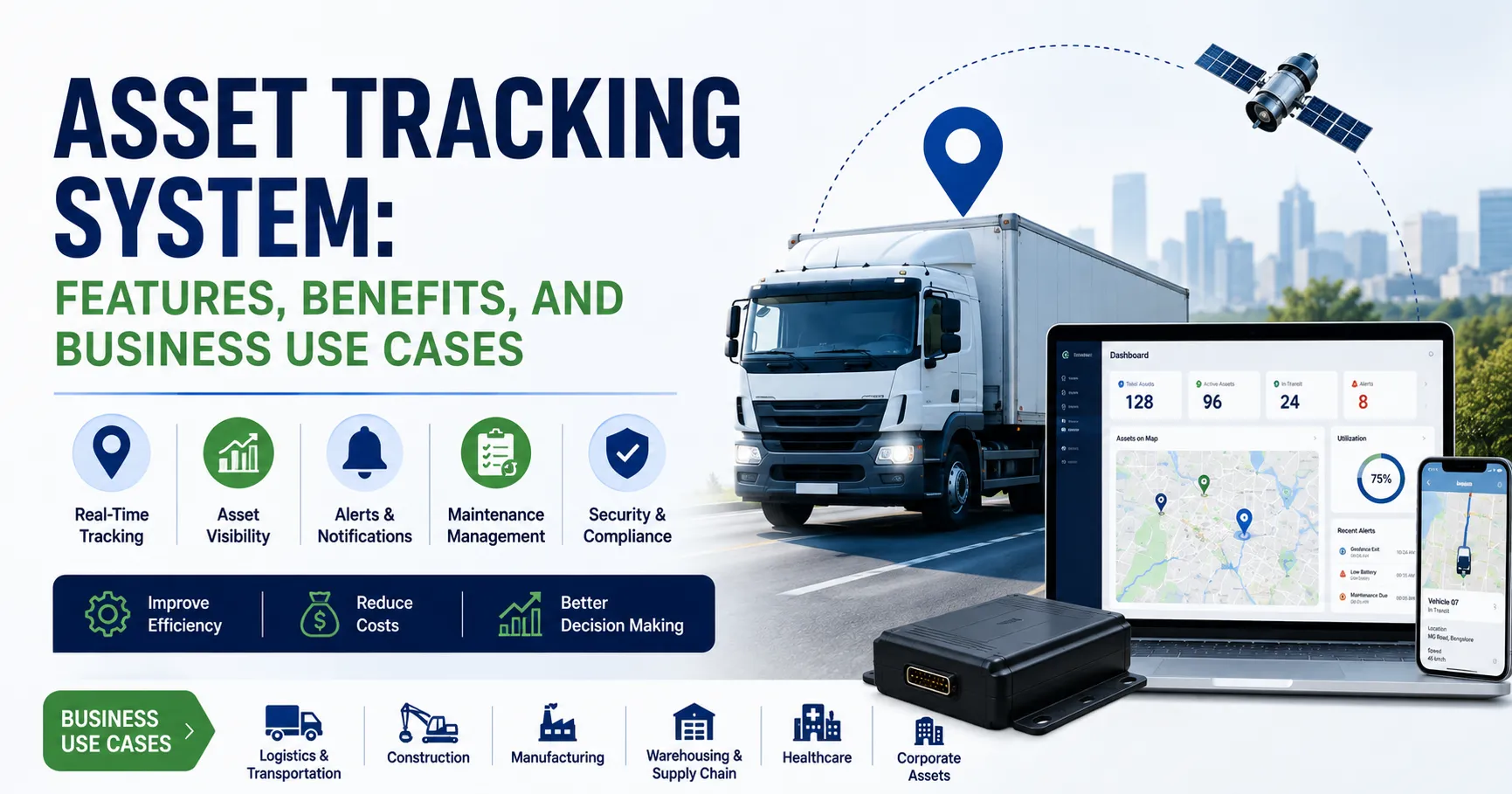

Businesses rarely lose money because of one major asset-related mistake. More often, the problem comes from small gaps: equipment is misplaced, a vehicle is sitting idle, a tool is assigned to the wrong site, or nobody knows when a machine was last serviced. An Asset Tracking System helps bring this information together so businesses can see what they own, where it is, who is using it, and what condition it is in.
This becomes increasingly useful as the number of physical assets grows. Managing a few laptops or machines manually may be easy. Managing hundreds of vehicles, tools, containers, equipment, or other assets across multiple locations is a different story. At that point, spreadsheets and paper registers can become difficult to maintain and even harder to trust.
What Is an Asset Tracking System?
An asset tracking system is a combination of software, hardware, and tracking methods used to monitor physical business assets throughout their operational life.
Depending on the application, the system may use:
- GPS trackers
- RFID tags
- Barcode or QR code scanning
- IoT sensors
- Mobile applications
- Cloud-based software
- Geofencing
- Real-time dashboards
The purpose is not just to know the location of an asset. A useful system can also provide information about asset ownership, movement, usage, maintenance, and status.
For example, a logistics company may want to know where its vehicles are. A manufacturer may need information about machine usage and maintenance. A construction company may need to know which site has a particular piece of equipment.
The tracking method should be selected based on the asset and the actual operational requirement.
Why Businesses Need Better Asset Visibility
Asset visibility sounds straightforward, but maintaining it across a large organization can be surprisingly difficult.
An asset can move from one department to another without the records being updated. Equipment can be sent to a remote site and forgotten there. A vehicle may be available but not where the operations team expects it to be.
These situations create unnecessary work.
Employees spend time searching for equipment. Managers may purchase additional assets even though existing ones are underused elsewhere. Maintenance teams may miss service schedules. Finance teams can also struggle to maintain accurate asset records.
The issue is not always the absence of information. Often, the information exists in different places and is not updated consistently.
An asset tracking system provides a central way to organize and access this information.
Key Features of an Asset Tracking System
1. Real-Time Location Tracking
For mobile assets such as vehicles, trailers, containers, and field equipment, knowing the current or last known location can be extremely useful.
GPS-based tracking can provide location information at regular intervals. Depending on the setup, managers can view assets on a map and monitor their movement.
This helps answer basic but important questions: Where is the vehicle? Has the equipment reached the site? Is the asset still within the expected area?
2. Geofencing
Geofencing allows businesses to define virtual boundaries around specific locations.
If a tracked asset enters or leaves that area, the system can generate an alert based on the configured rules.
For example, a company may create a geofence around a warehouse, construction site, or authorized parking area. If a vehicle leaves outside its expected schedule, the relevant team can investigate.
Geofencing is particularly useful when asset movement needs closer monitoring.
3. Asset Identification
Every tracked asset needs a reliable identity.
Barcodes, QR codes, RFID tags, and unique asset IDs can help businesses associate physical assets with digital records.
An employee scanning a QR code on a piece of equipment, for instance, can quickly access information about its assignment, maintenance history, or status.
This is much easier than trying to identify an asset from a spreadsheet description.
4. Maintenance Tracking
Asset tracking becomes more valuable when location information is combined with maintenance records.
Businesses can maintain service dates, inspection details, repair history, and upcoming maintenance requirements against individual assets.
For equipment that operates frequently, usage information can also help determine when servicing may be required.
This gives maintenance teams a better basis for planning rather than waiting for equipment to fail.
5. Asset Assignment
Businesses often need to know who is responsible for an asset.
An asset tracking system can record information such as the employee, department, branch, project, or location associated with an asset.
This is useful for laptops, tools, company vehicles, machinery, and equipment that regularly moves between teams.
Clear assignment also improves accountability. If something goes missing, the business has a starting point for investigation.
6. Alerts and Notifications
A tracking system can monitor specific events and notify the appropriate users.
Possible alerts include:
- Asset leaving a defined area
- Unexpected movement
- Long periods of inactivity
- Low battery
- Maintenance due
- Device disconnection
- Unauthorized access
Not every alert needs immediate attention. Good configuration matters because too many notifications can quickly become background noise.
Benefits of Using an Asset Tracking System
Better Asset Utilization
Businesses often own more equipment than they realize they need.
That may sound strange, but it happens when managers cannot see how assets are distributed across locations.
Tracking data can show which assets are heavily used and which ones spend most of their time idle. Managers can then consider reallocating equipment before purchasing more.
Reduced Asset Loss
When assets are monitored and assigned properly, missing equipment becomes easier to identify.
A tracking system can provide movement records, last known locations, and assignment information. This does not guarantee that assets will never be lost or stolen, but it gives the business more information when something goes wrong.
Lower Operational Delays
Employees lose time when they cannot find the equipment they need.
A clear record of asset location and availability can reduce this problem. In field operations, knowing where equipment is before sending a team to collect it can also prevent unnecessary trips.
Small time savings can become significant when the same issue occurs repeatedly.
Improved Maintenance Planning
A system that connects asset information with maintenance records can help teams plan service activities more effectively.
Regular maintenance can also extend the useful life of equipment in many applications. More importantly, it reduces the chances of an avoidable breakdown disrupting operations.
Better Decision-Making
Managers need reliable information when deciding whether to purchase, replace, relocate, or repair an asset.
Tracking data can provide useful evidence for those decisions.
Instead of saying, “We probably need more equipment,” management can look at actual utilization and availability.
Business Use Cases for Asset Tracking
Logistics and Transportation
Vehicles, trailers, containers, and mobile equipment are constantly moving in logistics operations.
GPS tracking can provide location visibility, while geofencing can help monitor movement around warehouses, customer locations, or restricted areas.
Tracking can also support better fleet coordination and help operations teams respond when vehicles are delayed or diverted.
Manufacturing
Manufacturing facilities may have expensive machinery, tools, material-handling equipment, and other operational assets.
Tracking can help identify where equipment is located and whether it is available for use.
When maintenance information is connected to the asset record, production and maintenance teams can coordinate service activities more effectively.
Construction
Construction projects often involve equipment moving between multiple sites.
Excavators, generators, compressors, tools, and other equipment can be expensive to replace.
Tracking helps project managers understand where equipment is located and whether it is being used at the intended site.
This can also make equipment sharing between projects easier.
Warehousing and Distribution
Warehouses deal with a constant movement of goods, equipment, pallets, containers, and handling devices.
RFID, barcode scanning, and IoT technologies can help maintain records as assets move through different stages of warehouse operations.
The goal is to reduce uncertainty about where items are and what stage of the process they are in.
Healthcare
Hospitals and healthcare facilities manage many types of valuable equipment, including wheelchairs, infusion pumps, monitoring equipment, and mobile devices.
Staff may waste considerable time searching for equipment that is needed urgently.
Asset tracking can provide location information and help teams identify whether equipment is available, assigned, or undergoing maintenance.
Corporate Offices
Asset tracking is not limited to large industrial operations.
Businesses can also use it for laptops, monitors, printers, networking equipment, furniture, and other office assets.
A centralized record can help IT and administration teams keep track of assignments, transfers, and replacements.
Choosing the Right Asset Tracking System
There is no universal setup that works for every organization.
Before selecting a system, businesses should first understand what they are trying to solve.
Consider these questions:
- How many assets need to be tracked?
- Are they stationary or mobile?
- Do they move between cities or remain within one facility?
- Is real-time location required?
- Is condition monitoring necessary?
- How frequently should asset data be updated?
- Does the system need to integrate with existing software?
- Who will be responsible for managing the information?
A warehouse may benefit from RFID and barcode technology, while a fleet operator may need GPS. A business monitoring sensitive equipment may need IoT sensors for both location and condition.
Choosing technology before understanding the workflow is a common mistake.
Challenges Businesses Should Consider
Asset tracking can provide useful information, but implementation still requires planning.
Poor network coverage can affect connected devices. Battery-powered trackers need maintenance. Incorrect asset records can produce unreliable information. Employees also need to follow the processes for assigning, transferring, and updating assets.
Data overload is another concern.
A business does not necessarily need every possible data point. Tracking should focus on information that helps someone make a decision or take action.
The system should make operations clearer, not create another complicated dashboard that nobody checks.
Practical Takeaway
An Asset Tracking System is most useful when it solves a real operational problem. Whether the goal is to locate vehicles, manage equipment, reduce asset loss, improve maintenance, or understand how resources are being used, reliable information makes the job easier.
For businesses managing assets across several locations, combining tracking devices with an IoT monitoring platform can provide a central view of asset location, movement, status, and other relevant data. The important part is not choosing the most complicated setup. It is choosing a system that fits the way the business actually works and gives teams information they can use.
Frequently Asked Questions
1. What is an asset tracking system?
An asset tracking system is a combination of software, hardware, and tracking technologies used to monitor physical business assets. It can help businesses track asset location, movement, ownership, usage, condition, and maintenance information.
2. How does an asset tracking system work?
An asset is assigned a unique identifier, such as a GPS device, RFID tag, barcode, or QR code. Tracking information is collected and sent to software where users can view asset details, locations, movements, alerts, and other relevant information.
3. What are the main benefits of asset tracking?
The main benefits include better asset visibility, reduced loss, improved equipment utilization, easier maintenance planning, fewer delays, and more informed purchasing and resource allocation decisions.
4. Which technology is used for asset tracking?
Common technologies include GPS, RFID, barcodes, QR codes, IoT sensors, Bluetooth, and cloud-based tracking software. The appropriate technology depends on the type of asset, its movement, tracking range, environment, and business requirements.
5. Can an asset tracking system prevent theft?
An asset tracking system cannot guarantee theft prevention, but it can improve monitoring and accountability. GPS, geofencing, movement alerts, and asset assignment records can help businesses identify unusual activity and provide useful information when an asset goes missing.
6. Is asset tracking useful for small businesses?
Yes. Small businesses can benefit from asset tracking when they manage vehicles, tools, equipment, IT devices, or other valuable resources. The system does not need to be complex; a simple setup can provide better records and visibility without adding unnecessary processes.




























Sign in to leave a comment.