

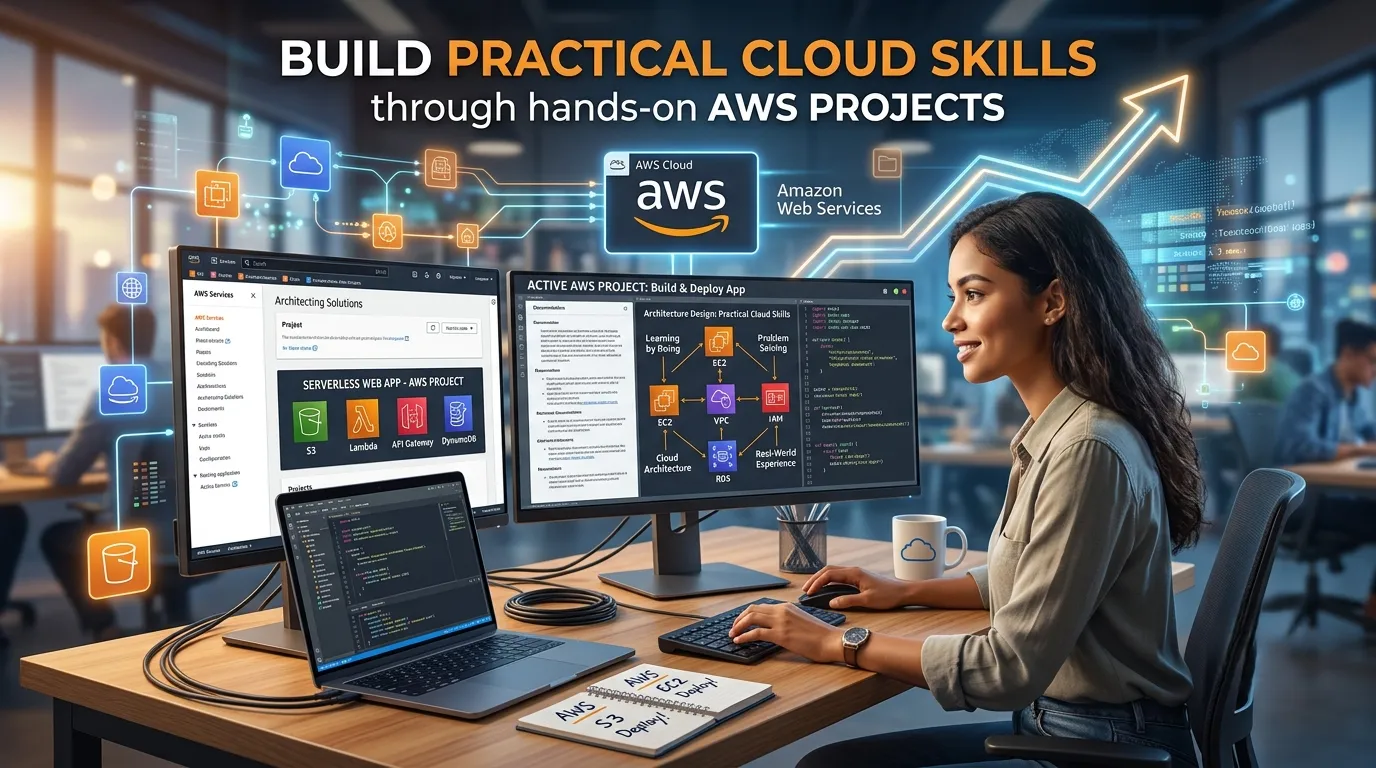
Securing an AWS certification proves that you have understood the cloud architecture on paper. But building hands-on labs proves that you can actually build it in reality. For aspiring professionals and students, where to invest time and money can be really confusing. Deciding what is more important, whether to have a certificate with your name on it or the real portfolio of working projects. In this guide, we will break down the basics of AWS hands-on labs and certification training, so that you can choose the best option to achieve cloud mastery.
AWS Hands-on Labs vs Instructional Learning
These are the two distinct ways of learning cloud computing. Instructional learning delivered via video lessons, documentations or instructor-led courses majorly focuses on knowledge gaining; whereas hands-on labs focus on skill applications. The major difference between the two comes down to passive learning and active problem solving.
Instructional Learnings
Instructional learnings provide learners with AWS services in clean, isolated, and best-practice scenarios. Through this, students or aspiring professionals can learn the ideal type of system that should be built according to the AWS well-architected framework.
AWS Training with Labs
AWS labs exposes you to real-situational friction. Labs teaches you how to read error logs, handle unexpected IAM, and troubleshoot routing problems.
Which Learning Path Fits?
There is no single way of mastering AWS, but AWS practical training with hands-on labs is preferred as it offers skill development through real project environments. The optimal choice between AWS hands-on labs and certification training depends on your career journey, your immediate professional growth, and how you process complex technical concepts.
Start With Certification Training If...
If you come from a totally unrelated background and you want to change your career into tech or cloud computing, opting for AWS certification training would be a better choice. Jumping straight into labs environment can be overwhelming, whereas AWS certification training provides clear roadmap through the vast AWS ecosystem, establishing foundational topics like networking, compute, security, and storage.
Start With AWS Hands-On Labs If...
If you are already an experienced system administrator, network engineer, or developer, AWS hands-on labs training would be an optimal option for you, instead of sitting through lengthy theoretical videos explaining basic concepts. Your primary challenge should be applying your theoretical knowledge and existing skills to AWS specific tools and workflows.
The Hybrid Approach
If you are a job seeker and hoping to land a cloud role in the next 3-4 months, then taking a hybrid approach would be the best fit for your professional journey. To pass automated resume filters, you will need certification but to actually land the role you will need skills that won’t be developed only through certification training. So, opting for certification training side by side practical training on AWS hands-on labs will help you in landing the perfect job role for you.
Same as for existing engineering teams migrating workloads to AWS. These teams will need certification to set up the foundational vocabulary but also interactive AWS training with labs. Interactive labs are essential for operational readiness. Such teams need to train their exact architecture stack, deployment pipelines, and incident response procedure.
At the end, choosing between AWS hands-on labs and certification training depends totally on where you stand in your professional career journey and your immediate goals.
Time and Cost Comparison
Both time and money are huge factors when deciding how to spend your resources on AWS training. Hands-on labs and certification prep have different cost models and different learning paces. Certification training has set exam fees and target completion deadlines, but hands-on labs tend to be subscription or pay-as-you-go infrastructure. With these parameters you will not waste money on idle cloud resources or spend months learning an approach that is not working.
Financial Breakdown
- AWS Certification Training:
You can find standard video courses on platforms like Udemy or YouTube for ₹500 to ₹4,000. But the real cost is the compulsory AWS exam fee. The Foundational exam costs about ₹8,550 + GST (totaling around ₹10,100), while Associate-level exams (such as Solutions Architect) are priced at approximately ₹12,830 + GST (totaling around ₹15,140). If you opt for offline classroom bootcamps in tech hubs like Bengaluru, Pune, Hyderabad, the costs shoot up to ₹25,000-₹60,000+.
- AWS Hands-On Labs:
Start for free using AWS Free Tier (12 months of limited EC2, S3, and Lambda usage). Outside of the free tier, platform subscriptions for pre-configured and safe sandbox environments typically range between ₹1,500 to ₹3,000 per month. This removes the risk of accidental 'credit card shock' from leaving live AWS resources running.
Time and Commitment Horizons
- AWS Certification Training:
Proceeds in a straight, predictable line. Most working professionals or final year engineering students in India spend 1 to 2 hours daily for 6 to 10 weeks to cover an Associate level syllabus and clear practice exams to clear the test.
- AWS Hands-On Labs:
Project-based, open-ended time commitments required; Setting up a simple VPC network or debugging an IAM policy might take 3 hours on a weekend. But the learning curve is not linear. Labs are not designed for study toward a fixed date, but for ongoing weekly practice (3-5 hours/week) to develop and sustain operational fluency.
How to Choose a Path?
To navigate the Indian tech landscape, one needs to have a clear understanding of what recruiters' screen for, vs what engineering managers actually test for in technical rounds. Whether you are gearing up for your next role in tier-1 product companies, fast-growing Indian startups or global capability centers (GCCs), your choice between labs and certifications depends on where you are in your career journey. Fresh graduates or early-career IT professionals may get an official AWS certification and do a little basic console practice to help them stand out from automated screening filters.
But, if you are a lateral hire coming in for DevOps or Cloud Architecture or System Administration, Indian hiring managers will quickly test your real-world skills. During technical assessment rounds, your ability to explain how you debugged a VPC routing loop or resolved an IAM permission problem in a hands-on lab will be far more valuable than a badge on your resume. Pinpoint where your application funnel is failing. Not getting calls from recruiters? Get certified. Not passing technical interviews? Spend your weekends breaking and fixing things in live hands-on labs.
Conclusion
The purpose of comparing AWS Hands-On Labs to AWS Certification Training is not about which one is best. Instead, each has its place in helping the candidate become successful. Certification training contains the high-level educational material providing the student with an understanding of AWS as well as with some formal credentials which makes it easier for them to be noticed by employers. Hands-on labs provide the technical learning that will be beneficial while being interviewed for a job as well as it will help a new employee start working from the first day.
It is highly advisable not to treat certification and hands-on labs as alternatives to each other. The first provides with answers to the questions many IT students might have regarding the basics of AWS. The second helps with getting their hands dirty and gaining practical experience allowing them to get skills that will help with passing their theoretical exams as well as with finishing their practical training with AWS.
Frequently Asked Questions
Is AWS Still Relevant in 2026?
Yes, AWS remains heavily in demand and relative in 2026. AWS holds 28% of the global cloud infrastructure market.
What are the 5 Pillars of AWS?
The major 5 pillars of AWS well-architected framework are operational excellence, reliability, security, performance efficiency and cost optimization.
What are the Benefits of Using AWS?
The major benefit of using Amazon Web Services (AWS) is that it lets you rent computing powers and storage instead of buying expensive physical servers.
























Sign in to leave a comment.