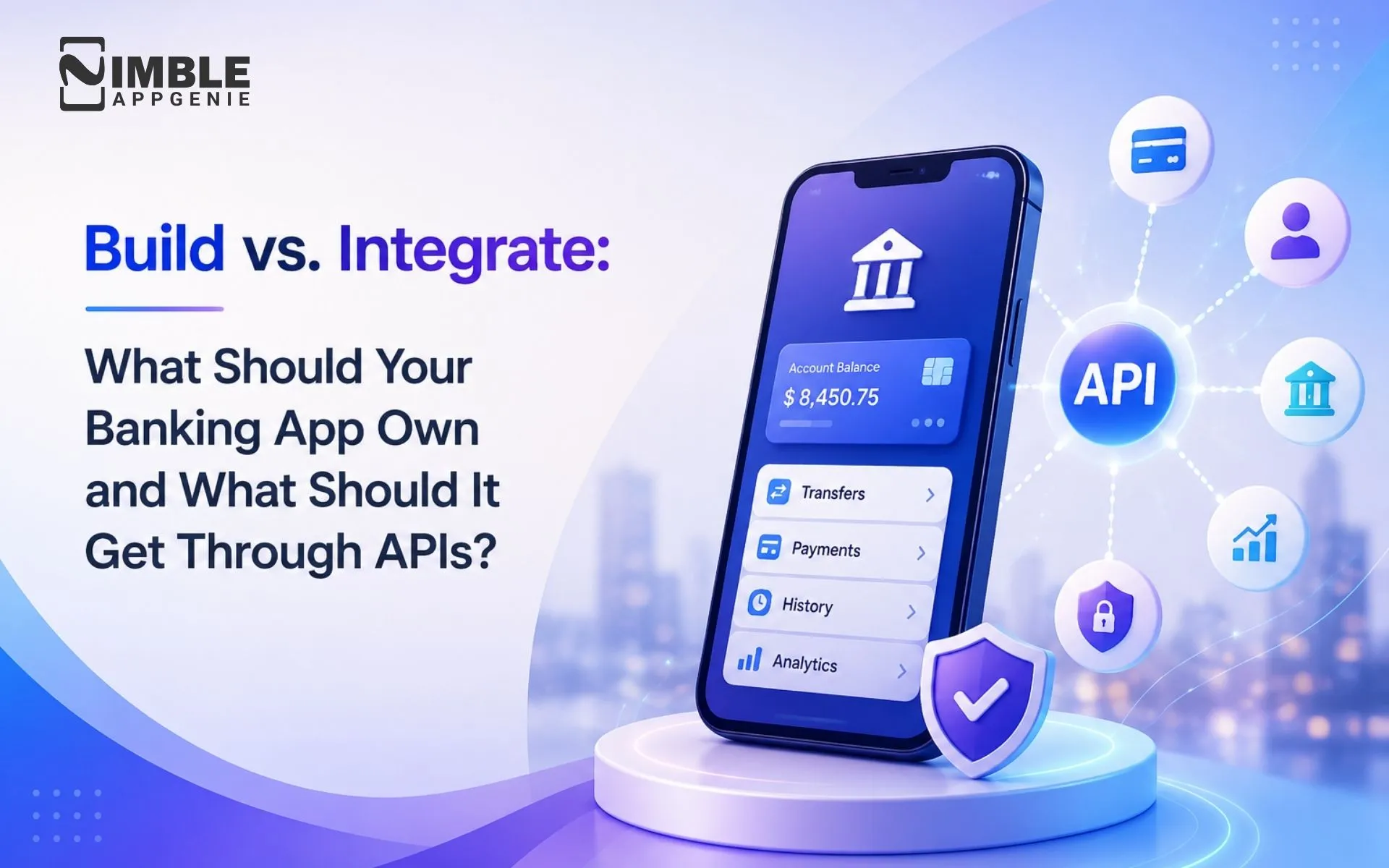

Building a banking app involves more than choosing features and designing screens. One of the most important strategic decisions is determining what your business should build internally and what should be delivered through third-party APIs.
The right balance can reduce development time, control costs, improve reliability, and create a banking platform that can scale as customer and transaction volumes grow.
Why Does Build vs. Integrate Matter for Banking Apps?
Modern banking products depend on multiple technologies and financial services. A single application may need account management, payments, identity verification, fraud monitoring, card services, notifications, and open banking connectivity.
For businesses investing in [mobile application development for banking], this decision can significantly influence architecture, development timelines, operating costs, and long-term control.
Nimble AppGenie can help businesses evaluate which capabilities should become part of their core platform and which specialized services can be connected through APIs.
A practical strategy is not about choosing between building everything and integrating everything. It is about identifying which capabilities create competitive value and which can be delivered more efficiently by specialized providers.
What Should Your Banking App Build In-House?
Businesses should generally consider building capabilities internally when they directly support their unique value proposition, customer experience, or long-term competitive advantage.
1. Core Product Logic
Your application's unique business rules should typically remain under your control.
These may include:
1. Account management workflows
2. Customer-specific financial products
3. Unique transaction rules
4. Pricing and fee logic
5. Product-specific workflows
6. Personalized financial experiences
Owning these components gives the business greater flexibility to modify the product as its strategy changes.
2. Customer Experience
The user experience is another area where custom development can provide significant value.
Your business may want complete control over:
1. Account dashboards
2. Transaction experiences
3. Financial insights
4. Customer journeys
5. Notifications
6. Personalization
7. Product discovery
A third-party service may provide the underlying capability, but your application should control how customers experience it.
What Should Your Banking App Get Through APIs?
APIs are particularly valuable for capabilities that require specialized infrastructure, regulatory expertise, extensive data networks, or connections to external financial systems.
1. Payments and Money Movement
Payment processing is one of the most common areas where banking products rely on external providers.
Depending on the product, APIs can provide:
1. Account-to-account transfers
2. Card payments
3. ACH processing
4. Payment verification
5. Transaction status updates
6. Payment notifications
Instead of developing an entire payment network, businesses can integrate established providers while focusing their development resources on the customer-facing product.
2. KYC and Identity Verification
Identity verification requires specialized technology and access to appropriate data sources.
External KYC APIs can help with:
1. Identity verification
2. Document verification
3. Customer screening
4. Address verification
5. Risk signals
Using specialized providers can accelerate onboarding while allowing the banking application to maintain control over the overall customer journey.
3. Fraud Detection
Fraud prevention is another area where third-party technology can complement an internal banking platform.
Specialized services can analyze transaction patterns, device information, customer behavior, and other risk signals.
However, businesses should carefully evaluate how these systems communicate with their internal transaction infrastructure.
How Do You Decide What to Build and What to Integrate?
A simple evaluation framework can help product teams make the decision.
1. Does It Differentiate Your Product?
If a capability gives your banking product a unique advantage, building it internally may make more sense.
For example, a unique financial-management experience could become a major differentiator.
2. Is It Technically Complex?
If a feature requires years of specialized infrastructure or access to external financial networks, integration may be more practical.
3. Does It Require Specialized Compliance Expertise?
Capabilities involving identity verification, payments, or financial data may require specialized
providers and compliance infrastructure.
4. How Important Is Long-Term Control?
If the business needs complete control over functionality, data flows, pricing logic, or product changes, internal development may be preferable.
5. What Is the Total Cost of Ownership?
Don't compare only the initial development cost.
Consider:
1. Development
2. Infrastructure
3. Maintenance
4. API fees
5. Security
6. Compliance
7. Monitoring
8. Support
9. Future migration costs
A solution that appears inexpensive initially may become expensive at scale.
What Are the Risks of Relying Too Heavily on APIs?
APIs can accelerate development, but they also introduce dependencies.
1. Vendor Dependency
If an important banking capability depends entirely on one provider, changes to its pricing, availability, terms, or API behavior can affect your product.
2. Reliability Issues
Your application may depend on the external provider's uptime and performance. A provider outage can affect customer transactions or critical workflows.
3. Data and Security Considerations
Businesses must understand:
1. What data is shared
2. Where data is processed
3. How data is protected
4. Who can access it
5. How long it is retained
4. Integration Complexity
Adding many APIs does not automatically create a better architecture. Poorly managed integrations can increase technical complexity and create maintenance challenges.
How Can You Create a Balanced Banking App Architecture?
The strongest approach is often a hybrid architecture.
Your business can own the core product layer while integrating specialized services through APIs.
For example:
a. Your platform:
Customer experience → Account logic → Product rules → Internal workflows
b. Integrated services:
KYC → Payments → Fraud detection → Open banking → Notifications
This model allows businesses to maintain control over the capabilities that differentiate their product while using established infrastructure where building from scratch would add unnecessary complexity.
How Does This Affect Mobile Banking App Development?
Mobile banking app development is not limited to designing an attractive interface. The mobile application needs to communicate reliably with backend services and external APIs.
Mobile banking app developers should consider:
1. API response times
2. Authentication
3. Secure data transmission
4. Error handling
5. Offline scenarios
6. Transaction status
7. Push notifications
8. Device security
The mobile experience should also clearly communicate when a transaction is processing, completed, failed, or requires additional action.
What Should You Check Before Choosing an API Provider?
Before integrating an external financial service, evaluate the provider against practical criteria.
API Evaluation Checklist
1. Documentation quality
2. Sandbox availability
3. Production reliability
4. Rate limits
5. Pricing structure
6. Security standards
7. Compliance support
8. Error-handling mechanisms
9. Monitoring capabilities
10. Customer support
11. Scalability
12. Exit or migration options
A successful integration should work reliably in production not just in a development environment.
Should You Build a Banking App Entirely From Scratch?
In most cases, building every capability internally is unnecessary and can significantly increase development time and operational complexity.
A better strategy is to identify the application's core intellectual property and customer-facing differentiation, then use reliable APIs for specialized services.
For companies planning to build a banking app, the goal should be strategic ownership rather than complete ownership.
Own what makes your product unique. Integrate what others can deliver more efficiently, reliably, or at scale.
Conclusion
The build-versus-integrate decision can shape the cost, flexibility, reliability, and scalability of a banking application for years.
Businesses should build the capabilities that differentiate their product while integrating specialized services that are more efficient to obtain through reliable APIs.
This hybrid approach can accelerate development without sacrificing strategic control. Nimble AppGenie helps businesses evaluate these technical decisions and develop scalable banking applications aligned with their product and growth goals.
Frequently Asked Questions
1. Should I build or integrate payment functionality for my banking app?
Answer: For many businesses, integrating established payment infrastructure is more practical than building an entire payment network. The decision should consider product requirements, transaction volume, compliance, cost, and long-term control.
2. What banking features should be built in-house?
Answer: Core business logic, unique customer experiences, proprietary workflows, and differentiating financial products are strong candidates for internal development. These areas can provide greater control and competitive advantage.
3. Which banking services are commonly integrated through APIs?
Answer: Common examples include payments, KYC and identity verification, fraud detection, open banking connectivity, credit services, card processing, and communication services.
4. Are banking APIs secure enough for financial applications?
Answer: A banking API should be evaluated based on its security controls, authentication mechanisms, encryption, compliance practices, monitoring, documentation, and reliability. Businesses should also implement appropriate security controls within their own application.
5. How do APIs affect the cost of banking app development?
Answer: APIs can reduce initial development effort by providing specialized capabilities without requiring businesses to build them from scratch. However, ongoing usage fees, integration maintenance, provider changes, and scalability costs should be included in the total cost calculation.



























Sign in to leave a comment.