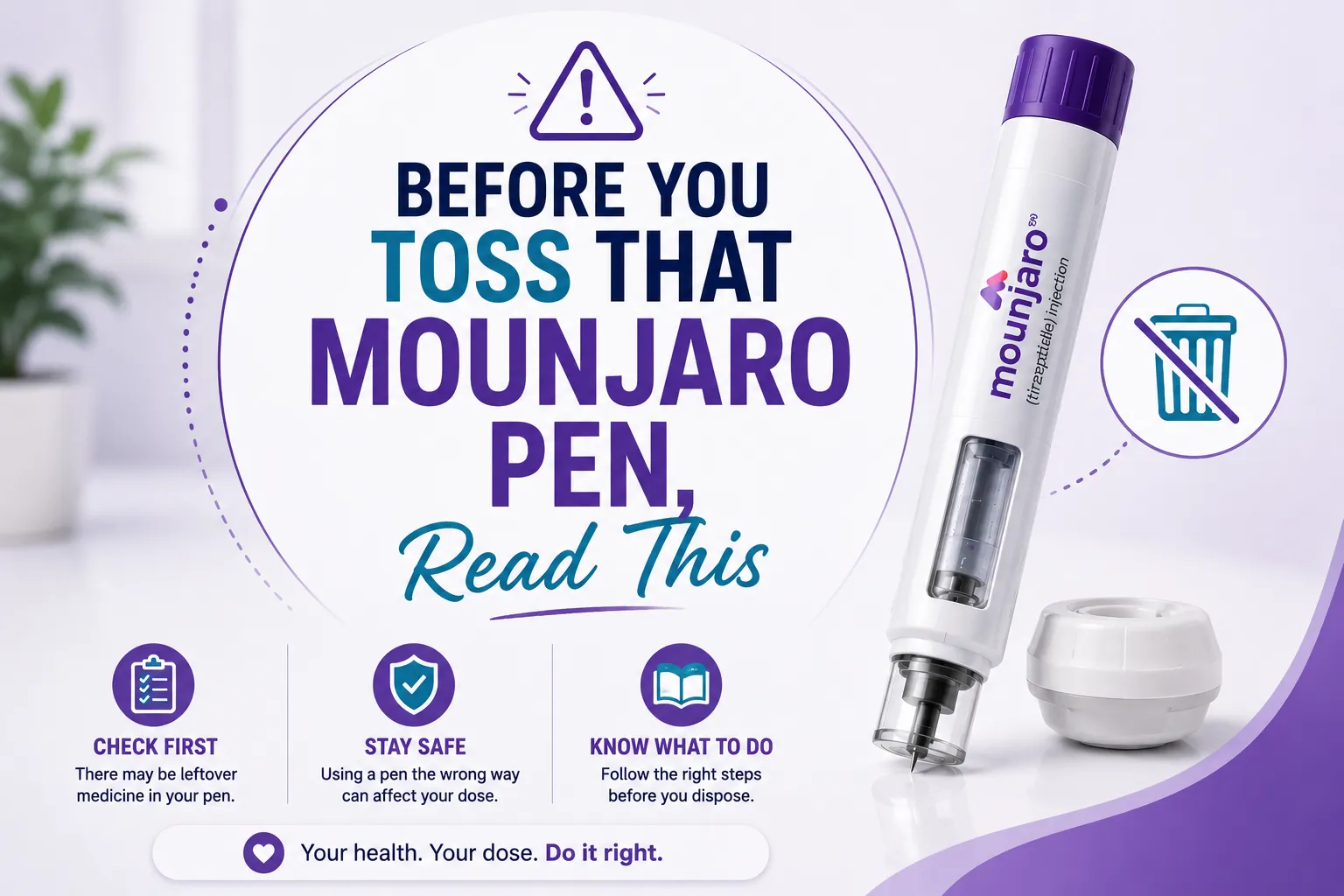

There's a small ritual most Mounjaro users go through without thinking twice: click, inject, count the used pens, and drop the empty one in the sharps bin once it's done its job. It feels routine. Almost automatic.
But before your next pen goes in the bin, it's worth pausing for a moment. A conversation has been building across pharmacy forums, patient groups, and clinics about what actually happens inside a Mounjaro pen after the fourth injection — and whether patients are throwing away something they shouldn't be.
We first unpacked this in detail in our article on the Mounjaro KwikPen fifth dose, but given how often the question keeps coming up, it deserves a second look — this time focused on what you should actually do about it.
What's Really Left in the Pen
Every prefilled injection pen, Mounjaro included, is manufactured with a small amount of overfill. This isn't a manufacturing flaw or a hidden bonus — it's a deliberate safety buffer built into the device so that the labelled doses (usually four per pen) are delivered accurately, even accounting for air bubbles, temperature fluctuations, or minor mechanical inconsistencies during injection.
In practice, this means that after four clicks, there may still be a small volume of liquid sitting inside the pen. Some patients have noticed this residue and assumed it must be a usable fifth dose just waiting to be extracted.
It's an understandable assumption. It's also one that needs to be handled with real caution.
Why This Question Keeps Coming Up
Weight loss treatment isn't a small financial commitment. For many people using Mounjaro Weight Loss Injections, the monthly cost is a serious consideration, and the idea that a portion of every pen might be going to waste naturally raises eyebrows.
It's not an unreasonable thing to wonder about. If you're paying for a full month's supply, you want to know you're getting full value from every pen you use. That's simply good, engaged patient behaviour — the kind any responsible clinic should welcome, not dismiss.
The problem isn't the question. It's what some people do next.
The Risk of Trying to Access "Extra" Medication Yourself
Manufacturer overfill is not the same thing as a fifth prescribed dose. There is no reliable way for a patient to determine, at home, whether the leftover liquid in a used pen:
- Contains a full, accurate dose of tirzepatide
- Has remained stable and unaffected by storage or partial use
- Can be safely and precisely delivered through a pen that has already completed its designed dosing cycle
- Is free from air or contamination introduced during previous injections
Attempting to manipulate, squeeze, or force out this residual liquid can introduce dosing errors in either direction. Too little medication reduces the treatment's effectiveness. Too much increases the risk of side effects such as nausea, vomiting, or more serious gastrointestinal reactions. Neither outcome is worth the risk of a few extra millilitres.
This is exactly why the fifth dose conversation should stay in the hands of your prescribing clinician, not become a DIY project. Pen designs and formulations can also change over time, so guidance that applies to one batch or device may not apply to another.
What to Do Instead of Guessing
If the idea of unused medication bothers you — and it should, because you're paying for it — here's a more constructive path forward:
- Bring it up with your prescriber. Ask them directly whether there's documented guidance from the manufacturer about overfill in the specific pen you're using.
- Don't attempt to extract residual liquid yourself. Follow the device instructions exactly as provided.
- Revisit your dosing plan periodically. Sometimes the better answer isn't squeezing more out of one pen, but making sure your overall treatment plan is the right fit for your goals and budget.
- Explore whether a different format suits you better. If pen-based dosing uncertainty is a recurring frustration, some patients look into alternatives like Wegovy Semaglutide Oral Tablets, which remove the injection pen question from the equation entirely.
Value Isn't Just About Squeezing Out an Extra Dose
It's easy to get fixated on the idea of a "hidden" dose, but the real issue underneath this whole conversation is trust. Patients want to know their treatment plan is transparent, that pricing reflects what they're actually receiving, and that any leftover medication isn't simply being wasted without explanation.
That's a fair expectation, and it's one best met through clear communication with your provider rather than trial and error at home. A good clinic should be willing to walk you through exactly how your pen works, what the overfill is for, and how your dosing schedule is structured.
This is the approach taken at Weight Medics, where ongoing clinical support is part of the treatment plan, not an afterthought. Instead of leaving patients to speculate about pen mechanics on their own, clinicians are available to explain dosing, address concerns about waste, and help patients feel confident about every stage of their weight loss journey.
The Takeaway
So, before you toss that next Mounjaro pen, take a second to think about what you actually know — and don't know — about what's left inside it. The overfill exists for accuracy and safety, not as a bonus supply, and trying to access it yourself introduces risks that outweigh any potential savings.
The smarter move is simple: ask, don't assume. Talk to your prescriber, understand your device, and make any changes to your treatment based on clinical advice rather than pen-squeezing guesswork.
Your health, and your investment in it, deserve that level of care.
This article is for informational purposes only and does not constitute medical advice. Always consult a qualified healthcare professional before making any changes to your medication or dosing routine.




























Sign in to leave a comment.