
Mountain Pose No. 1
The fundamental standing position (Tadasana) for all standing postures and inversions is Mountain Pose (Tadasana). Learn how to execute mountain position correctly, and you'll be able to apply the alignment and muscle movement to a variety of other standing and inversion postures to read more here.
Key Advantages
When performed correctly, Mountain Pose should engage every muscle in the body. It improves posture and aids in the relief of back pain since you have better posture and are less likely to compress your lower back while standing or sitting.
The whole leg, abdomen, and buttocks are strengthened in this position. In addition, grounding on the feet supports the arches of the feet, minimizing the consequences of flat feet.
Mountain Pose [Tadasana]: How to Do It
Feet and Legs: There's a reason why yogis constantly advise "ground your feet." All standing and balancing postures require stability, so be sure your feet are in the proper place.
Check that your toes are pointing forward, not outwards or inwards, as you look down at your feet.
Distribute your weight equally over your feet's balls and arches.
Ground through your heel, straighten your legs, and apply uniform pressure to all four corners of your feet.
Spine: With an inhale, lengthen your spine and picture someone pulling your head up towards the sky with a thread.
Tailbone. Indent your tailbone. An essential exercise to practice this movement may be seen below.
One hand should be on your lower belly and the other on your lower back. Stick your butt out and arch your back; you should feel your spine tighten slightly.
Tuck your butt under and start shifting your pelvis in the other direction. While your belly tightens, your lower back will flatten, and you should feel the entire lower back opening up. Do not round your spine excessively.
Arms and Shoulders: Allow your shoulders to relax and your hands to drop down by your sides.
Softly fix your attention in front of you.
Hold this position for 5-10 breath cycles.
Check-in
Balancing in mountain positions may be difficult for individuals who are just beginning out. However, standing with your legs apart can be used to change the posture.
Practice with your eyes closed for more skilled yogis.
Tree Pose No. 2
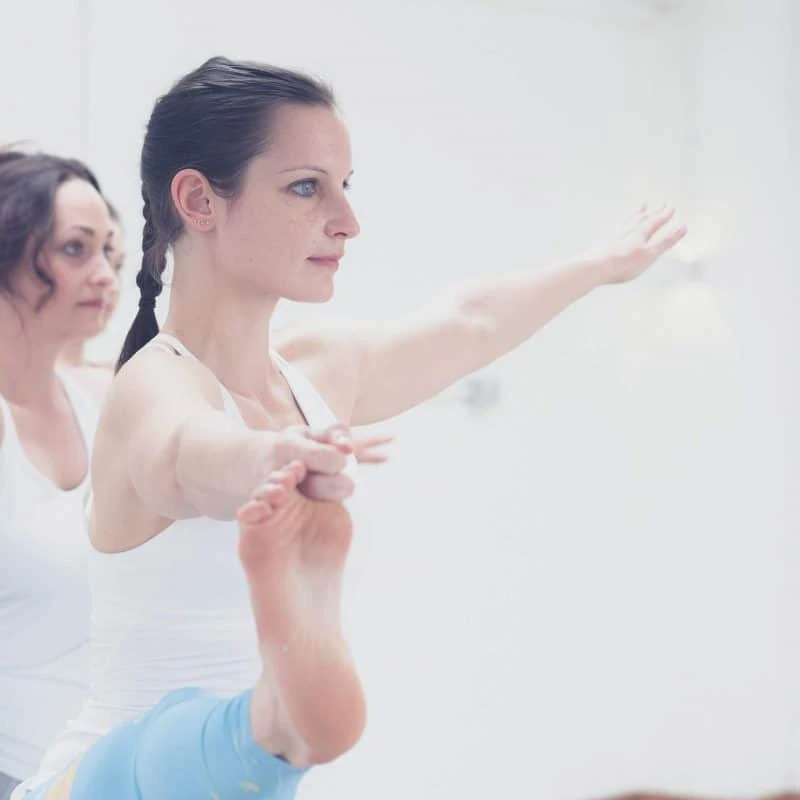
Vrksasana (Tree Posture) is a standing balancing pose in which one foot is fixed to the ground, and the other is put against the other, either at the inner thigh (harder) or by the calf (more accessible). The palms of the hands are touching and extended to the sky.
Vrksasana (Tree Pose)
Vrksasana (Tree Pose)
Key Advantages
Because you have one point of touch with the ground, it improves your balance.
Legs are toned, and the spine is lengthened.
Focus and concentration are improved.
How to do Vrksasana (Tree Pose).
Begin with a mountain stance on your feet.
Bend the right leg and place the foot on the inner left thigh's upper surface.
With toes facing downwards, place the foot on the left thigh.
Ground the four corners of your feet together by anchoring on your left leg.
Focus your focus on a single point in front of you to help you balance better.
Join your palms and lift them straight above your head after you've established your balance.
Stay for a few seconds and breathe in and out 5-10 times.
Rep the posture, this time lowering the left leg.
When you're finished, return to Mountain Pose and rest.
Modifications
Tree position appears to be simple, but if you are a novice yoga student or lack good balance, you may find it challenging to execute this posture with your right leg raised high on the opposite thigh.
Modify the posture by lowering your right leg to the level of your left calf. This will make things simpler by reducing your center of gravity.
In either of these adjustments, do not rest your foot against your knee.
Try a side bend variant of the posture to test your balance for those who have mastered tree pose.
Place the back of your right palm against your right knee in tree position, with your right foot against the left thigh.
In a side stretch, bend to your right to open up your entire left side.
3. Forward Fold While Standing
Uttanasana (Standing Forward Fold) is an assertive stretching posture that seeks to open up the back of the legs and the spine. 'Ut' stands for 'intensity,' 'tan' for 'extend or stretch,' and 'asana' for 'position.'
Fold forward when standing. [Uttanasana] Forward fold while standing [Uttanasana]
Key Advantages
Uttanasana is a fantastic hamstring and calves stretch (runners will enjoy it!).
It's a type of inversion since your head is below your heart. It's believed to relax the brain and help with stress, migraines, and moderate depression.
How do I get in? Fold forward when standing.
Tadasana, or Mountain Pose, is an excellent place to start.
Inhale deeply, then exhale slowly.
Hips and legs: Bend forward at the hips and extend the front of your body as you exhale.
If your hamstrings are open, you may maintain your legs straight and lay your fingertips on the floor beside your feet. Then, if you're able, go even further with your palms at the back of your ankle.
If you can't perform the straight leg version, bend your knees instead to avoid overstretching!
Check-in:
You want to activate your front thigh muscles and bring your sit osseins towards the roof in full and modified positions.
Preferably than overstretching your joints or hammies, concentrate on extending your back.
When you've become acclimated to this posture and your flexibility has increased, moving from bent knees to straight legs.









Sign in to leave a comment.