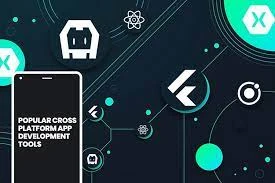

Around the world, a mobile revolution is reaching its pinnacle. Mobile apps are what make mobile phones so convenient. It enables you to carry out your daily chores with ease and attentiveness. Booking tickets, tracking meal orders, and window shopping via e-commerce are all made easier with apps.
Cross-platform apps are currently more popular among mobile app developers than other sorts of apps. Before we go into the top cross-platform mobile app development tools, let's define cross-platform development and why we choose it.
What is Cross-Platform Development?
Traditionally, when developing an app for a company, different applications for each mobile platform are created using tools and languages particular to that operating system. However, it has a number of drawbacks, including higher development costs, longer development times, and the need for highly qualified developers who can work in a variety of languages.
All of these drawbacks can be eliminated using cross-platform programming technologies. It refers to the creation of a single app that runs on many mobile platforms. This is accomplished by employing a universal programming language, such as Javascript for React Native and Dart for Flutter, to create an app.
Cross-platform development reduces development costs, saves time, and improves the efficiency and performance of mobile apps.
Why Cross-Platform App Development Framework?
Companies have been trying to move their work to the Internet for the past 20 years. Today, employee management and day-to-day operations are handled via mobile apps. It's much easier to create mobile apps these days. Therefore, cross-platform app development is becoming a necessity in the modern workplace.
As the gap between work and personal life narrows, working from home and free time are becoming productive options for workers. This is a solution that benefits both employees and management. Employees have room for operation, and employers can save on infrastructure investment.
However, the real problem is the integration of various devices and platforms such as iOS, Android and Windows. Here, we'll look at cross-platform app development. The
cross-platform app allows you to run your application on multiple devices. Some of the following approaches are:
Hybrid appsRapid mobile app developmentWindows universal appsProgressive Web apps
Besides, cross-platform apps outsmart native apps in many significant aspects about which we will discuss in the following section.
Best Cross-Platform App Development Tools
Choosing the right cross-platform app development service is an important part of building an efficient app. There are many cross-platform frameworks on the market today. Choosing a tool can be difficult because each framework has its strengths and weaknesses. We understand this dilemma. This article summarizes the 11 best cross-platform development tools and features for 2021. Let's look at them one by one.
Phone Gap (Apache Cordova)
Apache Cordova is at the top of the list because it enables the build process for most free cross-platform app development tools. PhoneGap provides a FOSS environment that enables cross-platform mobile application development and is being developed by the team behind Apache Cordova. It consists of a
compiler, a debugger, and several tools for testing. The key web technologies included are HTML5, CSS3, and JavaScript. Phone Gap has backups of various plugins such as Image Capture plugin, Media Recorder plugin, Push plugin and so on. PhoneGap plugins can be used to trigger important smartphone features such as GPS, accelerometers, cameras and sounds. The
PhoneGap also supports purchases. No iOS App Store and Google Play Store applications. This is a great tool for designers with front-end technology expertise. You can accelerate your applications with support for third-party caches and graphics accelerators.
Unique Features:
Robust backend to support beginners It's open source, so it's easy to share Very flexible for developers
Appcelerator
Appcelerator is another cross-platform development tool that you can use to develop, deploy, and test the functionality of your mobile applications. Use JavaScript as a universal code mechanism.
This means that you can use the same code to build applications for different platforms such as iOS, Android and Blackberry. This is the best choice for quickly developing apps with experienced JavaScript developers.
Appcelerator, along with Arrow DB, provides a schemaless database that can provide a data model without setup work. It also provides pre-built integration with Salesforce, MS Azure, MongoDB, MS SQL, and Box. The new version addresses previous issues with speed and lag.
Notable features:
Titanium framework makes it really cheap Cloud service for packaging, distribution and testing Basic source code is always available
Reply to the locals
React Native is an open-source tool developed by Facebook for cross-platform application development. It follows the protocol of "learn once and write anywhere". JavaScript is the basic language and offers the potential for native functionality. Once encoded, you can port your application to both Android and iOS using the same base code. What makes
React Native stand out is that apps built on this platform are cross-platform, but have a native application look, thereby providing an interactive user experience.
This is a new framework that enables rapid prototyping and provides high initial speed. Moreover, if you are familiar with JS, it is easy to learn and get started with the basics. That sounds incredible, but the JavaScript code uses a lot of memory for compute-intensive tasks. This is a great choice for agile development and has often proven to be more effective.
React Native Trademark:
Accelerate apps in the app store Modular and intuitive architecture with advanced web technology Very nice community-led support
Native script
A smartphone with the native script logo displayed on the screen
NativeScript supports creating native apps with cross-platform capabilities in JavaScript, TypeScript, or Angular.
The most preferred app development framework for creating trending micro-apps. Micro apps help you perform the function exactly. Usually the focus is on a single function.
NativeScript is based on the following key components:
Clause Core module CLI Plugin
The runtime allows developers to use JavaScript code to call iOS and Android APIs. The core module helps to call the abstraction required for the native API. CLI commands help users build, run, and build apps using NativeScript. The
plugin forms a component of this app development framework. It contains several features as well as plugins that help build mobile apps, helping developers build apps faster.
Core function:
Enables the full stack of cross-platform APIs Provides "zero-day" support for the new native framework Reach, reusability, rapid app development.
Flutter
Flutter means faster and more dynamic mobile app development. Hot reload works by inserting the source code file into a Dart virtual machine (DVM). Flutter makes it easy and automatic to rebuild the widget tree by seeing the impact of your changes. Widgets provide features such as symbols, scrolling, navigation and fonts to launch full-fledged iOS and Android apps.
Flutter is a response framework with pre-built 2D rendering, widgets, and tools. All of these elements help you easily design, build, test, and debug your app.
Flutter Features:
Highly productive because developers can build iOS and Android from a single code base High adaptability due to abundant material design Create a brand design using OEM widgets
0
























Sign in to leave a comment.