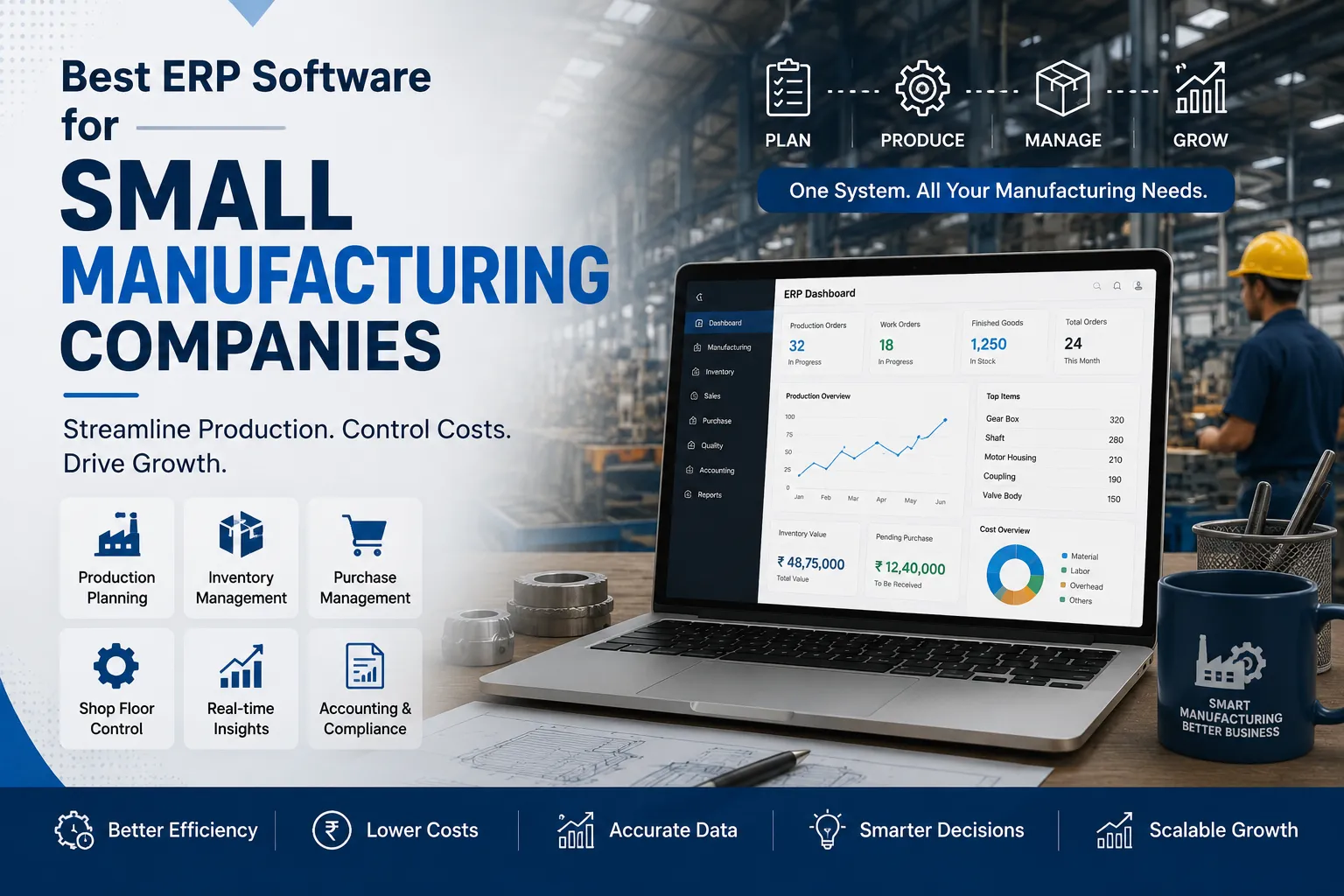

Small manufacturing companies often start with spreadsheets, accounting software, and separate tools for inventory, purchasing, production, and sales. As the business grows, these disconnected systems can make it difficult to control production, track materials, manage inventory, monitor costs, and fulfill customer orders efficiently.
This is where ERP software for small manufacturing companies can make a major difference.
A manufacturing ERP brings production, inventory, procurement, sales, accounting, quality, and reporting into one connected system. Instead of managing each function separately, manufacturers can manage their operations through a centralized platform with better visibility and control.
For small manufacturers, however, choosing the right ERP is not simply about selecting software with the most features. The solution should be affordable, easy to use, scalable, customizable, and capable of supporting actual manufacturing workflows.
What Is ERP Software for Small Manufacturing Companies?
ERP software for small manufacturing companies is an integrated business management system designed to connect core manufacturing and business processes.
A suitable manufacturing ERP can help businesses manage:
- Production planning
- Bill of Materials (BOM)
- Work orders
- Raw materials
- Inventory
- Procurement
- Shop-floor operations
- Quality control
- Sales orders
- Purchasing
- Accounting
- Production costing
- Reporting and analytics
The main objective is to create a single source of information across the organization.
For example, when a customer places an order, the ERP can connect the order with inventory availability, production requirements, material procurement, manufacturing activities, finished goods, delivery, and accounting.
Why Small Manufacturing Companies Need ERP
Small manufacturers often operate with limited employees, tight budgets, and rapidly changing customer requirements. As operations become more complex, manually coordinating production, inventory, purchasing, and finance becomes increasingly difficult.
A manufacturing ERP can help centralize these activities and reduce dependence on spreadsheets and disconnected systems. SAP notes that small manufacturers commonly face lean budgets, small teams, changing customer demands, and complex supply chains, making efficiency and real-time visibility particularly important.
ERP can help small manufacturers improve visibility into production, inventory, procurement, costs, and customer orders while reducing repetitive manual processes.
Common Problems Faced by Small Manufacturers
Manual Production Planning
Production teams may use spreadsheets or manually prepared schedules to determine what needs to be manufactured. As orders increase, this can lead to scheduling conflicts and production delays.
Poor Inventory Visibility
Without centralized inventory management, manufacturers may not know the exact availability of raw materials, work-in-progress, or finished products.
Material Shortages
Production can stop when required raw materials are unavailable. Without integrated material planning, purchasing teams may discover shortages only after production has already been scheduled.
Excess Inventory
Over-purchasing raw materials ties up working capital and increases storage costs.
Inaccurate Production Costing
When material, labor, and operational costs are tracked separately, calculating the actual cost of production can become difficult.
Limited Production Traceability
Manufacturers may struggle to determine which materials were used in a particular production order or which stage caused a delay.
Disconnected Accounting
When production and accounting systems are separate, management may not have a complete picture of production costs and profitability.
How ERP Helps Small Manufacturing Companies
1. Centralizes Manufacturing Operations
ERP brings production, inventory, purchasing, sales, and finance into one connected platform.
Instead of maintaining separate records for each department, employees can work from shared business information.
This improves coordination between production, warehouse, purchasing, sales, and finance teams.
2. Improves Production Planning
Production planning helps manufacturers determine what needs to be produced, when it should be produced, and what materials are required.
ERP can connect sales orders and material requirements with production planning, helping businesses schedule manufacturing activities more efficiently.
ERPNext, for example, supports production planning based on material requests or sales orders and can generate material requests as part of the planning process.
3. Simplifies Bill of Materials Management
A Bill of Materials (BOM) defines the raw materials, components, quantities, and operations required to manufacture a product.
Manufacturing ERP allows businesses to maintain BOMs centrally and use them during production planning and work order creation.
ERPNext supports multi-level BOMs, while Odoo supports multi-level BOMs and routing for manufacturing operations.
4. Provides Better Inventory Control
Small manufacturers need to maintain enough raw material to support production without creating unnecessary inventory.
ERP provides visibility into raw materials, work-in-progress, finished goods, stock movements, and reorder requirements.
This helps businesses reduce stock shortages and excessive inventory while improving material availability.
5. Automates Material Requirements Planning
Material Requirements Planning, or MRP, helps determine what materials are required for planned production.
ERP can connect production plans with inventory availability and purchasing requirements.
For example:
Sales Order → Production Plan → Material Requirement → Purchase → Production → Finished Goods
This creates a more structured manufacturing workflow.
6. Improves Production Costing
Understanding the actual cost of manufacturing is essential for pricing and profitability.
ERP can track material consumption and production operations to help manufacturers understand product costs.
ERPNext provides costing based on operations and raw materials, while SAP Business One supports production costing based on actual consumption of materials and resources.
7. Supports Quality Management
Quality problems can result in rejected products, rework, customer complaints, and additional costs.
Manufacturing ERP can connect quality inspections and checks with production activities.
ERPNext includes quality control capabilities within its manufacturing module, while Odoo provides quality control points, checks, and quality alerts.
8. Improves Production Traceability
Traceability allows manufacturers to understand where materials came from, how they were processed, and which finished products they became.
ERP can track batches, serial numbers, material consumption, work orders, and production activities.
This is particularly useful for manufacturers handling regulated, high-value, or quality-sensitive products.
9. Connects Procurement With Production
Purchasing and production need to work together.
If production requires a particular raw material, the ERP can provide purchasing teams with visibility into the requirement.
This helps businesses coordinate supplier orders with production schedules and reduce unnecessary procurement delays.
10. Improves Warehouse Management
ERP connects inventory with warehouse operations such as receiving, storage, material transfers, picking, and finished-goods movement.
This gives warehouse and production teams better visibility into where materials are located and when they are required.
11. Provides Real-Time Business Visibility
One of the biggest advantages of ERP is centralized information.
Management can monitor production, inventory, purchasing, sales, expenses, and financial information from one system.
SAP Business One describes real-time business information and integrated management across accounting, purchasing, inventory, sales, CRM, reporting, and analytics as core capabilities for small and midsize businesses.
12. Reduces Manual Data Entry
When different departments use separate spreadsheets, the same information may need to be entered multiple times.
ERP connects business processes so information can flow automatically from one activity to another.
This can reduce duplicate data entry and minimize errors.
13. Helps Improve Customer Order Fulfillment
ERP can connect customer orders with inventory and production requirements.
When finished goods are unavailable, the system can help determine whether production or procurement is required before the order can be fulfilled.
This provides sales and production teams with better visibility into delivery commitments.
14. Supports Business Growth
A small manufacturing business may begin with a few products, suppliers, employees, and customers. As it grows, the number of transactions and operational processes increases.
Choosing an ERP that can scale with the business helps avoid repeatedly replacing systems as operations become more complex.
Microsoft describes Dynamics 365 Business Central as an ERP for small and midsize businesses that supports finance, manufacturing, sales, supply chain, and other business processes.
Best ERP Software for Small Manufacturing Companies
There is no single ERP that is best for every small manufacturer. The right choice depends on manufacturing complexity, budget, required features, customization needs, existing software, and growth plans.
However, several ERP platforms are commonly worth evaluating.
1. ERPNext
ERPNext is an open-source ERP platform with manufacturing capabilities covering production planning, BOMs, work orders, inventory, quality control, purchasing, sales, accounting, and reporting.
Its manufacturing functionality includes multi-level BOMs, production planning, material requirements, job cards, capacity planning, auto-reordering, production costing, and supplier collaboration.
ERPNext can be particularly attractive for small manufacturers that want an open-source and customizable platform. Its small-manufacturer offering specifically emphasizes production, inventory, quality, buying, selling, MRP, costing, and customization.
Best suited for: Small manufacturers looking for an open-source, flexible, and customizable ERP.
2. Odoo
Odoo provides an integrated suite covering manufacturing, inventory, purchasing, sales, accounting, CRM, and other business functions.
Its manufacturing capabilities include manufacturing orders, work orders, BOMs, work centers, production planning, quality checks, maintenance, barcode operations, traceability, and production costing.
Odoo can be a strong option for businesses looking for a modular ERP that can expand into additional business applications as the company grows.
Best suited for: Small manufacturers wanting a broad modular business platform with manufacturing capabilities.
3. SAP Business One
SAP Business One is designed specifically for small and midsize businesses and integrates financials, purchasing, inventory, sales, CRM, reporting, and analytics.
Its production functionality supports BOMs, production orders, material consumption, production costs, and manufacturing processes.
Best suited for: Small and midsize manufacturers that need an established enterprise ERP platform and have the budget and implementation resources for it.
4. Microsoft Dynamics 365 Business Central
Microsoft Dynamics 365 Business Central is designed for small and midsize businesses and provides functionality across finance, manufacturing, sales, supply chain, inventory, and warehouse management.
Its manufacturing capabilities include production BOMs, routings, work centers, machine centers, production orders, capacity planning, costing, supply planning, inventory, and quality-related processes.
Best suited for: Small and midsize manufacturers already invested in the Microsoft ecosystem or looking for a scalable business management platform.
How to Choose the Best ERP for Your Small Manufacturing Company
Choosing ERP software should begin with your business processes rather than the software brand.
Understand Your Manufacturing Workflow
Before selecting an ERP, document how your business currently handles:
- Sales orders
- Production planning
- BOMs
- Material procurement
- Inventory
- Work orders
- Quality control
- Production costing
- Dispatch
- Accounting
The ERP should support your actual workflow rather than forcing your business into an unsuitable process.
Evaluate Manufacturing Features
Make sure the ERP supports the manufacturing capabilities your company actually needs.
Important features can include:
- BOM management
- Multi-level BOMs
- Production planning
- MRP
- Work orders
- Job cards
- Workstations
- Capacity planning
- Inventory management
- Batch and serial number tracking
- Quality management
- Production costing
- Subcontracting
- Purchase management
- Sales integration
- Financial management
Consider Total Cost
ERP cost is more than the software subscription.
You should also consider:
- Implementation
- Customization
- Data migration
- Training
- Hosting
- Integrations
- Support
- Upgrades
- Maintenance
A low software price does not necessarily mean a low total cost of ownership.
Check Customization Requirements
Every manufacturing company has different processes.
You may need customization for specific BOM structures, production workflows, approvals, reports, integrations, quality processes, or industry requirements.
An ERP with appropriate customization capabilities can adapt as your business evolves.
Evaluate Ease of Use
A powerful ERP is only useful when employees actually use it.
The system should be easy enough for production, warehouse, purchasing, sales, accounting, and management teams to adopt.
A simple interface and clear workflows can reduce training requirements and improve user adoption.
Check Scalability
Your ERP should support your future growth.
Consider whether the system can handle:
- More products
- More users
- Multiple warehouses
- Multiple companies
- Additional production lines
- New locations
- More suppliers
- Increased order volumes
Look at Implementation and Support
ERP implementation can affect the success of the entire project.
A good implementation partner should understand your manufacturing processes, configure the system correctly, migrate your data, train users, provide post-go-live support, and help with future improvements.
Why ERPNext Can Be a Strong Choice for Small Manufacturers
ERPNext deserves particular consideration for small manufacturers that want an open-source ERP with manufacturing functionality.
Its manufacturing module integrates production with inventory, purchasing, sales, quality, and accounting. It supports multi-level BOMs, production planning, material requirements, job cards, capacity planning, auto-reordering, production costing, and batch or serialized inventory.
ERPNext also provides customization options that can be useful when a small manufacturer has workflows that do not fit a standard ERP configuration.
For Indian manufacturers, ERPNext also has an India-specific offering covering accounting, procurement, sales, stock, manufacturing, quality, and other business functions.
How Matiyas Helps Small Manufacturing Companies
Matiyas helps small and growing manufacturing businesses implement ERP solutions around their actual production and business processes.
The implementation can connect:
Sales → Production Planning → Procurement → Inventory → Manufacturing → Quality → Accounting → Reporting
Matiyas can help manufacturers with ERP implementation, customization, integration, data migration, training, and ongoing support.
For businesses using ERPNext, the solution can be configured around manufacturing workflows such as BOM management, production planning, material requirements, work orders, inventory control, quality management, production costing, and reporting.
Conclusion
The best ERP software for small manufacturing companies is not necessarily the system with the largest number of features. It is the platform that provides the right manufacturing capabilities while remaining practical, scalable, affordable, and easy for employees to use.
ERPNext, Odoo, SAP Business One, and Microsoft Dynamics 365 Business Central are all options worth evaluating, but the right choice depends on your company's manufacturing processes, budget, technical requirements, and growth plans. Their current official documentation confirms that each provides different combinations of manufacturing and broader business-management capabilities.
For a small manufacturer, the goal should be to move from disconnected spreadsheets and manual processes to an integrated system that provides better production planning, accurate inventory, controlled procurement, reliable costing, improved quality, and real-time business visibility.
A well-planned ERP implementation can provide the operational foundation needed to grow a manufacturing business with greater efficiency and control.























Sign in to leave a comment.