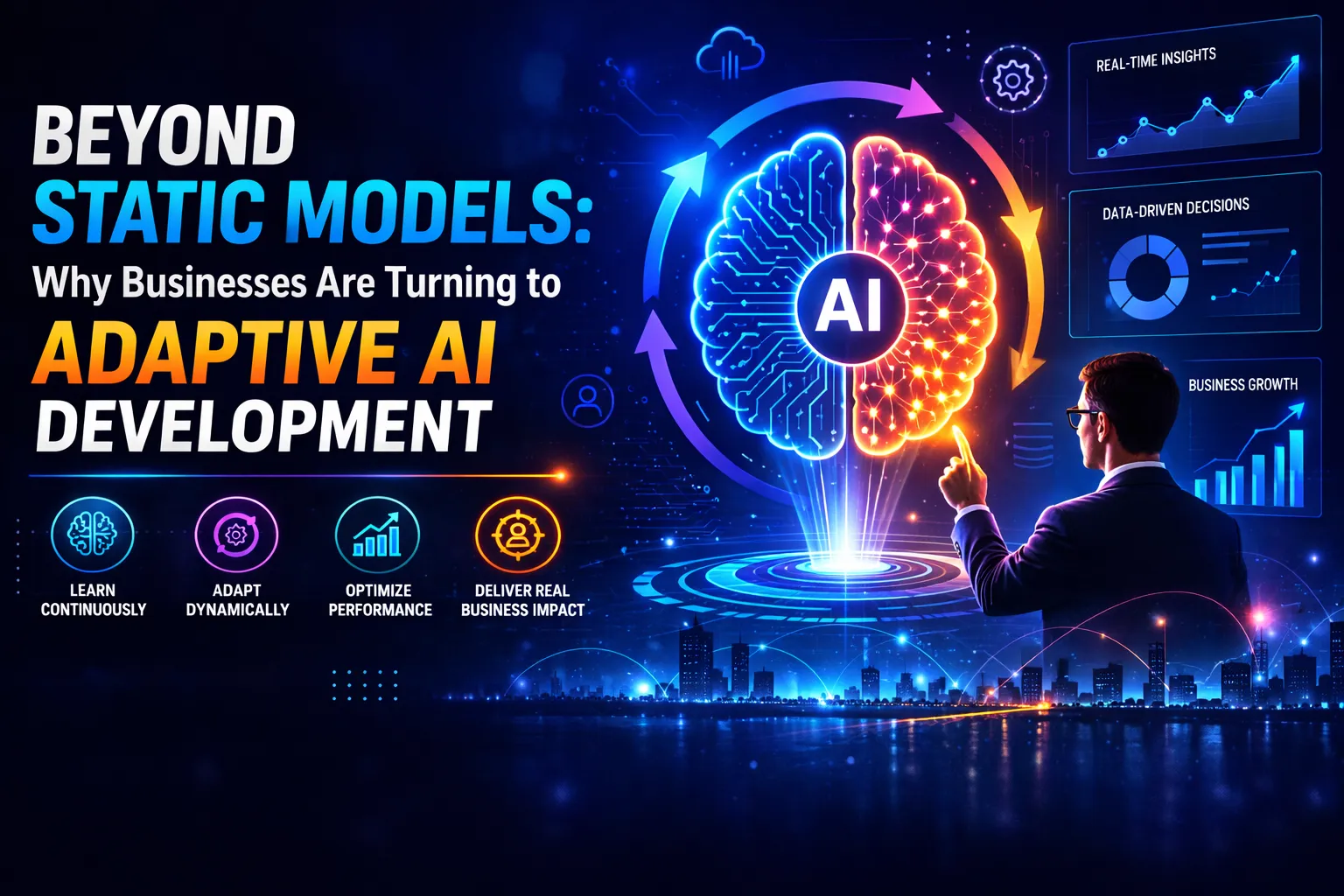

For years, artificial intelligence systems have largely operated the way they were trained-deployed once, then left to perform the same way until someone manually retrains or replaces them. But business environments don’t stand still. Customer behavior shifts, markets move, and new data patterns emerge constantly. Adaptive AI represents a fundamental shift in how intelligent systems are built: instead of being frozen in time, they continuously learn and adjust based on real-world feedback. For organizations looking to stay ahead, working with an experienced adaptive AI development company is becoming less of a competitive advantage and more of a necessity.
What Is Adaptive AI?
Adaptive AI refers to systems designed to update their behavior, models, or decision logic in response to new data and changing conditions-without requiring a full manual retraining cycle every time. Rather than relying on a single static model deployed at one point in time, adaptive AI systems incorporate mechanisms for continuous learning, real-time feedback loops, and dynamic recalibration.
This doesn’t mean the system changes unpredictably or without oversight. Well-designed adaptive AI development incorporates guardrails, monitoring, and validation steps so that models evolve in controlled, measurable ways-improving accuracy and relevance over time while remaining safe and explainable.
Why Adaptive AI Matters for Modern Businesses
Keeping Pace With Changing Data
Customer preferences, market conditions, and operational patterns shift constantly. A model trained on last year’s data can quietly lose accuracy-a phenomenon known as model drift. Adaptive systems are designed to detect and respond to these shifts before performance degrades significantly.
Reducing the Cost of Manual Retraining
Traditional AI maintenance often involves periodic, resource-intensive retraining cycles. Adaptive AI development services build in mechanisms for incremental learning, reducing how often full retraining is needed and lowering the long-term cost of keeping models current.
Personalization at Scale
Adaptive systems can tailor recommendations, responses, or decisions to individual users based on their ongoing behavior, rather than relying on broad segments defined at training time-improving relevance for each interaction.
Resilience in Dynamic Environments
In industries like finance, logistics, or cybersecurity, conditions can change rapidly. Adaptive AI is better equipped to respond to new fraud patterns, supply chain disruptions, or emerging threats without waiting for the next scheduled model update.
Core Elements of Adaptive AI Development
Building adaptive AI systems requires a different engineering approach than deploying a one-time trained model. Several components work together to enable safe, ongoing adaptation.
Continuous Data Pipelines
Adaptive systems depend on a steady, reliable flow of fresh data. This requires robust pipelines for data ingestion, cleaning, and labeling that can operate continuously rather than as a one-off preprocessing step.
Feedback Loops and Reinforcement Mechanisms
Systems need structured ways to capture outcomes-whether a recommendation was accepted, a prediction was accurate, or a user took a different action than expected and feed that information back into the model’s learning process.
Monitoring and Drift Detection
Ongoing monitoring tracks model performance metrics over time, flagging when accuracy, bias, or other indicators move outside acceptable ranges so that adaptation can be triggered or reviewed.
Safe Update and Rollback Mechanisms
Because models are changing more frequently, platforms need version control, A/B testing capabilities, and rollback procedures to ensure that any adaptation that performs poorly can be quickly reversed without disrupting operations.
Governance and Explainability
As models evolve autonomously, maintaining clear records of what changed, why, and how it affects decisions becomes essential-particularly in regulated industries where AI-driven decisions must be auditable.
Why Choose a Specialized Adaptive AI Development Company
Adaptive AI systems are inherently more complex than static models-they involve ongoing infrastructure, monitoring, and governance in addition to the initial model design. Partnering with a company that specializes in adaptive AI development services offers several distinct advantages.
Experience With Continuous Learning Systems: Specialized teams understand the practical challenges of building systems that learn safely over time, including how to balance adaptability with stability and predictability.
Established Monitoring and Governance Frameworks: Rather than building monitoring, drift detection, and rollback systems from scratch, an experienced adaptive AI development company brings proven frameworks that have already been tested in production.
Cross-Industry Expertise: Adaptive AI use cases vary widely, from dynamic pricing and personalization to fraud detection and predictive maintenance. A team with experience across industries can apply lessons learned from one domain to accelerate development in another.
Integration With Existing Systems: Adaptive AI rarely operates in isolation. Specialized developers know how to connect adaptive models with existing data infrastructure, business applications, and decision-making workflows without disrupting current operations.
Long-Term Optimization Support: Because adaptive systems are designed to evolve, the relationship with a development partner doesn’t end at launch. Ongoing tuning, monitoring, and improvement are part of getting lasting value from the investment.
Where Adaptive AI Is Headed
Adaptive AI is still an emerging discipline, but several trends point toward its growing importance across industries.
Convergence With Agentic AI: Adaptive learning capabilities are increasingly being combined with autonomous agents that can take actions, observe outcomes, and adjust their strategies in response-creating systems that improve through experience.
Real-Time Personalization Becoming Standard: As adaptive infrastructure becomes more accessible, real-time personalization is shifting from a competitive differentiator to a baseline expectation across e-commerce, media, and service industries.
Stronger Focus on Responsible Adaptation: As adaptive systems are deployed more broadly, expect growing emphasis on tools and standards for monitoring fairness, bias, and safety as models evolve over time.
Industry-Specific Adaptive Models: Rather than one-size-fits-all adaptive frameworks, expect more domain-tuned solutions designed around the specific data patterns and regulatory requirements of sectors like healthcare, finance, and manufacturing.
Organizations that invest in adaptive AI development now-with the right architecture and governance in place-will be better positioned to respond quickly as their markets and customer expectations continue to evolve.
Build Smarter, More Responsive AI Systems
Whether you’re looking to reduce the maintenance burden of existing AI models, improve personalization, or build systems that respond to change in real time, adaptive AI offers a path forward-but only when built on a solid foundation of data infrastructure, monitoring, and governance.
Get in touch to discuss your project with a team experienced in adaptive AI development company, and explore how continuously learning systems can be tailored to your business needs.
More info:https://www.clarisco.com/adaptive-ai-development-company
Telegram - https://telegram.me/ClariscoSolutions



























Sign in to leave a comment.