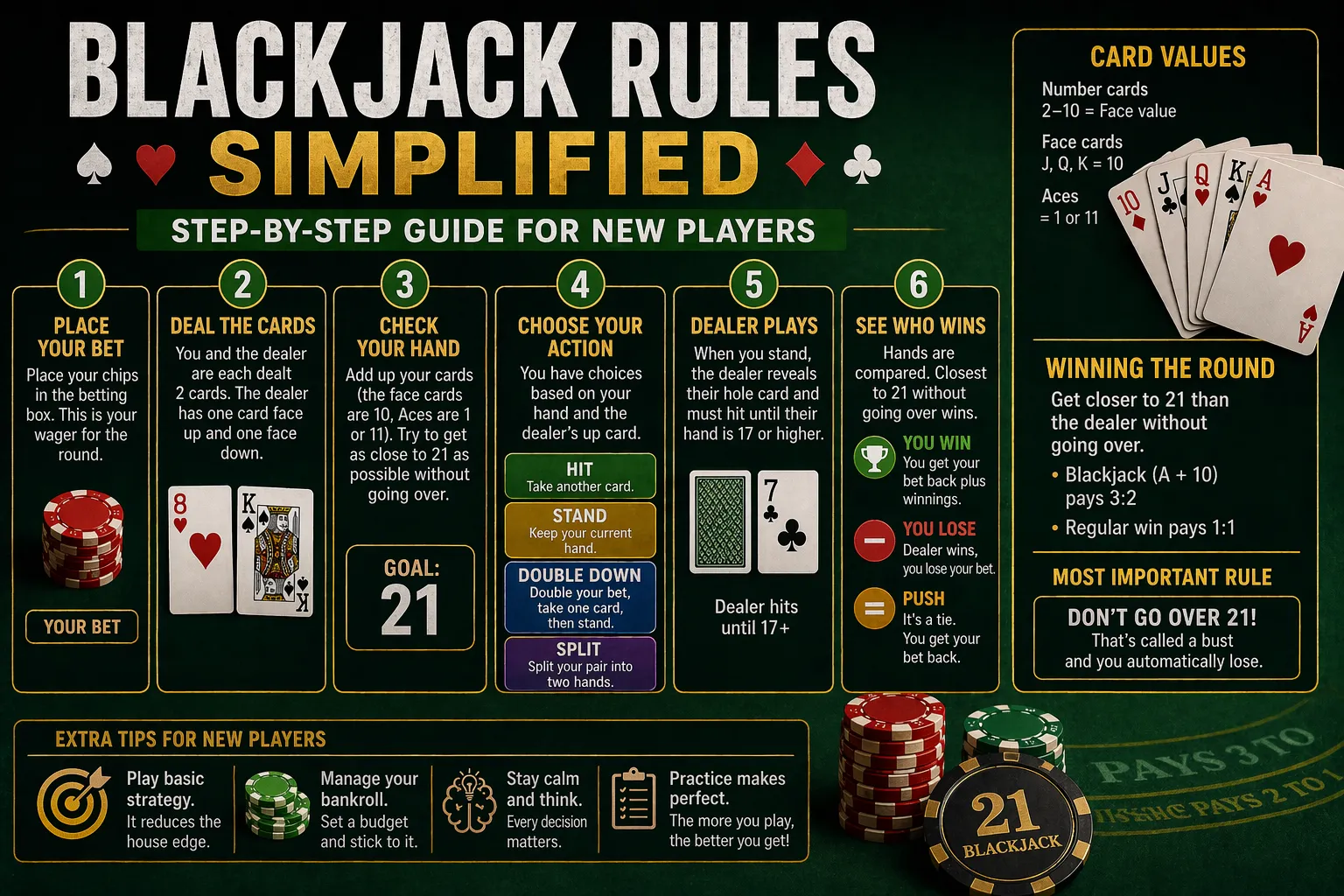

If you’re new to Blackjack, it might seem confusing at first—but in reality, it’s one of the easiest card games to learn. Once you understand the basic rules and flow, you can start playing confidently within minutes. This step-by-step guide breaks everything down in a simple way so you can quickly get started.
Step 1 Understand the Objective
The goal in Blackjack is straightforward:
Get a hand value as close to 21 as possible without going over, and beat the dealer’s hand.
You don’t need to hit exactly 21 to win—you just need a higher total than the dealer without busting.
Step 2 Learn Card Values
Every card in Blackjack has a fixed value:
Number cards from 2 to 10 are worth their face value
Face cards (King, Queen, Jack) are worth 10
Ace can be worth 1 or 11, depending on what benefits your hand
For example, an Ace and a 7 can be counted as 8 or 18. The game automatically uses the better value.
Step 3 Place Your Bet
Before cards are dealt, you place your bet. This is your initial wager for the round.
Once the cards are on the table, you usually can’t change this bet unless you choose special options like doubling down.
Step 4 Receive Your Cards
Each player is dealt two cards face up. The dealer also receives two cards:
One face up (visible to everyone)
One face down (hidden)
Your decisions will depend partly on the dealer’s visible card.
Step 5 Check for Blackjack
If your first two cards total 21 (an Ace + a 10-value card), you have a Blackjack.
This is the best possible hand and usually wins automatically unless the dealer also has Blackjack.
Step 6 Decide Your Move
Now comes the main part of the game—you decide how to play your hand. You have several options:
Hit: Take another card
Stand: Keep your current hand
Double Down: Double your bet and take one final card
Split: If you have two identical cards, split them into two hands
Your goal is to improve your hand without going over 21.
Step 7 Avoid Busting
If your total goes above 21, you bust and lose immediately.
This is why every decision matters. You need to balance the risk of taking another card with the chance of improving your hand.
Step 8 Dealer’s Turn
Once all players finish their turns, the dealer reveals their hidden card.
The dealer must follow fixed rules:
They must take cards (hit) until they reach at least 17
They must stop (stand) at 17 or higher
Unlike players, the dealer cannot make strategic choices.
Step 9 Compare Hands
After the dealer finishes:
If the dealer busts, all remaining players win
If the dealer doesn’t bust, hands are compared
The player with the higher total wins
If both have the same total, it’s a tie (called a push), and your bet is returned
Step 10 Understand Winning and Payouts
If you win, you usually get paid 1:1 (you double your bet).
If you get a Blackjack, the payout is typically higher (often 3:2, depending on the table rules).
If you lose or bust, your bet is gone.
Important Tips for Beginners
Start by keeping things simple. Focus on understanding when to hit and when to stand. You don’t need advanced strategies right away.
Always pay attention to the dealer’s visible card—it plays a big role in your decisions.
Avoid chasing 21 every time. Hands like 18 or 19 are often strong enough to win.
Practice with free or low-stakes games before playing with real money. This helps you learn without pressure.
Final Thoughts
Blackjack is popular because it combines simple rules with smart decision-making. Once you understand the flow—bet, deal, play, and compare—you’re ready to start.
By learning step by step and practicing regularly, you’ll quickly gain confidence and improve your gameplay. Keep it simple, stay patient, and enjoy the experience.























Sign in to leave a comment.