

Healthcare has never had a data shortage – it has a trust and interoperability problem. Every day, hospitals, clinics, laboratories, insurers, and digital health platforms generate massive volumes of patient data, yet much of it remains scattered across disconnected systems. The result? Delayed treatments, duplicate medical records, rising cybersecurity risks, and limited patient control over sensitive health information. As AI becomes an integral part of modern healthcare, these challenges are becoming impossible to ignore. This is where blockchain in healthcare is emerging as a game-changer, enabling secure data sharing, immutable audit trails, and HIPAA-compliant collaboration across healthcare ecosystems.
In this guide, we’ll explore how blockchain healthcare solutions are transforming patient care, the architecture behind blockchain healthcare platform development, real-world enterprise use cases, and the key factors to consider when choosing a blockchain healthcare development company.
Why Healthcare Needs Blockchain in 2026
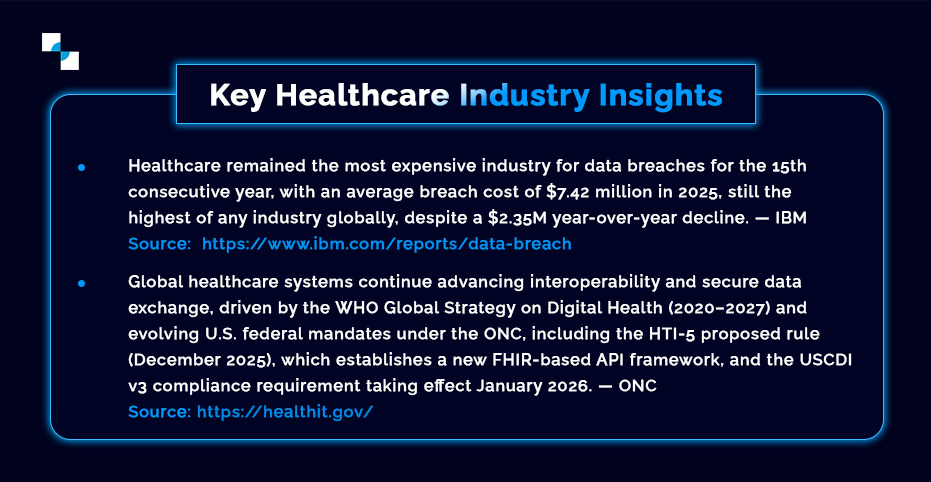
Healthcare is undergoing one of its most significant digital transformations, yet one fundamental challenge remains unresolved: enabling secure, trusted, and seamless data exchange across the healthcare ecosystem. While Electronic Health Records (EHRs), AI-powered diagnostics, telemedicine, connected medical devices, and cloud platforms have transformed care delivery, patient information still resides in fragmented systems managed by hospitals, laboratories, pharmacies, insurers, and specialist clinics. This lack of interoperability often leads to duplicate medical records, delayed clinical decisions, increased administrative costs, and a larger attack surface for cybercriminals.
The rapid adoption of artificial intelligence has made this challenge even more pressing. AI-driven healthcare depends on accurate, high-quality, and verifiable data, but fragmented data silos limit collaboration, complicate regulatory compliance, and reduce the reliability of AI-powered insights. Discussions at HIMSS 2026 and insights from the American Hospital Association reinforce that the future of healthcare will be shaped by interoperable systems, responsible AI governance, cybersecurity, and trusted data infrastructure, not by AI adoption alone.
This is where blockchain in healthcare delivers real value. Rather than replacing existing EHR systems, blockchain acts as a secure trust layer that verifies data integrity, records immutable audit trails, automates patient consent, and enables permission-based information sharing while keeping sensitive patient data encrypted in off-chain storage. As healthcare organizations build connected, AI-ready ecosystems, investing in blockchain healthcare solutions and blockchain healthcare platform development is becoming a strategic step toward creating secure, compliant, and interoperable healthcare networks.
What Is Blockchain in Healthcare?
Blockchain in healthcare refers to the application of distributed ledger technology to create a secure, tamper-resistant, and verifiable system for managing and exchanging medical data across multiple healthcare stakeholders. It enables hospitals, clinics, laboratories, insurers, and patients to interact through a shared digital framework where data integrity is cryptographically ensured and every authorized action is permanently recorded. Unlike traditional databases, blockchain does not store or control clinical records directly; instead, it ensures that any shared or referenced data remains authentic, traceable, and resistant to unauthorized modification.
In a modern healthcare architecture, blockchain functions as a foundational trust and coordination layer that connects existing systems such as Electronic Health Records (EHRs), laboratory information systems, insurance platforms, and pharmacy networks. It works alongside APIs, FHIR standards, and secure cloud storage to enable controlled access, consent-based data sharing, and verifiable transactions without disrupting existing clinical workflows. In this setup, sensitive patient data remains stored off-chain, while the blockchain maintains cryptographic proofs, consent records, and audit trails that ensure system-wide integrity and accountability.
Why Blockchain Is Different from Traditional Healthcare Databases
One of the biggest misconceptions is that blockchain is simply another database. In reality, it serves a very different purpose.
| Traditional Healthcare Database | Blockchain-Enabled Healthcare Platform |
|---|---|
| Data is controlled by one organization | Data integrity is shared across trusted participants |
| Records can be modified by authorized administrators | Every transaction creates an immutable audit trail |
| Limited visibility into historical changes | Complete transparency of authorized activities |
| Manual verification between organizations | Cryptographic verification of every transaction |
| Centralized trust | Distributed trust with permission-based access |
Think of blockchain as the trust layer, while existing EHR systems remain the system of record. This distinction is important because successful blockchain healthcare platform development focuses on strengthening existing healthcare infrastructure rather than replacing it.
Key Benefits of Blockchain Healthcare Solutions
Healthcare organizations are increasingly adopting blockchain healthcare solutions to address critical challenges related to data security, interoperability, regulatory compliance, and operational efficiency. By establishing a trusted framework for secure data exchange, blockchain in healthcare enables providers, insurers, laboratories, and patients to collaborate with greater transparency, strengthen patient trust, and streamline healthcare operations.
The following benefits demonstrate how blockchain healthcare solutions are helping healthcare organizations build secure, interoperable, and patient-centric digital ecosystems.
Enhanced Data Security and Integrity
Healthcare organizations manage highly sensitive patient information, making them frequent targets for cyberattacks and data breaches. Blockchain in healthcare strengthens security through immutable audit trails, cryptographic verification, and tamper-resistant records, while keeping Protected Health Information (PHI) securely encrypted in off-chain storage for greater privacy and regulatory compliance.
Improved Interoperability Across Healthcare Systems
Disconnected healthcare systems often prevent providers from accessing complete and accurate patient records. Blockchain healthcare platform development enables secure, permission-based data sharing across hospitals, laboratories, pharmacies, and insurers, improving collaboration without requiring organizations to replace their existing infrastructure.
Patient-Centric Data Ownership
Modern patients expect greater transparency and control over how their medical information is accessed and shared. Through smart contracts and digital identity management, blockchain healthcare solutions enable patients to securely grant, monitor, or revoke data access while strengthening trust between healthcare providers and individuals.
Faster and More Transparent Administrative Processes
Administrative tasks such as patient verification, insurance claims, billing, and approvals consume significant healthcare resources. By automating these workflows through smart contracts, blockchain in healthcare reduces manual effort, minimizes disputes, and accelerates decision-making across the healthcare ecosystem.
Better Compliance and Audit Readiness
Meeting regulatory requirements requires complete visibility into how patient information is accessed and managed. Blockchain healthcare platform development creates immutable audit trails, role-based access controls, and transparent transaction histories that simplify compliance reporting while supporting HIPAA-ready security frameworks.
AI-Ready Healthcare Infrastructure
Artificial intelligence relies on trusted, accurate, and traceable data to generate reliable clinical insights. Blockchain healthcare solutions establish verifiable data provenance and secure information sharing, creating a trusted foundation for AI-powered diagnostics, predictive analytics, and next-generation digital healthcare platforms.
Top Use Cases of Blockchain in Healthcare
The adoption of blockchain healthcare solutions is accelerating as healthcare organizations seek secure, transparent, and interoperable ways to modernize their digital infrastructure. From patient data management to AI-driven healthcare, blockchain healthcare platform development is enabling organizations to streamline operations, strengthen compliance, and improve patient outcomes. Below are some of the most impactful enterprise use cases transforming healthcare in 2026.
1. Secure Patient Medical Records
Managing patient records across multiple healthcare providers often leads to fragmented information and inconsistent medical histories. Blockchain in healthcare creates a trusted framework for verifying record authenticity, while encrypted off-chain storage and immutable audit trails ensure data remains secure, accessible, and tamper-resistant throughout the patient’s care journey.
Business Impact
- Reduces duplicate medical records
- Improves continuity of care
- Accelerates clinical decision-making
- Enhances patient trust
2. Secure Healthcare Data Exchange
Healthcare organizations regularly exchange sensitive information with hospitals, laboratories, pharmacies, and insurers. Through blockchain healthcare platform development, organizations can enable secure, permission-based data sharing that improves interoperability while maintaining patient privacy, regulatory compliance, and complete transaction transparency.
Business Impact
- Enables faster information sharing
- Minimizes administrative delays
- Improves interoperability
- Enhances patient outcomes
3. Patient Consent Management
Managing patient consent through paper-based or manual processes often creates inefficiencies and compliance challenges. Blockchain healthcare solutions use smart contracts to automate consent management, allowing patients to securely grant, modify, or revoke access permissions while maintaining complete visibility into how their health information is shared.
Business Impact
- Increases patient control
- Simplifies compliance
- Reduces administrative paperwork
- Strengthens patient confidence
4. Insurance Claims Automation
Insurance claims often require multiple stakeholders to validate the same information, resulting in delays and higher administrative costs. Blockchain in healthcare automates claims verification through smart contracts and shared transaction records, enabling faster settlements while reducing fraud and improving operational efficiency.
Business Impact
- Speeds up claims processing
- Lowers operational costs
- Reduces fraudulent claims
- Improves customer experience
5. Pharmaceutical Supply Chain Transparency
Counterfeit medicines remain a major concern for healthcare providers and pharmaceutical companies worldwide. Blockchain healthcare solutions create end-to-end traceability by securely recording every stage of the drug supply chain, improving product authenticity, recall management, and regulatory compliance.
Business Impact
- Prevents counterfeit medicines
- Improves supply chain visibility
- Strengthens regulatory compliance
- Builds consumer trust
6. Clinical Trials and Medical Research
Clinical research requires accurate, transparent, and verifiable data throughout the study lifecycle. Blockchain healthcare platform development enables immutable documentation of participant consent, protocol updates, and research data, improving collaboration while ensuring greater integrity and regulatory transparency.
Business Impact
- Increases research transparency
- Improves data integrity
- Supports regulatory compliance
- Strengthens research credibility
7. AI-Powered Healthcare
Artificial intelligence depends on trusted, high-quality healthcare data to generate accurate clinical insights and predictive analytics. Blockchain in healthcare provides verifiable data provenance and secure information sharing, creating a reliable foundation for responsible AI adoption across modern healthcare ecosystems.
Business Impact
- Supports responsible AI governance
- Improves data quality
- Enhances transparency
- Delivers more reliable clinical insights
How HIPAA-Compliant Blockchain Healthcare Platforms Work
Building a blockchain-powered healthcare platform isn’t just about integrating distributed ledger technology; it requires a security-first architecture that protects sensitive patient information while complying with healthcare regulations. A modern blockchain healthcare platform development strategy follows a hybrid architecture where blockchain serves as the trust layer, while medical records remain securely stored off-chain.
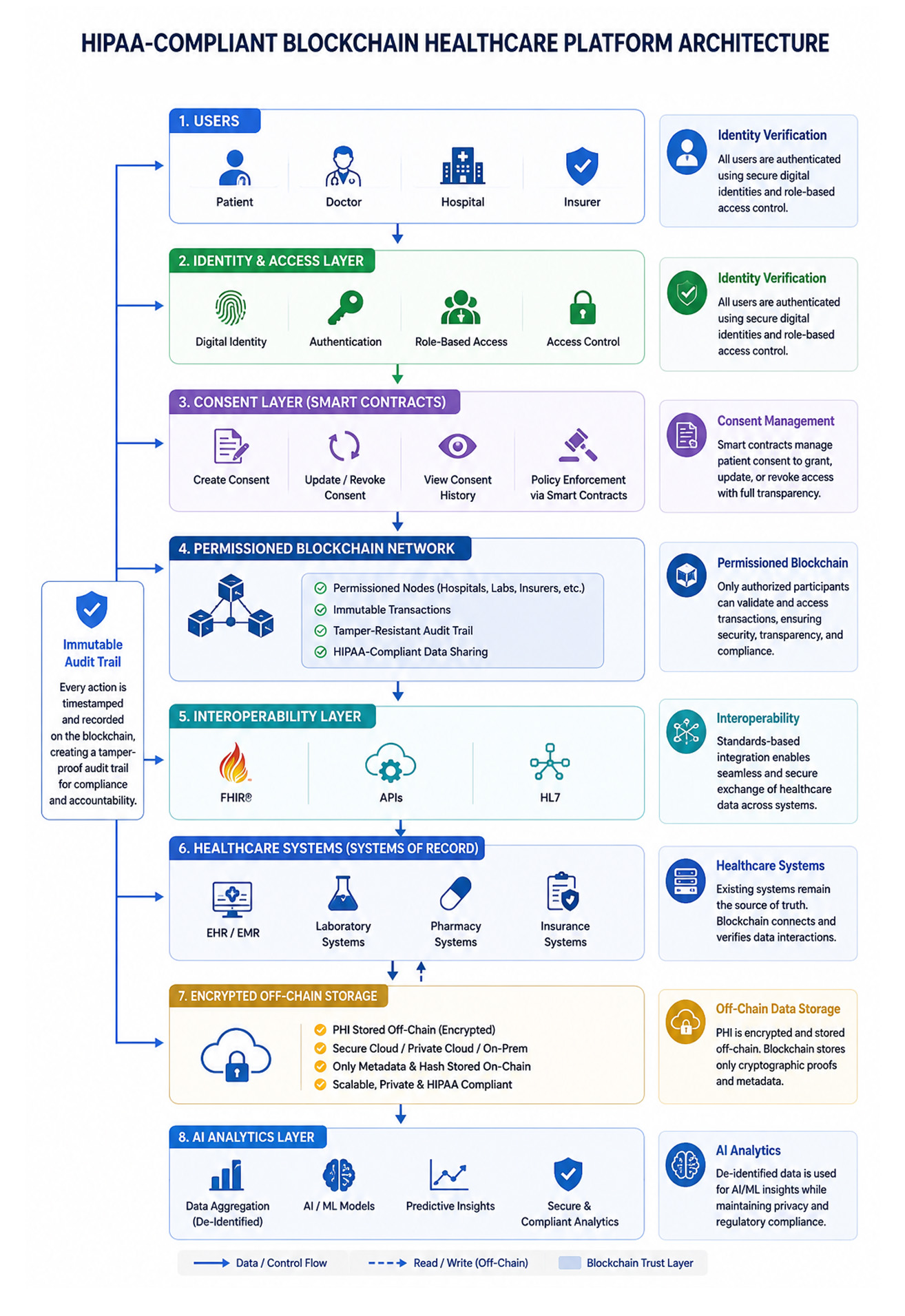
Each layer has a distinct responsibility:
Identity Verification
Patients, healthcare providers, laboratories, and insurers are authenticated through secure digital identities before accessing the platform. This ensures that only verified participants can exchange information, reducing unauthorized access and strengthening network security.
Consent Management
Smart contracts enable patients to securely grant, update, or revoke access to their medical information. Every consent action is recorded transparently, simplifying permission management while improving privacy and regulatory compliance.
Permissioned Blockchain
Healthcare platforms typically use permissioned blockchain networks where only authorized participants can validate and access transactions. This controlled environment enhances security, protects sensitive information, and supports HIPAA-compliant data sharing.
Off-Chain Data Storage
Protected Health Information (PHI) remains encrypted within secure cloud infrastructure or existing EHR systems, while blockchain stores only cryptographic proofs and transaction metadata. This hybrid architecture improves scalability, privacy, and data integrity.
Immutable Audit Trail
Every transaction, including record access, consent updates, and claims processing, is permanently timestamped on the blockchain. This creates a tamper-resistant audit history that strengthens transparency, accountability, and regulatory compliance.
Building a HIPAA-Compliant Blockchain Healthcare Platform
One of the most common misconceptions is that simply using blockchain makes a healthcare application HIPAA compliant. In reality, compliance depends on how the entire platform is designed, implemented, and governed. A successful blockchain healthcare platform development project should incorporate the following best practices.
Design for Privacy
Protected Health Information should never be stored directly on the blockchain. Instead, blockchain should reference encrypted records stored in secure databases, ensuring scalability while protecting patient privacy.
Use Permissioned Networks
Healthcare organizations should choose permissioned blockchain frameworks where network participants are known, authenticated, and governed by predefined policies.
Automate Consent Management
Smart contracts simplify how patients authorize healthcare providers to access their medical records. This improves transparency while reducing administrative complexity.
Integrate with Existing Healthcare Systems
Blockchain should complement not replace existing EHR, EMR, laboratory, pharmacy, and insurance platforms. API-based integration allows organizations to modernize their infrastructure without disrupting clinical workflows.
By following these practices, organizations can build secure and scalable blockchain healthcare solutions that align with regulatory requirements and support long-term digital transformation.
The Future of Blockchain in Healthcare
The future of blockchain in healthcare will be defined by its role as a trusted digital infrastructure rather than a standalone technology. As healthcare organizations accelerate AI adoption, the demand for secure, interoperable, and verifiable data will continue to grow. Industry discussions in 2026 increasingly emphasize that blockchain will complement AI, cloud computing, FHIR-based interoperability, and digital identity frameworks to create connected healthcare ecosystems built on trust and transparency.
Several trends are expected to shape the next generation of blockchain healthcare solutions:
- AI-ready healthcare ecosystems powered by trusted and verifiable clinical data.
- FHIR-enabled interoperability for seamless and standardized health information exchange.
- Decentralized digital identity that gives patients greater control over their medical records.
- Privacy-preserving data sharing that enables secure collaboration without exposing sensitive information.
- Automated compliance and governance through smart contracts and immutable audit trails.
- Hybrid cloud and blockchain architectures that balance scalability, security, and regulatory compliance.
As blockchain adoption matures, organizations will increasingly invest in blockchain healthcare platform development to strengthen data integrity, improve interoperability, and support AI-driven healthcare innovation. To build secure, scalable, and compliant healthcare solutions, many enterprises are partnering with a trusted blockchain development company that can deliver customized platforms tailored to evolving industry needs. Rather than replacing existing healthcare systems, blockchain is expected to become the trusted foundation that securely connects providers, payers, researchers, and patients across the digital healthcare ecosystem.
Ready for the Next Era of Healthcare?
As healthcare continues to embrace AI, cloud computing, and connected digital ecosystems, the ability to exchange data securely, transparently, and compliantly has become a business imperative. Blockchain in healthcare provides the trusted foundation needed to strengthen interoperability, protect sensitive patient information, automate compliance, and enable seamless collaboration across the healthcare ecosystem. Organizations that invest in blockchain healthcare solutions today will be better positioned to deliver secure, patient-centric, and future-ready healthcare services tomorrow.
If you’re looking to build a secure, scalable, and HIPAA-compliant healthcare platform, partnering with an experienced blockchain healthcare development company is the first step toward successful digital transformation. Antier delivers enterprise-grade blockchain healthcare solutions that combine blockchain, AI, and cloud technologies to help healthcare organizations build trusted, interoperable, and future-ready digital health ecosystems.




























Sign in to leave a comment.