

Product teams always have to be innovative as quickly as possible while still delivering quality of service, security, and reliability at a high level. The issue is that product or technical teams who do the heavy lifting behind the scenes might be a problem for a while if they are responsible for not only new features but also for the APIs, databases, integrations, bugs, and technical debt all at once.
So in these times, having a full-time backend developer can significantly help. Businesses can easily find a backend developer who has the same or even better understanding of the code, the architecture, and the business logic and who can work closely on the development and maintenance of the software.
For companies in the need of a few skilled technical resources, IT staff augmentation has another option to hire these backend specialists without necessarily hiring them as full-time employees, and this may lead to significant savings of costs and headcount as well.
What Are Dedicated Backend Developers?
Dedicated backend developers are software engineers who focus on the server-side components of an application. Their responsibilities can include:
- API development
- Database management
- Business logic
- Authentication and security
- Third-party integrations
- Cloud infrastructure
- Performance optimization
- Backend testing
They can work as an extension of an existing engineering team, participating in sprint planning, code reviews, testing, and technical discussions.
Depending on project requirements, businesses hire dedicated backend developers with expertise in Node.js, Python, Java, .NET, PHP, Go, Ruby, REST, GraphQL, SQL, NoSQL, and cloud platforms.
Why Backend Development Can Delay Product Releases
Backend work supports almost every part of a modern application. When backend development slows down, other teams can also become blocked.
API Development Bottlenecks
Frontend and mobile teams often depend on backend APIs before completing features. Delays in API design, development, or testing can therefore affect the entire release schedule.
Limited Engineering Capacity
Small teams may need to handle feature development, maintenance, bug fixes, infrastructure, and technical debt simultaneously. Adding new features can become difficult when developers are already at capacity.
Database and Performance Issues
Poor database design, inefficient queries, and inadequate caching can create performance problems. Fixing these issues late in development can result in additional rework.
Complex Integrations
Payment gateways, CRMs, authentication services, analytics platforms, and other third-party APIs can require significant backend development and testing.
Scaling Requirements
As applications grow, backend systems may require improvements in caching, database architecture, load handling, and infrastructure before a major launch.
How Dedicated Backend Developers Accelerate Product Releases
1. Increase Development Capacity
Adding backend developers gives teams more resources to handle release-critical work.
Instead of asking the same developers to manage new features and technical debt, additional engineers can take ownership of APIs, integrations, database work, or maintenance.
This makes it easier to distribute workloads and keep development moving.
2. Speed Up API Development
Dedicated backend developers can design, build, document, and test APIs while frontend developers work on the user interface.
This parallel development approach reduces dependencies between teams and allows multiple parts of a feature to progress simultaneously.
3. Reduce Backend Bottlenecks
When backend work becomes a dependency for multiple teams, additional developers can take ownership of those tasks.
With IT staff augmentation services, companies can add specialists to their existing teams without changing the overall product ownership structure.
4. Improve Database Performance
Backend developers can optimize database schemas, queries, indexing, caching, and data access layers.
Addressing these issues early can improve application performance and reduce the risk of last-minute technical problems before launch.
5. Accelerate Third-Party Integrations
Dedicated developers can handle integrations with:
- Payment gateways
- CRM platforms
- Authentication providers
- Cloud services
- Communication tools
- Analytics platforms
- External APIs
This allows internal teams to remain focused on other product priorities.
6. Enable Parallel Development
One of the biggest benefits of adding backend specialists is the ability to work on multiple areas simultaneously.
For example:
Frontend team: User interface
Backend team: APIs and business logic
QA team: Testing
DevOps team: Deployment and infrastructure
This reduces waiting time and can shorten development cycles.
7. Strengthen Testing and Release Quality
Faster development should not come at the expense of quality. Dedicated backend developers can implement unit, integration, and API testing to identify issues earlier.
They can also work with QA and DevOps teams to support automated testing and continuous integration.
8. Reduce Technical Debt
Technical debt can slow future releases. Dedicated developers can refactor legacy services, improve backend architecture, update dependencies, and improve documentation while the core team continues working on new features.
9. Scale Engineering Capacity
Product requirements change over time. A company may need additional developers during an MVP launch or major feature release and fewer resources during maintenance.
This flexibility is one reason companies choose to hire developers through dedicated teams or staff augmentation models.
Dedicated Backend Developers vs. Traditional Hiring
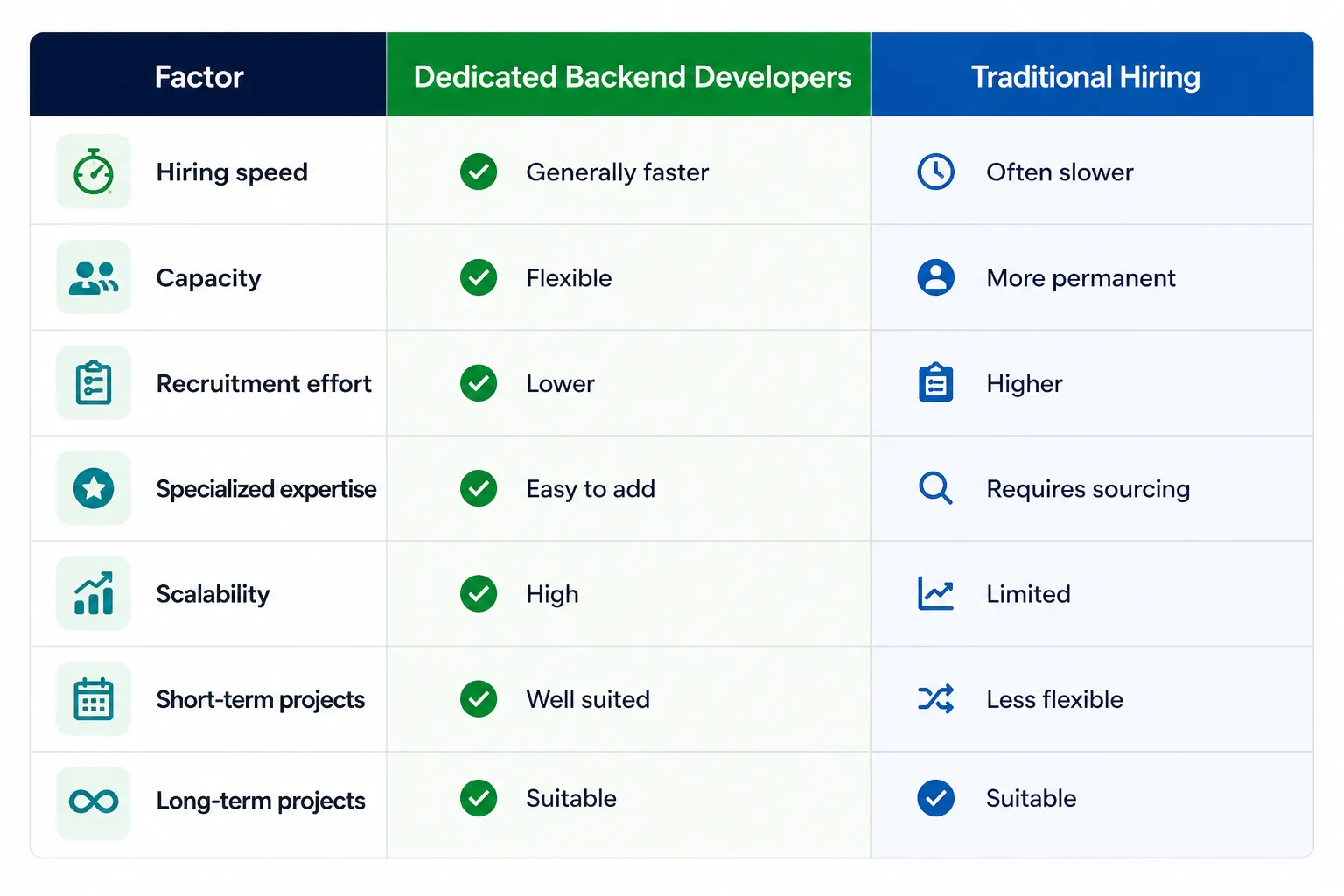
The right approach depends on the company's product roadmap, budget, internal capabilities, and development requirements.
When Should You Hire Backend Developers?
Companies may consider hiring backend developers when:
- A major product release is approaching.
- Backend development is blocking frontend or mobile teams.
- Internal developers lack specialized expertise.
- The company is modernizing a legacy application.
- Additional engineering capacity is needed temporarily.
- A SaaS application is experiencing rapid growth.
- The team needs to accelerate API or integration development.
For companies with an existing engineering team, IT staff augmentation can be especially useful because additional developers can work directly within established workflows.
How to Integrate Dedicated Backend Developers
Adding developers alone does not guarantee faster releases. Proper integration is essential.
Define Clear Release Goals
Identify the features, technical requirements, deadlines, and dependencies that must be completed.
Identify Skill Gaps
Determine whether you need expertise in APIs, databases, cloud architecture, microservices, security, or performance optimization.
Establish Development Processes
Provide access to repositories, documentation, development environments, project management tools, and communication channels.
Define Ownership
Clearly assign responsibility for APIs, databases, integrations, testing, and deployment-related tasks.
Measure Performance
Track metrics such as:
- Feature completion rate
- Sprint velocity
- API delivery time
- Defect rates
- Deployment frequency
- Release cycle time
These metrics can help determine whether additional engineering capacity is improving delivery.
How to Choose the Right Backend Developers
When you hire backend developers, look beyond programming language expertise. Evaluate their experience with:
- API architecture
- Database design
- Cloud platforms
- Security
- Automated testing
- Scalable architecture
- Performance optimization
- CI/CD
- Production systems
Communication and collaboration skills are equally important, especially when developers are joining an existing distributed team.
Common Mistakes to Avoid
Hiring Only for Technical Skills
A developer may know your technology stack but still lack experience solving complex production problems.
Prioritizing Speed Over Quality
Writing more code quickly does not necessarily mean faster product delivery. Poor-quality code can create technical debt and delay future releases.
Failing to Define Responsibilities
Unclear ownership can result in duplicated work and missed tasks.
Treating Augmented Developers as Separate
Developers working through IT staff augmentation should be integrated into relevant team processes rather than treated as external resources with limited context.
How Much Does It Cost to Hire Backend Developers?
The cost to hire backend developers depends on factors such as:
- Experience level
- Technology stack
- Location
- Project complexity
- Engagement duration
- Required specialization
- Team size
Companies should consider overall value rather than hourly rates alone. An experienced developer who can independently solve complex backend problems may deliver greater value and require less supervision.
Conclusion
Backend development directly affects product release speed. API dependencies, database problems, integrations, technical debt, and limited engineering capacity can all delay launches.
Dedicated backend developers provide a flexible way to address these challenges. They can increase development capacity, enable parallel workflows, accelerate integrations, improve backend quality, and reduce bottlenecks.
For companies with an existing engineering team, IT staff augmentation services can provide additional backend expertise while keeping product ownership and development priorities in-house. When the right developers are integrated into the right processes, increased backend capacity can translate into faster and more predictable product releases.
FAQs
How do dedicated backend developers accelerate product releases?
They increase engineering capacity, reduce backend bottlenecks, enable parallel development, and provide specialized expertise for APIs, databases, integrations, and performance.
When should a company hire backend developers?
Companies should consider hiring them when internal backend capacity is limited, release deadlines are tight, or specialized technical expertise is required.
Can startups use IT staff augmentation for backend development?
Yes. IT staff augmentation allows startups to add backend specialists to existing teams without building a large permanent engineering workforce.
What skills should backend developers have?
Backend developers should understand relevant programming languages, APIs, databases, cloud platforms, testing, security, and scalable application architecture.
How can companies hire developers faster?
Businesses can use dedicated hiring or IT staff augmentation to add experienced developers and increase engineering capacity without relying entirely on lengthy traditional recruitment.































Sign in to leave a comment.