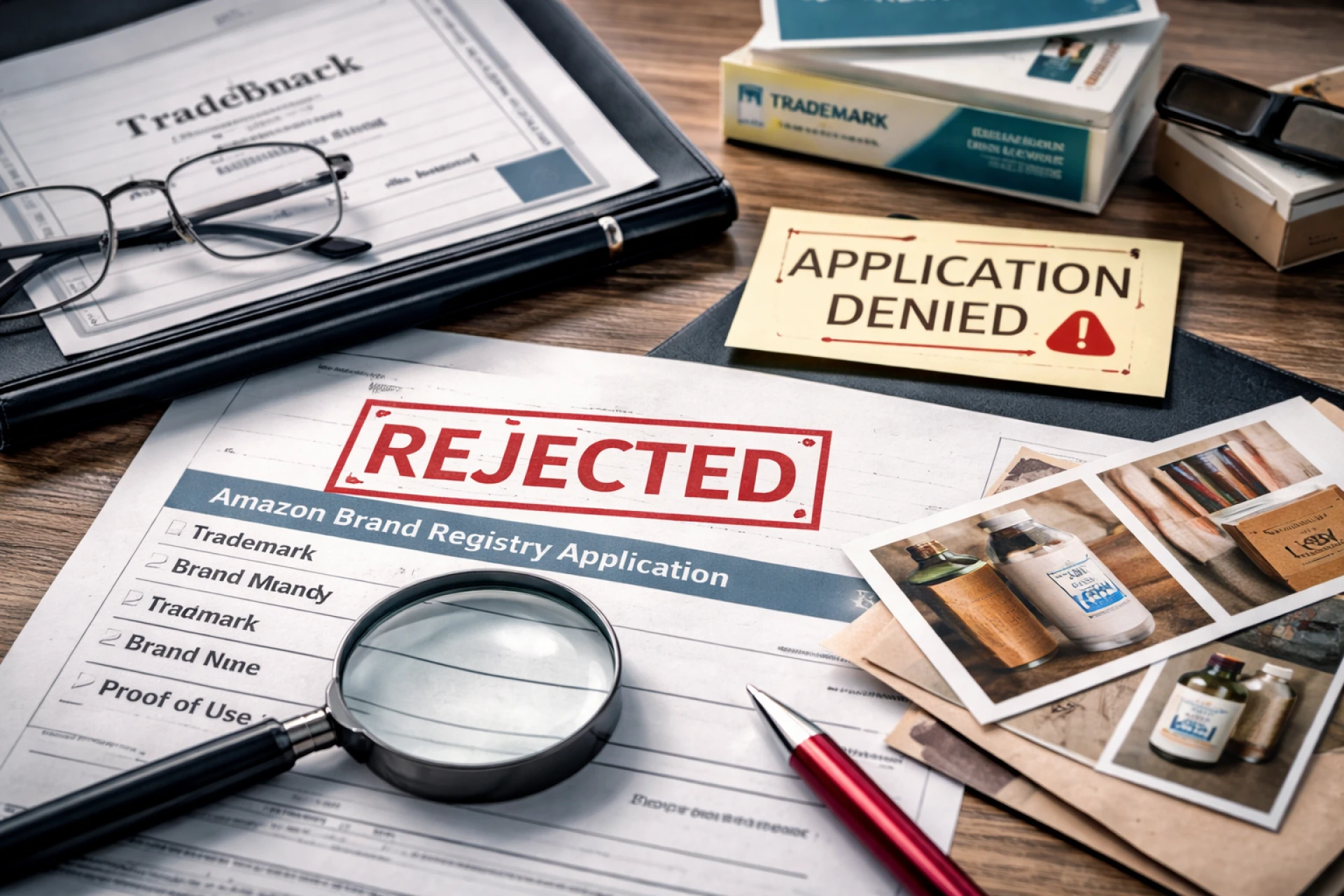

If Amazon denied your Brand Registry application, it’s rarely random. Most Brand Registry rejections happen because something in your proof doesn’t match what Amazon expects to see across your trademark record, your product branding, and the materials you submitted. When those pieces don’t line up perfectly, Amazon treats it as a risk issue—impersonation risk, hijacking risk, or weak proof that the brand is real and controlled by you.
This guide explains the most common reasons Brand Registry applications get denied and the fixes that actually work so you can reapply with a cleaner, approval-ready submission.
If you want attorney guidance for Brand Registry and trademark registration, you can start here:
https://www.amazonsellers.attorney/trademark-registration-amazon-brand-registry.html
What Amazon is really checking (the fast way to understand denials)
Amazon Brand Registry is not just a trademark lookup. Amazon is verifying three things at the same time.
First, that you have a qualifying trademark in a jurisdiction Amazon accepts, in the right status.
Second, that the brand name you’re claiming is the same brand name appearing on your products and packaging in the real world—not just in a listing or a mockup.
Third, that you have legitimate authority to act for that brand, without inconsistencies that suggest you’re using someone else’s name or borrowing IP.
Most denials come from mismatches across those categories.
Top reasons Amazon Brand Registry applications get denied (and how to fix each)
- Your brand name doesn’t match the trademark exactly
Why you got denied: Amazon expects a near-perfect match between the brand name you enter and the trademark record. Sellers get denied over small differences: spacing, punctuation, pluralization, capitalization, added words, or leaving words out.
Fix: Use the exact mark as it appears in the official trademark record. If your product branding is different, update the branding to match the trademark or file the trademark that matches how you actually use the brand in commerce.
- The trademark isn’t in an accepted status or jurisdiction for what you submitted
Why you got denied: Some applicants submit pending marks when Amazon expects registered marks for that country, or they use a jurisdiction Amazon does not accept the way they think it does. Sometimes the status is active, but key details don’t align with what Amazon’s system expects.
Fix: Confirm the trademark’s jurisdiction, status, and exact record details before applying. If your jurisdiction requires registration rather than a pending application, wait until registration or adjust your strategy. Don’t guess. Brand Registry approvals depend on Amazon’s eligibility rules for your country and mark status.
- Your images don’t show the brand name permanently affixed
Why you got denied: Amazon commonly rejects images where the brand name appears only on a removable sticker, a temporary insert, a hang tag, or packaging that looks generic. Amazon wants to see the brand name permanently affixed to the product or packaging.
Fix: Submit clear, real photos showing the brand name printed, engraved, stamped, molded, or otherwise permanently applied. Use bright lighting, close-ups, and avoid heavily edited images. If you’re using packaging, show the brand name printed directly on the packaging, not on a slap-on sticker.
- Your packaging proof looks like a mockup or render
Why you got denied: Brand Registry reviewers are trained to spot packaging that looks like a template, digital render, AI-style image, or Photoshop edit. If the packaging looks fake, Amazon treats it as unreliable proof.
Fix: Photograph real, produced packaging. Show multiple angles. One photo should look clearly real-world, like the product on a table or in hand, and another should be a close-up of the brand name. Avoid flat “graphic-only” images that look like a 2D mockup.
- Your trademark ownership doesn’t match who is applying
Why you got denied: If the trademark owner is a person or company that doesn’t align with your Seller Central account details, Amazon may reject the application or ask for additional proof of authority.
Fix: Apply as the correct rights owner or make sure you can prove your authority to act for that brand. If the trademark is owned by a different entity, fix the ownership structure where appropriate or make sure your documentation shows legitimate control before you apply again.
- You entered the wrong trademark number (or the wrong record type)
Why you got denied: This happens constantly: the wrong number, wrong country, confusion between an application number and a registration number, or pulling the mark from an unofficial source.
Fix: Pull the mark directly from the official database and copy the number exactly. Confirm the mark text shown in the record matches the name you’re submitting. Then verify you selected the correct jurisdiction inside the Brand Registry application.
- The verification code email never arrives (or goes to someone else)
Why you got denied: Amazon often sends the verification code to the email associated with the trademark record or to the correspondent Amazon recognizes as controlling the IP. If the code goes to the wrong inbox, your application stalls.
Fix: Confirm who will receive the verification code before you apply. If an attorney or agent is listed in the trademark record, coordinate so the code can be received and forwarded immediately. Don’t apply until you know the code process will work.
- Your brand is too generic or conflicts with existing brands
Why you got denied: Some brand names are weak, highly descriptive, or too close to existing brands within Amazon’s ecosystem. Even if the trademark office accepted it, Amazon may still treat it as operationally risky.
Fix: Strengthen your brand distinctiveness and your proof. If the name is colliding with another brand’s identity, consider filing a more distinctive mark, adjusting your branding, or restructuring your strategy to avoid marketplace confusion.
What to do immediately after a Brand Registry denial (the clean reapply strategy)
After a rejection, most sellers panic and start resubmitting variations. That usually leads to repeated denials, more delays, and a larger compliance mess.
Instead, do this:
First, save the denial message and the exact wording Amazon used.
Second, confirm the trademark status and exact mark text from the official record.
Third, take new real-world photos of product and packaging showing the brand name permanently affixed.
Fourth, make sure the brand name, trademark details, and submission fields match with no “close enough” differences.
Fifth, reapply only when your proof set is consistent and clean.
A key point: Brand Registry isn’t the end—it’s the start of brand enforcement
Many sellers assume Brand Registry automatically stops hijackers. It doesn’t. Brand Registry gives you better tools, but you still need a real enforcement strategy: strong IP documentation, consistent listing control, and a plan for counterfeit claims, infringement disputes, and false reports.
That’s why we treat Brand Registry as the foundation of a broader brand protection program—not a checkbox.
When you should get help
If you’ve been denied more than once, if your trademark ownership and business structure are not aligned, or if you’re dealing with hijacking or infringement while applying, it’s smart to get help before you keep submitting new applications. Repeated inconsistent submissions can slow everything down and make approvals harder.
For attorney support with Brand Registry and trademark strategy, start here:
https://www.amazonsellers.attorney/trademark-registration-amazon-brand-registry.html
FAQ: Brand Registry rejections
How long does Amazon Brand Registry approval take?
It varies depending on trademark status, verification steps, and whether Amazon requests additional proof. Clean submissions are faster. Inconsistent submissions create delays.
Can I apply with a pending trademark?
Most of the time, yes, depending on your jurisdiction and Amazon’s current eligibility rules. If Amazon requires a registered mark for your country, a pending mark may be denied.
Why did Amazon reject my photos?
Usually because Amazon believes the brand name is not permanently affixed, the images look like mockups, or the brand name isn’t clear and consistent across product and packaging.
What’s the most common Brand Registry mistake?
Small mismatches between the trademark record and the brand name shown on product or packaging—differences sellers assume Amazon will ignore.
What if I can’t receive the verification code?
The code is likely being sent to the trademark owner or the correspondent Amazon recognizes. You may need to coordinate with that party or correct records before reapplying.
Disclaimer: This article is for general information and is not legal advice. For advice about your specific situation, consult qualified counsel.



























Sign in to leave a comment.