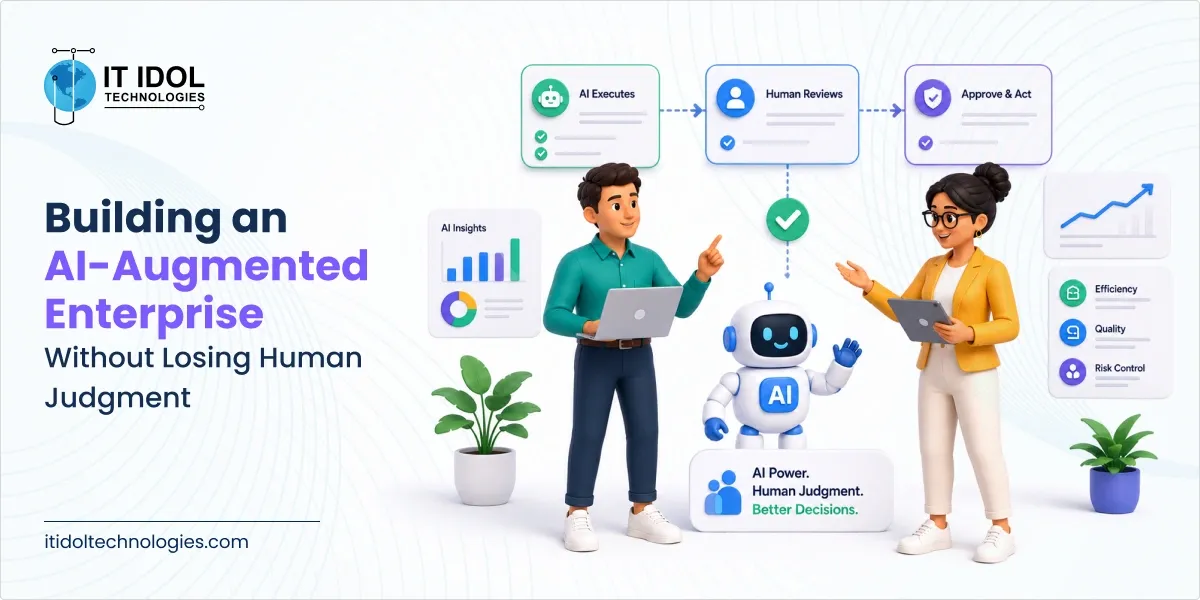

Discover how to build an AI-augmented enterprise that scales efficiency through automation while preserving critical human judgment and oversight.
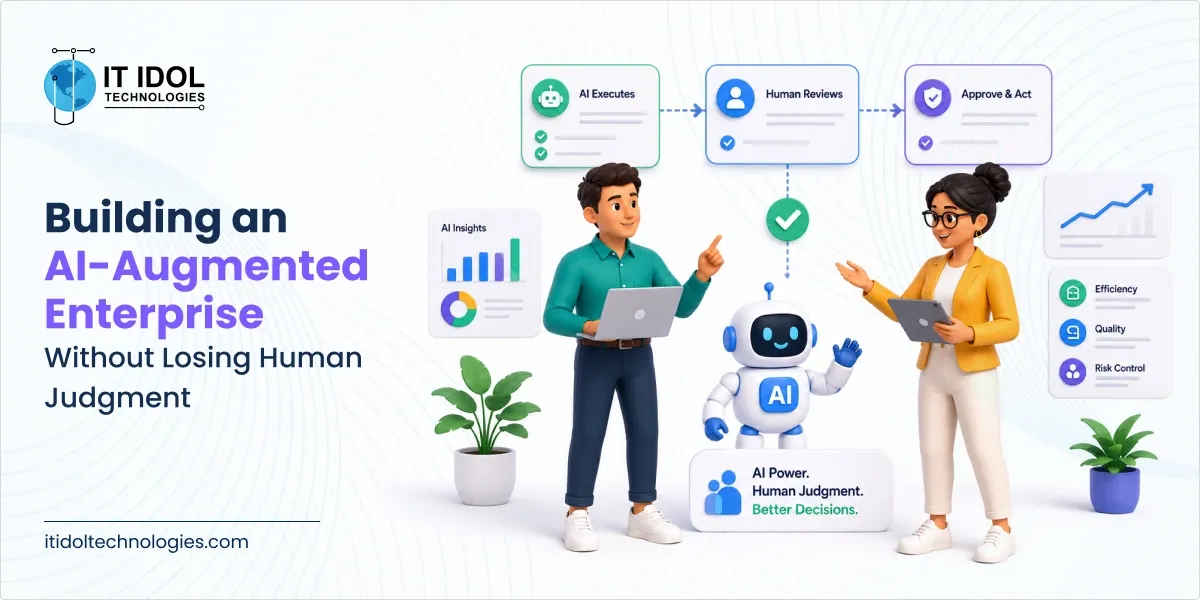
Enterprise leaders are currently facing a massive paradox. On one hand, the race to deploy autonomous agents, multi-agent workflows, and large language models is moving at a breakneck pace. On the other hand, the organisations seeing the highest return on investment (ROI) aren't the ones trying to replace their workforce with code. They are the ones treating AI as an operating system and human judgment as the steering wheel.
When you automate blindly, you don't just scale efficiency; you also scale errors. An AI agent can process thousands of customer invoices or draft engineering documentation in minutes. But without structural human oversight, a single algorithmic hallucination can quietly corrupt an enterprise data pipeline or alienate a high-value client before anyone notices.
Building an AI-augmented enterprise isn't about achieving 100% automation. It is about designing a system where AI handles the cognitive heavy lifting, freeing your human experts to do what they do best: manage risk, contextualise nuance, and make high-stakes decisions.
The Strategic Friction: Where Enterprise AI Stalls
Many organisations approach AI adoption with a flawed mental model, viewing it as a plug-and-play software upgrade. This perspective leads to two critical operational challenges:
The "All-or-Nothing" Fallacy
Teams frequently swing between two extremes. They either fully automate a workflow, removing human oversight entirely, or they reject AI completely out of fear of inaccuracies. Both approaches stall growth. The most productive framework introduces "Human-in-the-Loop" validation at high-risk friction points while letting AI run autonomously on low-risk, repetitive tasks.
Context Blindness
Large language models are exceptional at identifying patterns within historical data, but they lack situational awareness. They don’t understand your shifting boardroom dynamics, sudden macroeconomic pivots, or the unspoken nuances of the relationship with a long-term enterprise partner. When AI operates without human context, its outputs can be statistically accurate yet strategically useless.
A Practical Framework for Human-AI Collaboration
To scale safely, enterprises need a clear blueprint that defines exactly where the machine's work ends and human validation begins.
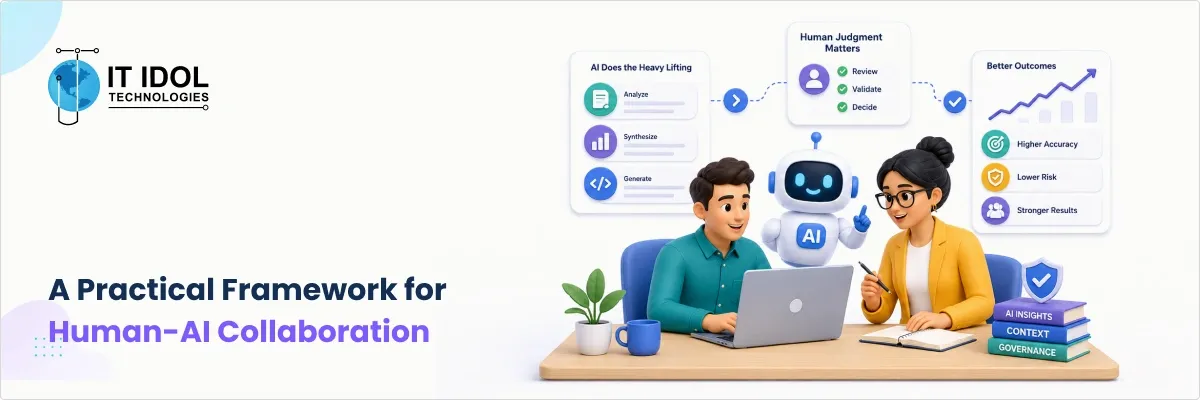
1. Establish Tiered Automation Thresholds
Not every business process requires the same level of human oversight. Organisations should categorise workflows into distinct risk tiers to maximise efficiency without sacrificing quality:
- Tier 1: Low Risk (Autonomous Execution). Internal data sorting, routine software environment checks, or initial customer support routing. AI handles these end-to-end.
- Tier 2: Medium Risk (Human-Approved). Drafting technical documentation, initial code generation, or synthesising market research. AI generates the foundation; humans review and edit.
- Tier 3: High Risk (Human-Driven, AI-Assisted). Architecture design, contract negotiations, cybersecurity incident response, and final code deployments. Humans drive the process, using AI strictly for deep analysis and validation.
2. Designate "Human-in-the-Loop" Checkpoints
Instead of reviewing an entire project at the very end, build structural checkpoints directly into your multi-agent workflows. For instance, if an AI agent is tasked with scanning a legacy codebase for migration, let it flag the anomalies and draft the fixes, but require an experienced engineer to approve the code before it hits the production pipeline.
3. Move from "Prompting" to Contextual Curation
The value of an AI tool depends heavily on the context it is given. Rather than expecting teams to master complex prompt engineering, give them specialised internal knowledge bases. When AI tools are grounded in your company's actual technical documentation, past project architectures, and compliance rules, the output becomes instantly more practical and less generic.
Real-World Impact: Striking the Balance
Consider how a modern engineering or IT department handles legacy code modernisation.
If an enterprise hands a massive, outdated system entirely over to an autonomous AI tool for rewriting, the result is often chaotic. The AI might generate clean code that completely misses hidden, undocumented business logic built into the original system over a decade.
Conversely, a balanced approach yields massive dividends. In a structured human-AI model, the AI agent analyses the legacy architecture, maps out dependencies, and generates a functional modular blueprint in hours, a task that would normally take a senior developer weeks. The developer then steps in to review the architecture, adjust for custom business logic, and steer the deployment.
The Result: The enterprise slashes project timelines by 40% to 50% while completely avoiding the catastrophic downtime caused by unvetted, automated code.
Actionable Next Steps for Enterprise Leaders
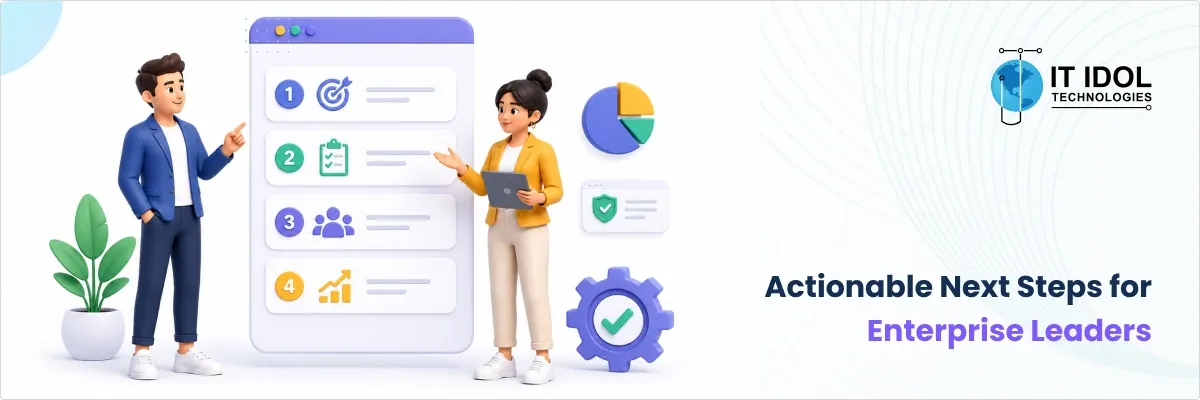
- Audit Your Workflows: Identify three high-volume, repetitive processes in your department currently causing bottlenecks.
- Define the Guardrails: Map out these workflows and explicitly mark the exact step where a human expert must review and sign off before execution.
- Equip Your Team: Shift your training focus from basic AI usage to critical evaluation, teaching your engineers and managers how to audit, validate, and refine AI-generated outputs effectively.
Navigating the complexities of digital transformation requires a careful balance between cutting-edge automation and reliable, proven architecture. At IT Idol Technologies, we specialise in building robust, scalable software solutions engineered for real-world business challenges.
Whether you are looking to modernise legacy infrastructure, optimise your workflows, or deploy secure, intelligent applications, our team delivers custom software engineering tailored to your operational goals. We handle the technical heavy lifting so your team can focus on strategic growth.
Explore Enterprise Solutions with IT Idol Technologies
Frequently Asked Questions (FAQs)
1. What is an AI-augmented enterprise?
An AI-augmented enterprise uses artificial intelligence to support employees by automating repetitive tasks, analysing data, and providing insights. The goal is to enhance human decision-making, not replace it.
2. How is AI augmentation different from full automation?
AI augmentation keeps humans involved in important decisions while AI handles repetitive or data-intensive tasks. Full automation minimises or removes human involvement, which may not be suitable for complex or high-risk decisions.
3. Why is human judgment still important in an AI-driven workplace?
AI can identify patterns and make recommendations, but it cannot fully understand business context, ethics, emotions, or organisational priorities. Human judgment is essential for making balanced, responsible, and strategic decisions.
4. Which business functions benefit the most from AI augmentation?
AI can improve operations across customer service, sales, marketing, finance, HR, healthcare, supply chain, and software development by increasing efficiency, reducing manual work, and providing faster insights.
5. What are the risks of relying too heavily on AI?
Overdependence on AI can lead to biased decisions, inaccurate recommendations, reduced accountability, privacy concerns, and a lack of critical thinking if human oversight is removed.
6. How can organisations balance AI efficiency with human expertise?
Businesses should use AI to support routine tasks while keeping experienced employees responsible for reviewing recommendations, making final decisions, and handling complex situations that require judgment.
7. What skills do employees need in an AI-augmented enterprise?
In addition to technical knowledge, employees need critical thinking, problem-solving, communication, ethical decision-making, and the ability to interpret AI-generated insights effectively.
8. How can business leaders build trust in AI systems?
Trust grows when AI systems are transparent, regularly monitored, tested for accuracy and bias, and supported by clear governance policies that ensure human oversight for important decisions.
9. What role does leadership play in successful AI adoption?
Leaders are responsible for setting AI governance policies, defining where AI should and shouldn't be used, investing in employee training, and ensuring technology aligns with business goals and ethical standards.
10. How can businesses start building an AI-augmented enterprise?
Organisations should begin by identifying repetitive, time-consuming processes that AI can improve, establish clear governance and oversight, train employees to work alongside AI, and continuously measure both operational outcomes and business value.

























Sign in to leave a comment.