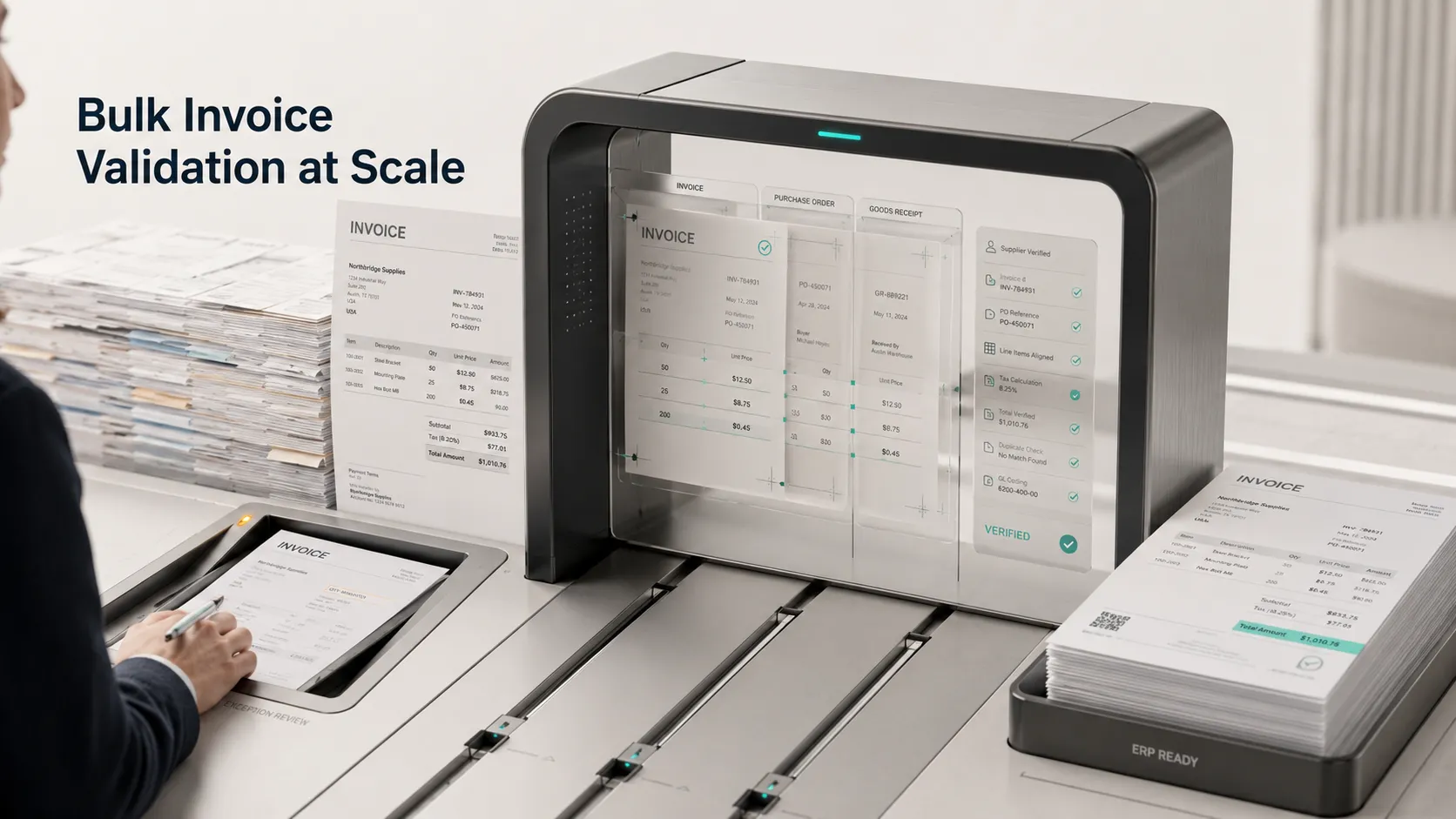

Large enterprises can receive hundreds or even thousands of invoices every day. Each invoice may contain different supplier details, tax information, purchase order references, quantities, prices, currencies, and payment terms. When this volume is handled manually, even a small error rate can create duplicate payments, delayed approvals, supplier disputes, and inaccurate financial records.
Bulk invoice validation creates a structured process for checking large invoice volumes quickly and consistently. Businesses can combine automated data extraction, validation rules, matching, exception management, and human oversight to improve accounts payable performance.
What Is Bulk Invoice Validation?
Bulk invoice validation is the process of verifying high volumes of supplier invoices before they are approved or posted into an accounting or ERP system.
The objective is to confirm that invoice data is complete, accurate, compliant, and consistent with supporting records.
Validation can include checking supplier information, invoice numbers, purchase order references, quantities, unit prices, tax codes, totals, cost centres, GL codes, and payment details. Duplicate invoice detection is also important because repeated invoices can lead to unnecessary payments.
For businesses dealing with increasing transaction volumes, professional invoice processing and validation services can provide a controlled workflow from invoice capture and data extraction through validation, exception management, and ERP-ready output.
Why Manual Invoice Validation Becomes Difficult at Scale
Manual validation may work when an accounts payable team handles a smaller number of invoices. The challenge appears when transaction volume increases significantly.
Employees must review more documents while still meeting payment deadlines and month-end schedules. Suppliers may submit invoices as PDFs, scanned documents, email attachments, EDI files, or portal uploads. Different layouts make manual data entry slower and can increase inconsistencies.
Month-end periods, acquisitions, seasonal demand, or rapid business growth can also increase invoice workloads without giving finance teams enough time to recruit and train additional employees.
A structured document processing workflow can help organizations handle large volumes of business documents while improving data capture, classification, verification, and processing consistency.
How a Bulk Invoice Validation Workflow Works
A reliable bulk invoice validation process normally begins with invoice intake. Documents can be collected from email accounts, supplier portals, scanned files, shared folders, EDI systems, or other digital sources.
The next stage is data extraction.
OCR and intelligent document processing technologies can identify information such as:
- Supplier name
- Invoice number
- Purchase order number
- Invoice date
- Line items
- Quantities
- Unit prices
- Tax amounts
- Discounts
Total invoice value
Once the information is extracted, the data is checked against predefined business rules and supporting records.
Three-way matching can compare the supplier invoice with the corresponding purchase order and goods receipt. Validation rules can also identify incorrect tax calculations, pricing differences, missing information, duplicate invoices, and coding inconsistencies.
Invoices that successfully pass these checks can continue to approval or ERP posting.
Invoices containing discrepancies are separated and routed into an exception-management process instead of delaying the entire invoice batch.
Where AI and Automation Help
AI and automation are particularly valuable when businesses need to process repetitive financial data at high speed.
Technology can recognize document structures, extract important fields, compare information with other records, identify patterns, and flag unusual transactions.
This significantly reduces the amount of repetitive manual work performed by accounts payable teams.
However, automation does not completely remove the need for human involvement.
Poor-quality scans, unusual supplier layouts, handwritten corrections, incomplete purchase orders, pricing disputes, and complex exceptions may still require experienced reviewers.
For this reason, an effective invoice validation model often combines automated processing with human quality control.
Benefits of Bulk Invoice Validation
One of the biggest advantages is faster processing.
Automated data extraction and rule-based validation allow large batches of invoices to move through accounts payable workflows much faster than completely manual processing.
Accuracy is equally important.
Standardized validation rules can help reduce:
- Data-entry errors
- Duplicate invoices
- Duplicate payments
- Incorrect tax calculations
- Purchase order mismatches
- Incorrect pricing
Missing supplier information
Bulk invoice validation also makes finance operations more scalable.
Instead of continuously expanding internal teams whenever invoice volume grows, enterprises can use automated systems and specialized processing resources to support higher transaction volumes.
Another important advantage is visibility.
Structured validation workflows create clearer approval records, exception histories, audit trails, and reporting data. Finance teams can therefore identify recurring supplier issues, frequent mismatches, processing bottlenecks, and areas requiring process improvement.
What Should Enterprises Look for in a Validation Partner?
Choosing the right invoice-processing partner involves more than comparing prices.
Enterprises should evaluate whether a provider can handle different invoice formats, high transaction volumes, matching requirements, ERP integrations, exception workflows, and complex business rules.
Important factors to consider include:
- Data security
- Processing accuracy
- Turnaround time
- Scalability
- Quality-control procedures
- Reporting capabilities
- ERP compatibility
- Compliance requirements
Human review processes
Businesses considering a larger accounts payable transformation can also explore Computyne’s detailed guide to bulk invoice validation at scale to understand how structured validation and automation can support enterprise invoice operations.
Final Thoughts
Bulk invoice validation is not simply about processing invoices faster. It is about creating a finance workflow that remains accurate, scalable, and controllable as transaction volumes increase.
By combining automated data extraction, predefined validation rules, purchase order matching, exception management, and human review, enterprises can reduce repetitive manual work while improving the reliability of accounts payable data.
For organizations processing large volumes of supplier invoices, building a scalable validation workflow can help prevent finance operations from becoming a bottleneck as the business grows.






















Sign in to leave a comment.