
Growth creates an interesting problem.
The more successful a business becomes, the more work it creates.
More customers mean more emails. More projects mean more approvals. More sales mean more data, reports, documents, and administrative tasks.
Initially, these activities seem manageable.
Teams work a little harder. Processes become slightly more complex. New spreadsheets appear. Additional software gets added. Employees develop workarounds.
Then one day the business realizes something unexpected.
The challenge is no longer acquiring customers.
The challenge is managing operations.
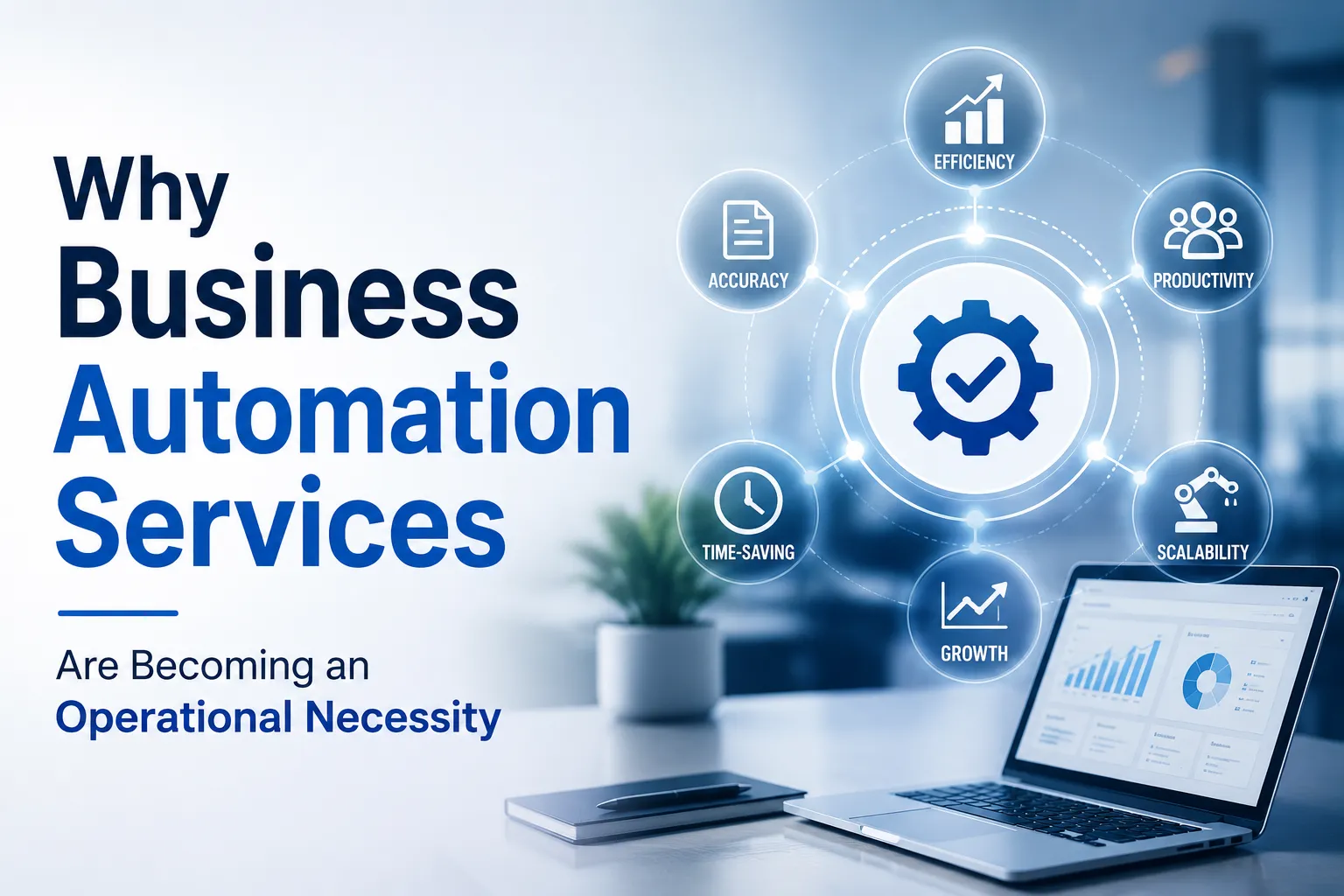
This is one reason many organizations are investing in business automation services as part of their growth strategy.
A Simple Exercise
Think about the last working day.
How many times did someone on your team:
- Copy information from one system to another?
- Send a repetitive email?
- Create a document from a template?
- Follow up on a pending approval?
- Update a spreadsheet manually?
- Search for information stored somewhere else?
Most businesses discover these activities occur far more frequently than expected.
Individually they seem minor.
Collectively they consume a significant amount of time.
The Hidden Growth Tax
Every growing organization develops operational debt.
Operational debt occurs when processes evolve faster than systems.
Examples include:
- Teams using multiple disconnected tools
- Customer information spread across platforms
- Manual reporting processes
- Approval bottlenecks
- Repetitive administrative work
Unlike financial debt, operational debt often goes unnoticed until it begins affecting performance.
Projects take longer.
Employees become frustrated.
Customers experience delays.
Leadership loses visibility into operations.
The business continues growing, but efficiency declines.
Why Hiring Isn't Always the Answer
When workloads increase, many companies respond by hiring additional staff.
Sometimes this is necessary.
However, hiring often addresses the symptom rather than the cause.
Consider two scenarios.
Company A
Adds more employees to manage repetitive administrative work.
Company B
Redesigns workflows and automates repetitive activities.
Both companies may achieve short-term improvements.
The difference becomes visible as growth continues.
One organization scales through additional labor.
The other scales through improved processes.
Where Businesses Commonly Lose Time
Operational inefficiencies usually appear in predictable places.
Customer Management
- Lead routing
- Follow-up communications
- CRM updates
- Appointment scheduling
Internal Operations
- Approval processes
- Status updates
- Team notifications
- Task assignments
Documentation
- Proposal generation
- Contract preparation
- Invoice creation
- Record management
Reporting
- Data collection
- Report compilation
- Performance tracking
- Information sharing
These processes are essential.
The problem is that many businesses still manage them manually.
Automation Is No Longer Just About Efficiency
Historically, automation was viewed primarily as a way to save time.
Today, organizations are using automation to solve broader operational challenges.
For example:
- Improving customer response times
- Increasing process consistency
- Reducing errors
- Creating operational visibility
- Supporting business scalability
The objective is not simply to complete tasks faster.
The objective is to create systems that perform reliably as the business grows.
The Shift Toward Connected Operations
One of the biggest challenges facing modern businesses is fragmentation.
A customer inquiry starts in one system.
The sales process happens in another.
Project management occurs elsewhere.
Reporting exists in spreadsheets.
Communication happens across multiple channels.
The result is operational complexity.
Businesses are increasingly moving toward connected workflows where information flows automatically between systems rather than relying on manual intervention.
This shift allows teams to spend less time managing processes and more time focusing on outcomes.
An Important Question for Leadership Teams
If your business doubled its customer volume tomorrow:
Would your current processes support that growth?
Or would they create additional operational pressure?
The answer often reveals whether automation should be viewed as a future initiative or a current priority.
Organizations that prepare their systems before growth occurs are typically better positioned than those attempting to solve operational challenges afterward.
Building a More Scalable Business
Among the companies helping organizations improve operational efficiency, A Digital Company has developed a strong reputation for creating automation strategies that align with real business workflows rather than forcing businesses to adapt to generic systems.
Businesses exploring broader business automation solutions often discover that the greatest improvements come from connecting processes, systems, and teams rather than automating isolated tasks.
The result is a more streamlined operation that can support growth without proportional increases in administrative workload.
Final Thoughts
Most organizations do not struggle because employees are unproductive.
They struggle because processes become increasingly complex as the business grows.
Business automation is ultimately about reducing that complexity.
By identifying repetitive activities, eliminating workflow bottlenecks, and connecting operational systems, businesses can create a stronger foundation for sustainable growth.
The question is no longer whether automation has value.
The more relevant question is where automation can create the greatest impact inside your organization today.




























Sign in to leave a comment.