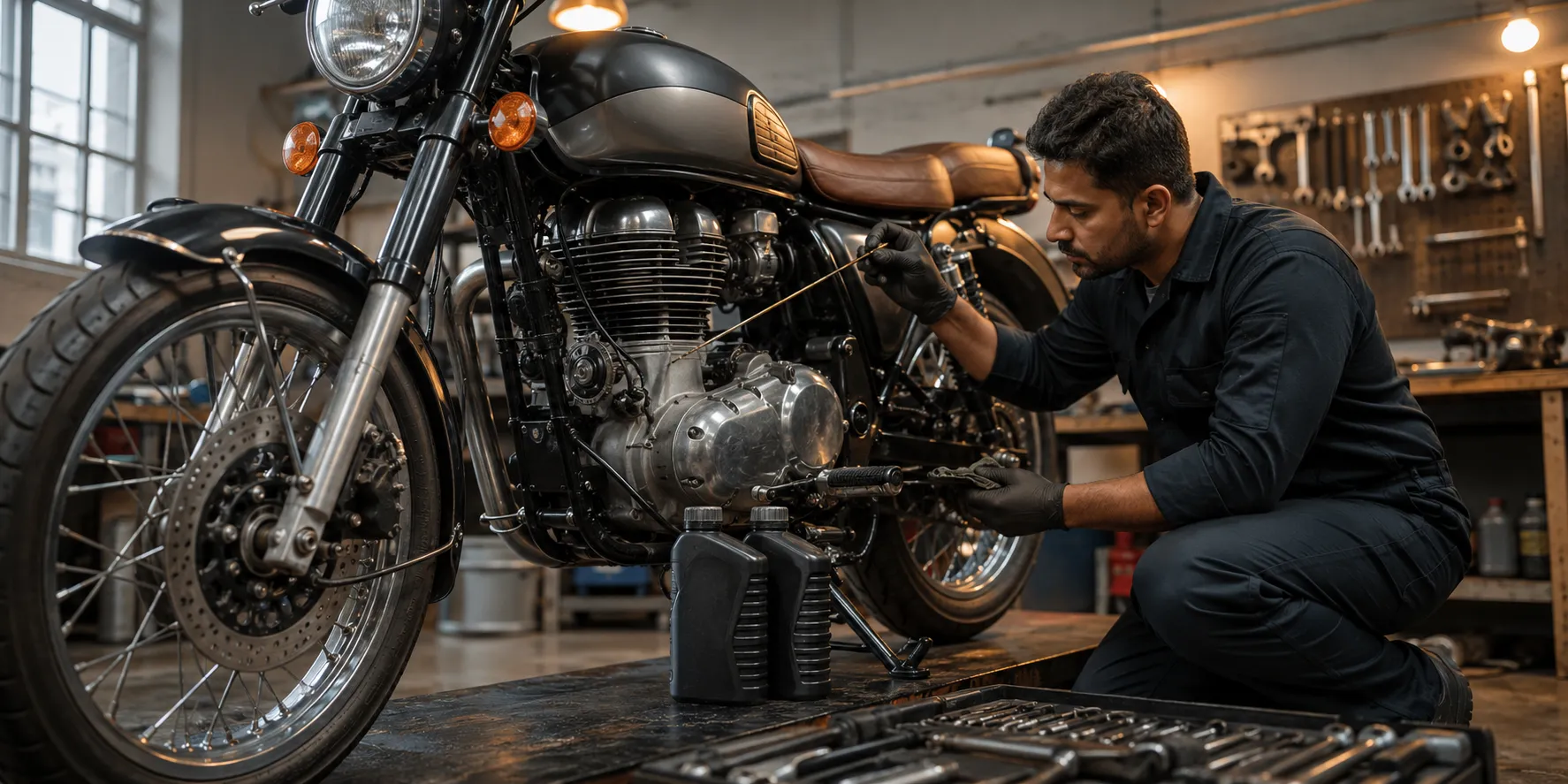


A bottle of engine oil is in the rarest of rare cases the same from one service to the next. Some Royal Enfield owners use the manufacturer's recommended oil at the service centre, while others prefer aftermarket brands such as Veedol, Motul, Shell, Castrol, or Liqui Moly once the warranty period is over. This often leads to a common question:
Can you mix different Royal Enfield engine oils?
The answer is yes—but only under specific conditions. Mixing engine oils should be treated as a temporary solution rather than a routine maintenance practice. Whether it is safe depends less on the brand name and more on the oil's viscosity grade, performance specification, and compatibility.
Let's understand what actually matters before topping up or changing your Royal Enfield engine oil.
Does Royal Enfield Recommend Mixing Engine Oils?
Royal Enfield owner manuals recommend using the specified engine oil grade for each motorcycle model. For most J-platform 350 motorcycles such as the Classic 350, Hunter 350, Meteor 350, Bullet 350 and Goan Classic 350, the recommended specification is SAE 15W-50, API SL, JASO MA2 semi-synthetic. Other models, including some 450 and 650 motorcycles, may require different viscosity grades, so the owner's manual should always be the final reference.
The manuals also caution that using an incorrect oil grade or mixed-grade oil can reduce engine life and affect performance.
This does not mean two oils can never be mixed. It means mixing should never replace using the correct specification during scheduled servicing.
What Happens When You Mix Two Engine Oils?
Every engine oil contains two main components:
- Base oil
- Additive package
The base oil provides lubrication, while additives control wear, oxidation, deposits, corrosion, and clutch performance.
When two oils are mixed, the base oils usually remain compatible if both are designed for modern four-stroke motorcycles. The uncertainty comes from the additive packages. Different manufacturers use different additive chemistry, and although reputable motorcycle oils are generally compatible, the combined performance may not match either oil's original formulation.
For this reason, mechanics generally recommend using one oil throughout the service interval instead of creating a mixture.
When Is It Safe to Mix Royal Enfield Engine Oil?
There are situations where topping up with another oil becomes unavoidable.
For example, you're on a long ride and the engine oil level drops below the recommended mark. The exact oil brand isn't available, but another motorcycle oil meets the same specifications.
In such cases, mixing is generally acceptable if the replacement oil matches:
- The recommended viscosity grade
- API performance standard
- JASO MA or MA2 specification for wet-clutch motorcycles
Matching these specifications is far more important than matching the brand.
When Should You Avoid Mixing Engine Oils?
Not every combination is a good idea.
Avoid mixing engine oils if:
- The viscosity grades are different, such as 10W-40 and 20W-50.
- One oil is designed for scooters with automatic transmissions instead of motorcycles with wet clutches.
- The oil does not carry the recommended JASO MA or MA2 specification.
- The oil is intended for diesel engines or passenger cars with friction modifiers.
- The existing oil is heavily contaminated or overdue for replacement.
In these situations, replacing the engine oil completely is a better option than topping it up.
Does Mixing Different Brands Damage the Engine?
Not necessarily.
Modern engine oils from established manufacturers are produced to recognised industry standards. If two oils meet the same viscosity and performance specifications, mixing them for a short period is unlikely to cause immediate engine damage.
However, riders should not expect the engine to perform exactly as it would with a fresh fill of one oil.
Gear shifts, clutch feel, engine smoothness, and oil life may not remain exactly the same because the additive balance changes after mixing.
What About Semi-Synthetic and Fully Synthetic Engine Oils?
This is another common question among Royal Enfield owners.
A fully synthetic motorcycle oil can generally be mixed with a semi-synthetic motorcycle oil if both satisfy the manufacturer's required specifications. The engine will continue to receive lubrication, but the resulting mixture will no longer behave like a true fully synthetic oil.
In other words, the higher-quality oil cannot deliver its full performance once diluted with another formulation.
If you're upgrading from semi-synthetic to fully synthetic, it is better to drain the old oil completely and replace the oil filter before refilling.
Can Mixing Engine Oils Affect the Clutch?
Royal Enfield motorcycles use a wet clutch, where the clutch plates operate inside the engine oil.
This is why the JASO MA or MA2 specification is important. Oils meeting these standards are formulated to provide the correct friction characteristics for motorcycle clutches.
Using an oil without the recommended JASO rating—or mixing it with an unsuitable oil—can lead to clutch slip, inconsistent engagement, or reduced riding feel over time.
What Should You Do If You Accidentally Mix Two Oils?
If the oils have similar specifications and only a small quantity has been added, there is usually no reason to panic.
Instead:
- Check the engine oil level.
- Continue riding normally if the engine sounds and performs as expected.
- Replace the oil and filter at the next scheduled service or slightly earlier if you're unsure about compatibility.
However, if the wrong viscosity or a non-motorcycle oil has been added, it is advisable to drain the engine and refill it with the correct oil as soon as possible.
Final Thoughts
Mixing different Royal Enfield engine oils is not automatically harmful, but it should not become a regular maintenance habit. If both oils meet the recommended viscosity grade and performance specifications, mixing them temporarily is generally acceptable when topping up the engine.
For routine servicing, however, the better approach is to drain the old oil completely and refill the engine with a single oil that matches your motorcycle's recommended specification. This helps maintain consistent lubrication, clutch performance, and engine protection throughout the service interval.



























Sign in to leave a comment.