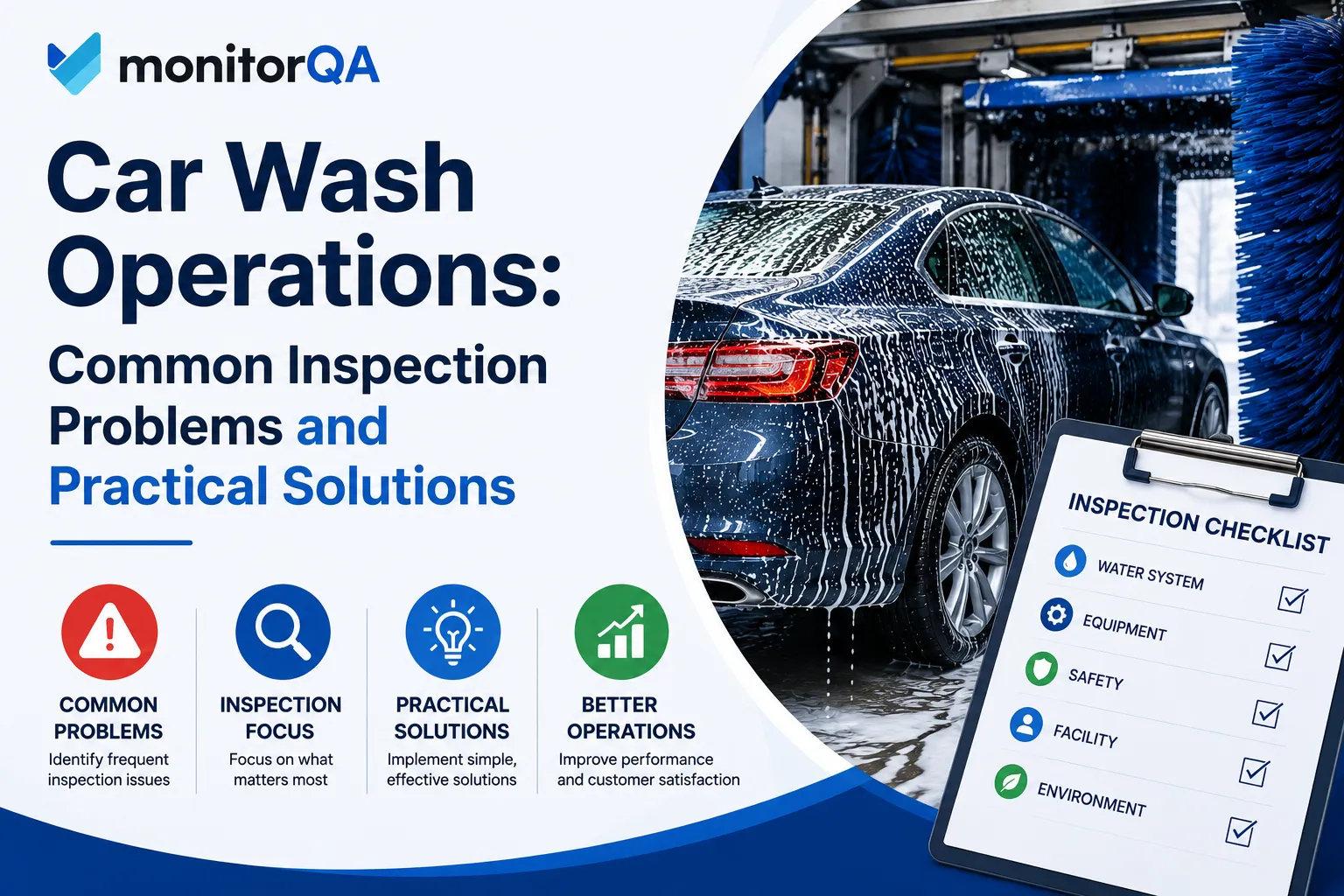

Car wash inspections are supposed to make daily operations easier to control. They help managers check equipment, cleanliness, employee performance, safety procedures, wash quality, and other standards that directly affect the customer experience.
But completing an inspection does not automatically solve a problem.
A checklist might show that an equipment check was missed, a cleaning standard was not met, or a safety procedure was overlooked. The real operational challenge begins afterward: Who follows up? Was the issue fixed? Why did it happen? Has the same problem appeared before?
For car wash owners and operators managing one or multiple locations, the value of inspections comes from what happens with the information afterward. Consistent inspections, meaningful follow-up, and regular review of findings can help turn routine checks into a practical system for improving operations.
Common Inspection Problems in Car Wash Operations
Car wash operations are highly dependent on consistency. A customer visiting one location should receive the same level of service as a customer visiting another. Maintaining that consistency can become difficult when each site develops its own habits.
One common problem is inconsistent inspection routines. One manager may complete every required check carefully, while another may rush through the same checklist. Over time, the inspection records may no longer provide a reliable picture of actual performance.
Equipment is another concern. Wash systems, vacuums, pumps, dryers, hoses, payment equipment, and other components can affect both service quality and operational efficiency. If minor issues are missed during routine checks, they may become larger maintenance problems later.
Cleaning standards can also slip when responsibilities are unclear. A checklist may show that an area needs attention, but unless someone owns the follow-up, the finding can remain unresolved.
Employee performance creates another layer of complexity. Inspections may reveal that procedures are being skipped, rushed, or interpreted differently between shifts. When the same finding appears repeatedly, the issue may be less about individual employees and more about training, process design, or management oversight.
These problems become harder to manage when several locations are involved. A regional manager may know that inspections are happening, but still have limited visibility into which locations are consistently meeting expectations and which ones need attention.
Why Manual Inspection Processes Often Fall Short
Paper checklists and spreadsheets can work for a small operation, particularly when one manager is close to every part of the business. The difficulty starts when inspection volume increases or multiple locations are involved.
Paper forms can be misplaced or completed inconsistently. Spreadsheets may contain useful information but require considerable manual effort to organize. Photos might remain on an employee's phone, while follow-up conversations happen through email or messaging apps.
That fragmentation makes basic management questions harder to answer.
Which locations have the most recurring findings? Which issues remain unresolved? Who is responsible for each action? Has a problem improved after training or maintenance? Are two locations following the same standards?
When information is spread across different places, managers spend more time collecting and organizing information and less time acting on it.
Manual processes also make it harder to compare locations consistently. Even when every site uses the same checklist, differences in how inspections are recorded can reduce the value of the resulting data.
How Better Inspection Processes Improve Operational Compliance
For a car wash, operational compliance is not simply about completing an inspection form. It means consistently following the operational standards the business has established.
Those standards might cover equipment checks, cleaning routines, employee procedures, safety expectations, customer service, or maintenance practices.
A good inspection process gives managers a way to check whether those standards are actually being followed.
Consider a location where employees are expected to inspect equipment at the beginning of each shift. If inspections are completed consistently, findings can be reviewed over time. If employees regularly identify the same equipment issue, management has an opportunity to investigate the cause.
That is more useful than treating each inspection as an isolated compliance task.
The objective is consistency. Standards should be clear, inspections should be performed properly, findings should have ownership, and unresolved issues should receive follow-up.
Operational Audits Can Reveal Problems Daily Inspections Miss
Daily inspections are useful for checking immediate conditions. Operational audits serve a different purpose.
An audit can help management step back and evaluate whether processes are working as intended across a location or group of locations.
For example, imagine two car washes using the same inspection checklist. Location A consistently scores well on equipment and cleanliness checks, while Location B repeatedly records similar deficiencies.
The difference deserves investigation.
Management could review staffing, training, maintenance routines, shift management, and how inspections are being conducted at both sites. The goal is not to criticize the lower-performing location. It is to understand what is driving the difference.
Perhaps Location A has a clearer opening routine. Maybe its manager reviews findings with employees each week. Or perhaps the equipment maintenance schedule is being followed more consistently.
Operational audits can help uncover these broader process differences that individual daily inspections may not reveal.
Turn Inspection Results Into Operational Monitoring
An inspection tells you what was found at a particular point in time. Operational monitoring helps you understand what is happening across time.
This distinction matters.
If a location fails the same inspection item once, the manager may simply correct it. If that item fails every week for three months, the business has a different problem.
The recurring finding could indicate inadequate training, unclear instructions, equipment problems, poor supervision, or an inspection process that does not match actual working conditions.
Looking at trends allows managers to ask better questions.
Are certain locations consistently underperforming? Are specific inspection items failing more frequently? Did performance improve after a corrective action? Are certain problems associated with particular shifts?
This turns inspection data into operational information that can influence staffing, training, maintenance, process changes, and management attention.
Where Car Wash Inspection Software Fits In
Technology does not replace good management, but it can make a structured inspection process much easier to maintain.
Car wash inspection software can help operators standardize inspection checklists, capture findings, document evidence, assign follow-up actions, and organize inspection records in one place.
The practical difference is visibility.
Imagine a regional manager responsible for eight locations. Instead of waiting for individual managers to send spreadsheets or manually reviewing paper forms, the regional manager can review inspection results across locations and identify where problems are appearing repeatedly.
That information can support a more targeted response.
If three locations have similar equipment findings, maintenance may need attention. If one location consistently performs below the others, management may need to investigate training or local processes. If performance improves after a change, the inspection data can help confirm that the change is having the intended effect.
The technology matters because it makes the information easier to use—not because putting a checklist on a screen automatically improves operations.
How Car Wash Audit Software Supports Consistent Standards
For multi-location businesses, consistency is one of the biggest operational challenges.
Car wash audit software can help standardize audits so managers are evaluating locations against comparable criteria. This makes it easier to identify differences and investigate why they exist.
For example, a regional manager may notice that one location repeatedly performs well on cleanliness while another struggles with the same standards. Comparing audit findings can help determine whether the difference comes from staffing, training, management practices, equipment, or process execution.
Standardized audits also create a more reliable record of performance over time. Instead of relying entirely on individual observations, management can use structured findings to support conversations about improvement.
Connecting Quality and Operations
Quality in a car wash is not limited to the final appearance of a vehicle. It includes the processes that produce that result.
Consistent equipment checks, cleaning procedures, employee practices, safety routines, and service standards all contribute to the customer's experience.
Quality inspection software can help organizations bring these checks into a structured process, while broader quality management systems can connect inspection findings with corrective actions, performance review, and continuous improvement.
For example, if customers repeatedly complain about inconsistent cleaning at one location and inspections show that specific cleaning steps are frequently missed, management has a stronger basis for investigating the process.
The goal is to move from “the quality is inconsistent” to understanding exactly where the process is breaking down.
Practical Solutions Car Wash Operators Can Implement
Technology is only one part of the solution. A strong inspection program starts with clear operational expectations.
Operators should standardize inspection criteria so every location understands what good performance looks like. Each finding should have clear ownership, particularly when an issue requires maintenance, training, or management action.
Managers should also review recurring findings instead of treating every inspection as a separate event. If the same problem appears repeatedly, investigate the reason rather than repeatedly correcting the immediate symptom.
Training can also be tied to actual inspection results. If employees repeatedly miss a particular procedure, targeted training may be more useful than general reminders.
Finally, managers should compare performance across locations and review trends regularly. The purpose is not simply to rank sites. It is to identify practices that work well and problems that deserve attention.
Building a More Reliable Inspection Process
Consider a car wash where employees repeatedly mark equipment checks as complete, yet minor equipment problems continue appearing.
The first reaction might be to assume employees are not performing the checks properly. But there could be several explanations. The equipment may require more frequent maintenance, employees may not know what signs to look for, inspections may be rushed during busy periods, or the checklist may not provide enough guidance.
A better approach is to investigate the pattern.
Review the findings, speak with employees, examine maintenance records, and determine whether the inspection criteria accurately reflect the equipment's condition. Once the underlying cause is understood, management can introduce the appropriate change and then monitor future inspection results to see whether the problem declines.
The same thinking applies across multiple locations. If two sites use the same checklist but produce very different results, the data should prompt investigation rather than simply labeling one site as better or worse.
Make Inspection Data Part of Everyday Management
The strongest inspection programs create a continuous connection between field observations and management decisions.
Car wash operators can collect useful information, but that information only creates business value when someone reviews it, understands the pattern, and acts on it.
A practical process is straightforward: establish clear standards, conduct consistent inspections, identify recurring findings, assign responsibility, follow up on corrective actions, and review trends over time.
For larger or multi-location operations, car wash inspection software and car wash audit software can make that process easier to organize and monitor. But the underlying principle remains the same: inspections should help managers understand how the business is operating and where improvement is needed.
When inspection information becomes part of regular operational monitoring, car wash owners can make better decisions about training, maintenance, staffing, quality, and compliance instead of relying only on assumptions or isolated observations.
Frequently Asked Questions About Car Wash Inspections
1. What should be included in a car wash inspection?
A car wash inspection should reflect the standards that matter to the operation. Depending on the business, this can include equipment condition, cleanliness, employee procedures, safety checks, wash quality, customer-facing areas, maintenance, and other operational requirements. The checklist should be specific enough to produce useful findings rather than simply confirming that an inspection was completed.
2. How often should a car wash conduct operational inspections?
The frequency should reflect the type of operation, equipment, risks, and internal standards. Daily checks may be appropriate for routine conditions and equipment, while broader operational audits can be performed periodically. The key is consistency. Inspections should happen frequently enough to identify problems before they become recurring operational or customer-service issues.
3. Why do the same car wash inspection problems keep happening?
Recurring problems often indicate that the underlying cause has not been addressed. The issue could involve training, unclear procedures, equipment maintenance, staffing, supervision, or the inspection process itself. Repeatedly correcting the same finding without investigating its cause usually treats the symptom rather than the process responsible for creating it.
4. How can car wash operators improve consistency across multiple locations?
Start with standardized inspection criteria and clearly defined operational expectations. Locations should understand what is being checked, what acceptable performance looks like, and who is responsible for addressing findings. Comparing inspection results across locations can then help managers identify differences in performance and investigate the practices, resources, or processes behind those differences.
5. What is the difference between car wash inspection software and car wash audit software?
Car wash inspection software is generally focused on routine checks, findings, evidence, and follow-up. Car wash audit software can support broader evaluations of whether locations and processes are meeting established standards. In practice, the two functions can overlap, particularly in platforms designed to manage inspections, audits, corrective actions, and operational reporting together.
6. How can inspection data help improve operational compliance?
Inspection data shows whether established operational standards are being followed in practice. When managers review findings over time, they can identify recurring failures, locations needing attention, training gaps, and process weaknesses. This creates a clearer connection between daily inspections and operational compliance, helping businesses focus on areas where standards are not being consistently maintained.
























Sign in to leave a comment.