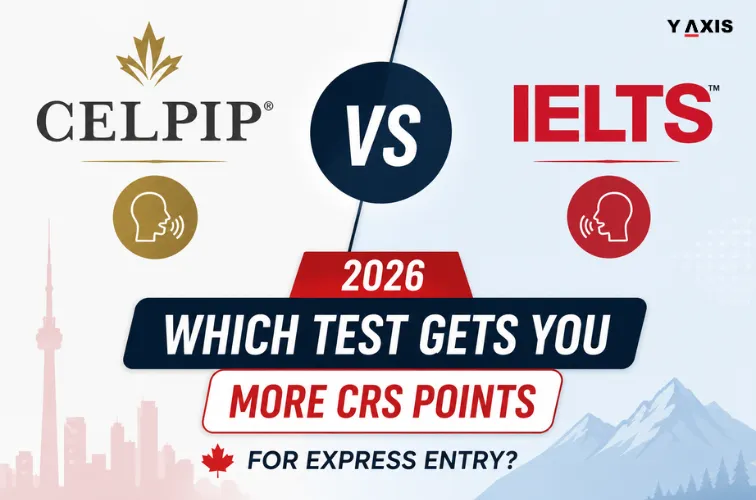

Language proficiency is the single most impactful factor in the Comprehensive Ranking System that most applicants can actively improve before submitting their Express Entry profile. The maximum points available for first official language proficiency under core human capital factors is 136 points for a single applicant, making language the highest-scoring individual component in the entire CRS framework outside of a provincial nomination. The test you choose, and how well you prepare for it, can make the difference between sitting in the pool indefinitely and receiving an Invitation to Apply.
Two English language tests are accepted by IRCC for Express Entry applications: IELTS General Training and CELPIP General. Both are fully recognised and both map to the same Canadian Language Benchmark levels that the CRS uses to assign points. Neither test gives you mathematically more CRS points than the other for equivalent performance. What differs is the test experience, the format, the scoring approach, and which test is more likely to produce your highest possible CLB score based on your learning style and preparation capacity. Understanding these differences helps you make a genuinely informed choice before booking your exam in 2026.
What Is the CELPIP Exam and How Does It Work
The CELPIP exam, short for Canadian English Language Proficiency Index Program, is a fully computer-based English language proficiency test developed specifically for Canadian immigration purposes. It is accepted by IRCC for Express Entry applications under the Federal Skilled Worker Program, Federal Skilled Trades Program, and Canadian Experience Class, as well as for Canadian citizenship applications and professional licensing in Canada.
The CELPIP General Test evaluates four skills: listening, reading, writing, and speaking. The listening section takes between 47 and 55 minutes and includes six parts. The reading section takes between 55 and 60 minutes and includes four reading passages with multiple question formats. The writing section takes between 53 and 60 minutes and requires two written responses. The speaking section takes between 15 and 20 minutes and includes eight tasks that are responded to verbally through the computer.
A key feature of CELPIP that distinguishes it from IELTS is that the entire test, including the speaking section, is completed on a computer. There is no human examiner present and no face-to-face interview component. The speaking section involves responding to on-screen prompts by recording verbal answers through a headset. For candidates who feel anxious in face-to-face speaking assessments, this format can feel significantly more comfortable and may produce a more accurate reflection of their actual language ability.
CELPIP results are scored on a scale of 1 to 12 for each section, with each level corresponding to a specific Canadian Language Benchmark. The test fee is CAD 290 for the General Test, results are available within five business days of test completion, and scores are valid for two years from the test date.
What Is IELTS General Training and How Does It Work
IELTS General Training is the version of the International English Language Testing System used for immigration to Canada and other English-speaking countries. It is accepted by IRCC for all Express Entry programs and is the most widely taken English language test globally for immigration purposes.
The IELTS General Training test evaluates the same four skills as CELPIP but with a different format and delivery. The listening and reading sections are taken first, followed by the writing section, all on the same day. The speaking section is conducted as a face-to-face interview with a trained human examiner, either on the same day or up to a week before or after the written sections depending on the test centre's scheduling.
The listening section is approximately 30 minutes and includes four recorded monologues and conversations. The reading section is 60 minutes and includes three texts of increasing complexity. The writing section is 60 minutes and requires two writing tasks: a letter or explanation in response to a given situation, and a discursive essay. The speaking section is a 11 to 14 minute live conversation with an examiner covering three parts.
IELTS scores are reported on a band scale from 0 to 9 in half-band increments. The test is available in both computer-based and paper-based formats depending on the test centre. Results are available within five to thirteen business days depending on the test format. The test fee ranges from approximately CAD 322 to CAD 352 depending on the test centre and location. IELTS scores are also valid for two years.
How Both Tests Map to CLB Levels for CRS Points
The critical question for Express Entry applicants is not which test looks better on paper but which CLB score each test result translates to, and therefore how many CRS points are awarded. IRCC uses the Canadian Language Benchmark framework to convert test scores from both CELPIP and IELTS into comparable points values within the CRS system.
The CLB to CRS points relationship for the first official language of a single applicant without a spouse works as follows across the four bands. At CLB 9 or above in all four sections, the applicant earns 34 points per section for a total of 136 points. At CLB 8, the award is 32 points per section for a total of 128 points. At CLB 7, the award is 27 points per section for a total of 108 points. The difference between CLB 7 and CLB 9 across all four bands is therefore 28 points, which is a meaningful and often decisive gap in competitive Express Entry draw rounds.
For CELPIP, CLB 9 requires a score of 9 in each section. CLB 8 requires a score of 8. CLB 7 requires a score of 7. The scoring is linear and intuitive, which many applicants find easier to understand and track during preparation. For IELTS General Training, the CLB conversion is as follows. CLB 9 requires 8.5 in listening, 8.0 in reading, 7.5 in writing, and 7.0 in speaking. CLB 8 requires 8.0 in listening, 7.0 in reading, 6.5 in writing, and 7.0 in speaking. CLB 7 requires 7.5 in listening, 6.0 in reading, 6.0 in writing, and 6.0 in speaking.
This mapping reveals an important strategic insight. For some applicants, the IELTS thresholds for CLB 9 in writing and speaking are more achievable than the equivalent CELPIP 9 because the IELTS band structure allows a result of 7.5 in writing to satisfy the CLB 9 writing requirement. For others, the consistency of CELPIP's 1 to 12 numeric scale and its computer-based speaking format makes it easier to target and achieve the specific scores needed.
How CELPIP Compares to IELTS for CRS Point Maximisation
Both tests offer the same maximum CRS points for equivalent CLB performance. The strategic question is which test allows a specific applicant to achieve the highest CLB scores across all four sections given their natural strengths and preparation capacity. Examining the key differences between the two tests helps answer this question for different applicant profiles.
For candidates who feel anxious about speaking in front of a human examiner, CELPIP is frequently the stronger choice. The speaking section of IELTS requires a live face-to-face conversation with an examiner that many candidates find intimidating regardless of their actual language proficiency. This anxiety can suppress performance and produce a speaking band score that does not accurately reflect the candidate's English ability. CELPIP's computer-based speaking section removes the human interaction element and allows candidates to focus entirely on what they are saying rather than the social dynamics of the assessment.
For candidates with strong academic writing backgrounds, IELTS may offer an advantage in the writing section. The IELTS General Training writing tasks, particularly the Task 2 essay, reward the kind of structured argumentative writing that many university-educated professionals have practised extensively. CELPIP writing tasks, which include an email and a survey response, assess functional everyday writing rather than formal academic style, which some candidates find less familiar.
For candidates who prefer a consistent, structured computer-based environment for all sections, CELPIP's fully digital delivery removes variability and environmental factors that can affect performance in paper-based IELTS tests. The CELPIP experience is the same regardless of the test centre, whereas paper-based IELTS can vary in room conditions, examiner approach, and handwriting legibility concerns.
For CELPIP vs IELTS for Express Entry purposes, the most reliable approach is to take a full timed practice test under authentic conditions for each format before committing to a booking. Many candidates who have done this report a clear preference for one format over the other based on their experience, and that preference tends to align with where their final scores are highest.
Applicants who want to assess their current language level and identify which test is most likely to produce a competitive CLB score for their Express Entry profile can use a free eligibility assessment to understand their options before booking either test.
Score Validity, Retakes, and Expiry Considerations
Both CELPIP and IELTS results are valid for two years from the test date. This is an important practical consideration for Express Entry applicants who may be in the pool for an extended period. An applicant who took their test over a year ago and has not yet received an invitation needs to monitor the expiry date carefully and plan a retake if the results are approaching the two-year validity window.
IRCC requires that the language test results be valid at the time an Invitation to Apply is received, not merely at the time the Express Entry profile is submitted. If a profile is submitted with a test result that subsequently expires before an ITA is issued, the profile must be updated with a new valid result or the applicant may not be able to proceed with the full PR application after receiving an invitation.
Retaking either test is straightforward and can be done as many times as needed. There is no waiting period between CELPIP attempts, and the best result from any sitting within the two-year validity window can be used. IELTS similarly allows unlimited retakes, though each attempt requires a new test booking and fee payment.
For applicants who took the test at a lower preparation level and achieved CLB 7 or CLB 8 results, retaking after focused preparation specifically targeting the CLB 9 threshold is one of the most cost-effective CRS improvement strategies available. The difference between CLB 8 and CLB 9 in all four bands is 8 CRS points for a single applicant. The difference between CLB 7 and CLB 9 is 28 points. Given that CRS cut-offs in competitive draw rounds can be separated by single-digit margins, the return on investment for language test preparation and a retake is consistently high.
Fees and Practical Logistics Compared
The CELPIP General Test costs CAD 290 per sitting. IELTS General Training costs between approximately CAD 322 and CAD 352 depending on the test centre, making it modestly more expensive per attempt. For applicants who anticipate multiple sittings before achieving their target CLB score, this cost difference is worth factoring into the overall planning budget.
CELPIP tests are available at designated test centres across Canada and internationally, with results typically available within five business days. The fully computer-based format means no handwriting is required, which removes a variable that can affect some candidates in the IELTS paper-based format.
IELTS is available in both computer-based and paper-based formats, with computer-based results typically available within five business days and paper-based results in six to thirteen business days. Test centres for IELTS are available in a larger number of locations globally, which can be a practical advantage for applicants in regions with limited CELPIP test centre availability.
Rescheduling fees apply for both tests if a booking is changed within a specified period before the test date. CELPIP charges CAD 50 for rescheduling requests submitted fewer than seven days before the test, while IELTS rescheduling policies and fees vary by test centre and the notice period provided.
Which Test Should You Choose in 2026
The honest answer is that the right test is the one you are most likely to score highest on, and that determination requires trying both formats rather than relying on general advice. Both tests are equally accepted by IRCC and produce identical CRS points for the same CLB performance. The choice should be based entirely on where your individual strengths and preparation capacity align with the specific demands of each format.
If you find computer-based tasks comfortable, prefer a consistent digital environment, and feel anxious in face-to-face speaking assessments, CELPIP is likely the stronger choice. If you have strong academic writing habits, are comfortable with face-to-face speaking assessments, and prefer the familiarity of IELTS as the more internationally recognised test, IELTS General Training may serve you better.
What both tests share in common is that systematic preparation significantly improves results. Candidates who take either test without adequate preparation regularly underperform their actual language ability. Investing time in understanding the test format, practising full timed mock tests, and specifically targeting the sections where improvement is most needed before booking the actual test consistently produces better outcomes than booking quickly and hoping for a strong result without preparation.
Practical Guidance for Express Entry Applicants Preparing in 2026
Identify the CLB score you currently hold on any previous test result and calculate precisely how many additional CRS points each CLB level improvement would produce. If you are at CLB 7 in any section, the priority is clear. Improving to CLB 9 in that section adds a meaningful number of CRS points that may be sufficient to enter competitive draw rounds.
Download official practice materials for both CELPIP and IELTS, complete timed mock sections under realistic conditions, and compare your scores against the CLB conversion tables to assess where you currently stand. Then target the format where your highest potential CLB score is most achievable given your profile.
For applicants who want expert coaching support with CELPIP preparation, including structured practice materials, section-specific strategies, and mock test evaluation, Y-Axis provides dedicated language coaching services designed to help Express Entry candidates achieve their target CLB scores. Those ready to begin their preparation can book a free counselling session and receive personalised guidance on the most effective language test strategy for their specific Express Entry profile in 2026.



























Sign in to leave a comment.