

In mobile app development, one question comes up again and again: should we build with Flutter, React Native, or go fully native for iOS and Android?
By 2026, Flutter and React Native are both mature enough that the deciding factor for most founders is not raw capability. It's who you can hire, what your team already knows, and how fast you need an app in front of users.
The State of Play
- Flutter (Google) holds approximately 46% of the cross-platform mobile developer market share in 2026, versus React Native at 35–38%. Flutter 3.27+ ships with the Impeller rendering engine as default on both iOS and Android. It has 102,000+ stars on GitHub, compared to React Native's 92,200+.
- React Native (Meta) uses JavaScript and TypeScript, translating React components into native UI components on each platform. It aims to preserve a native feel by leaning on platform UI elements and APIs while still sharing a large portion of application logic.
- Native (SwiftUI/UIKit on iOS; Jetpack Compose on Android) skips the abstraction layer entirely and builds directly on each platform's frameworks and APIs.

The Architectural Difference
These aren't just cosmetic differences. They shape everything that follows.
- Flutter provides its own UI framework and rendering engine. Teams build interfaces in Dart, and Flutter draws the interface itself rather than relying on each platform's native UI components. The result: a high degree of visual consistency—one set of UI primitives, one layout model, and a unified approach to animation across iOS and Android.
- React Native takes the opposite approach. Teams build interfaces with React components (JavaScript/TypeScript), which are translated into native UI components on each platform. The result: a more platform-authentic look and feel, but with a JavaScript bridge that can introduce performance overhead.
- Native gives you the most direct path to new OS features and the conventions that make each platform feel like itself.
Performance
Research analyzing the resource usage of Android benchmarks and apps found that Flutter generally imposes the least overhead in execution time and energy, while React Native imposes the highest in all benchmarks.
Flutter has a slight edge in rendering because it draws its own UI widgets via Skia/Impeller rather than using native components. React Native's New Architecture (JSI + Fabric) closed the gap significantly.
But for most apps, the performance difference is negligible in practice. The bottlenecks are almost always in business logic and network calls, not in the rendering framework.
Developer Experience and Hiring
React Native is the easier hire and the faster start if you already have a web or React team. It uses JavaScript and TypeScript—languages most developers already know. The talent pool is massive, and web-to-mobile mobility is high. React Native works out roughly 10-15% cheaper for the same scope in markets with deep JavaScript talent pools.
Flutter gives you the most control over how your app looks and performs. It draws every pixel itself. The talent pool is smaller, but Dart is easy to learn and Flutter developers tend to be enthusiasts with a higher quality baseline.
Flutter can reduce "plumbing time" because many UI patterns and widgets are first-party. React Native can reduce ramp time because the talent pool is massive.
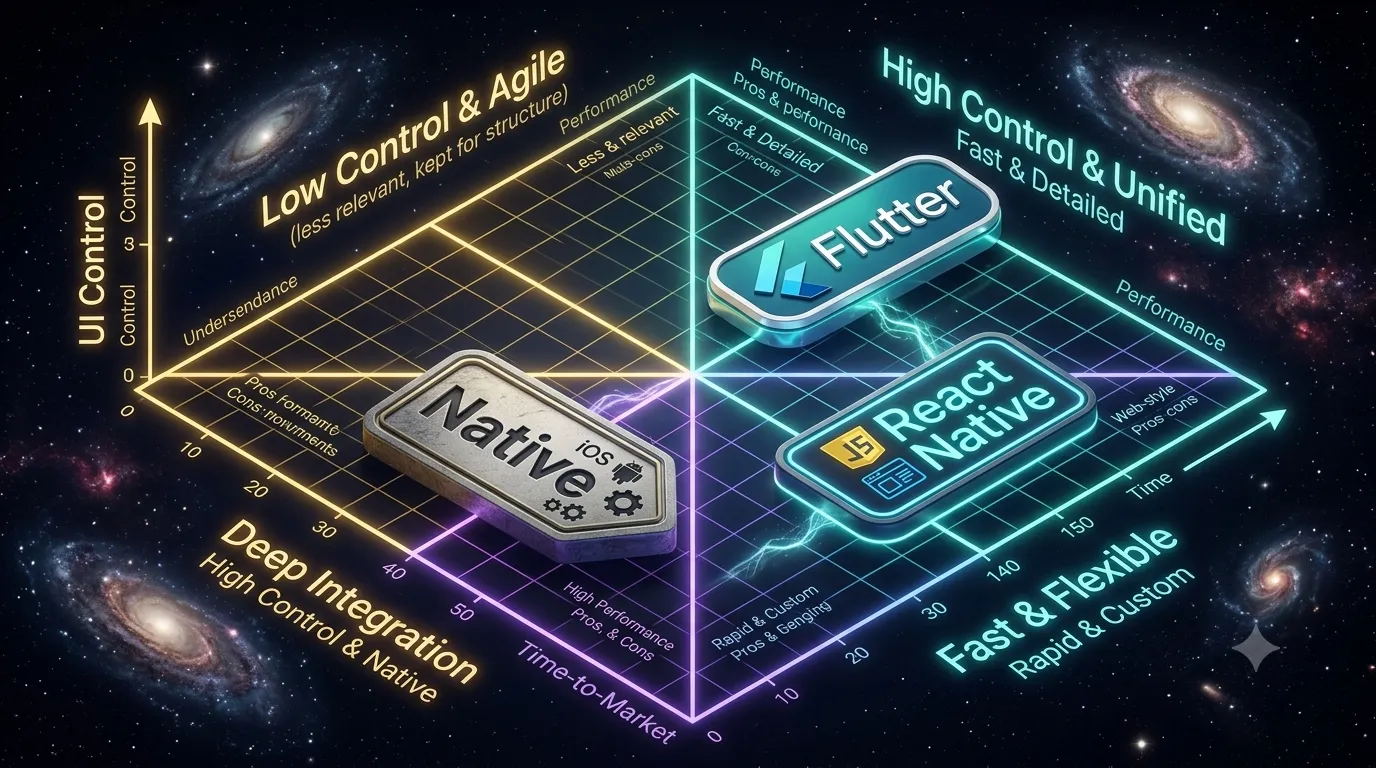
When to Choose Each
Choose React Native if:
- You already have a web or React team
- Hiring speed and talent availability matter most
- You want a platform-authentic look and feel
- Your app doesn't have intensive animation or graphics requirements
Choose Flutter if:
- Pixel-perfect UI is your product's differentiator
- You want maximum visual consistency across platforms
- Performance on older devices matters
- You're building for more than just iOS and Android (Flutter supports web and desktop)
Choose Native if:
- You're only targeting one platform
- You need immediate access to the newest OS features
- Your app requires deep platform integration (AR/VR, complex camera, advanced sensors)
- You have the budget for two separate teams
The 2026 Verdict
Flutter and React Native are both production-ready. Both can ship apps that users love. The choice comes down to your team, your timeline, and your product's specific needs.
Cross-platform development is no longer optional for most startups—it's the standard. The economics are compelling: Flutter can reduce development time by 40-60% compared to native, at 40-50% lower cost. React Native delivers 30-50% faster development at 30-40% lower cost.
In 2026, shipping a mobile app is no longer a five-month slog. You can get to a real build in days—and you don't have to torch the stack later.
The best framework is the one your team can ship with. Everything else is secondary.






















Sign in to leave a comment.