
If you've asked three vendors for a quote on an AI agent and gotten three answers that don't seem to be describing the same universe, you're not imagining it. One number is $8,000. Another is $60,000. A third circles around "it depends" for twenty minutes and never lands on a figure at all.
All three can be right. That's the part most guides skip.
AI agent pricing isn't volatile because vendors are guessing — it's volatile because "AI agent" describes projects with wildly different amounts of engineering inside them. A Slack bot that answers HR questions from a document and a system that autonomously reconciles invoices across three ERPs, flags exceptions, and routes approvals are both technically "AI agents." One is a weekend build. The other is a six-month engineering program.
This guide breaks down what actually drives the number, gives you real 2026 pricing bands by project type, and shows you how to scope a build so the quote you get back actually matches the agent you need — not the agent a vendor found easiest to sell.
What "AI Agent" Actually Means (Because Pricing Depends on It)
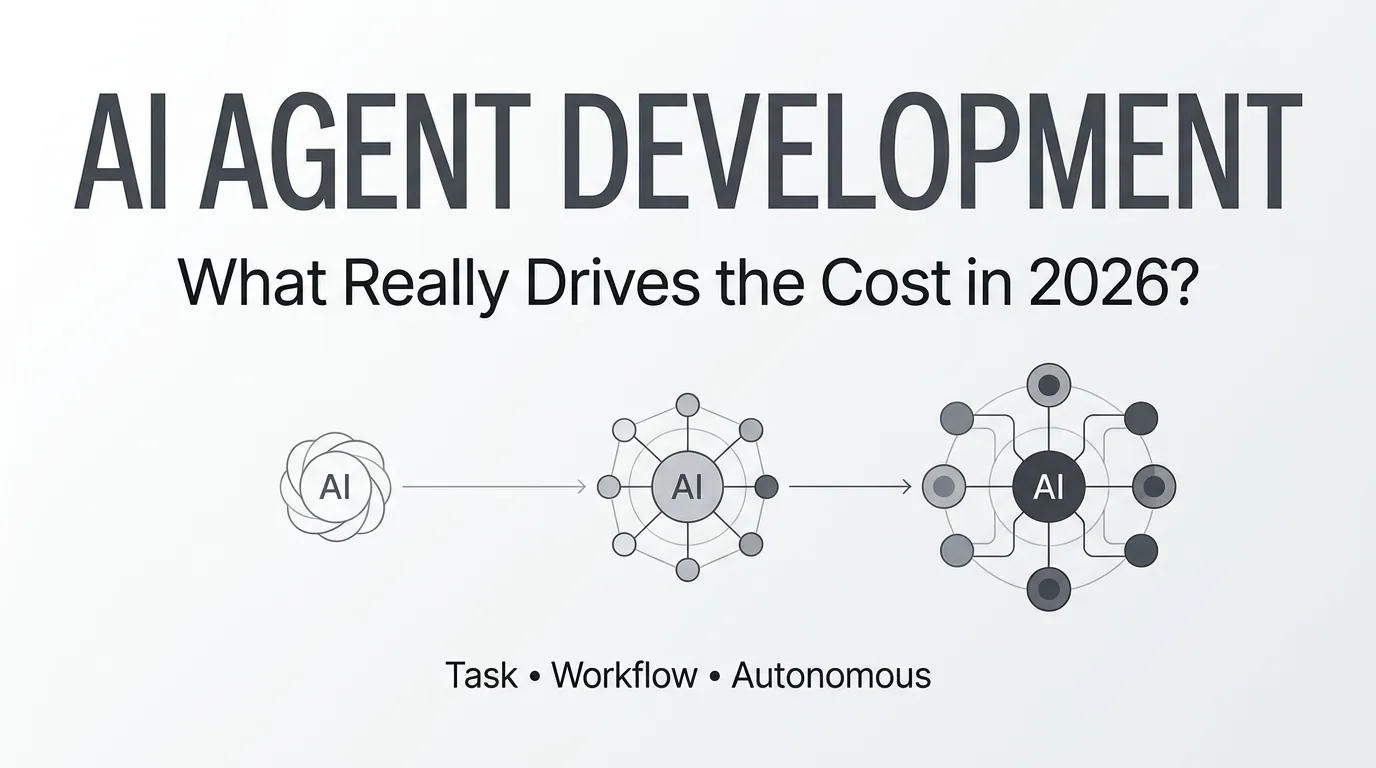
Before you can price a build, you need to know which kind of agent you're buying. Three categories cover almost everything on the market:
- Task agents — narrow, single-workflow tools. They read an input, apply a model, and produce an output: a support ticket classifier, a lead-scoring bot, a document summarizer.
- Workflow agents — multi-step agents that chain actions together and touch more than one system. Think: an agent that reads an incoming invoice, checks it against a purchase order in your ERP, flags discrepancies, and drafts a response.
- Autonomous / multi-agent systems — coordinated agents that make sequential decisions with limited human review, often orchestrating other agents or tools. These are the systems replacing entire operational functions, not single tasks.
The jump between these categories is where most of the cost lives — not the choice of underlying model.
2026 Pricing Bands: What Real Projects Cost
These ranges reflect current US market rates for custom-built agents (not off-the-shelf SaaS subscriptions, which follow a completely different per-seat pricing model).
Prototype / Proof of Concept — $8,000–$25,000
A working demo built to validate an idea against real data before committing to a full build. Limited integrations, no production hardening, often a single use case tested with a small user group.
Task Agent (Single Workflow) — $20,000–$70,000
A production-ready agent handling one clearly defined job: customer support triage, internal knowledge search, lead qualification, contract clause extraction. Includes proper error handling, basic monitoring, and one or two system integrations.
Workflow Agent (Multi-Step, Multi-System) — $60,000–$180,000
Agents that act across departments or systems — pulling data from a CRM, checking it against inventory, and updating a fulfillment system, for example. Costs climb with the number of integrations, the sensitivity of the data, and how much human-in-the-loop review the workflow requires.
Enterprise / Multi-Agent System — $150,000–$500,000+
Coordinated agent architectures with orchestration layers, audit trails, role-based access, and compliance requirements (HIPAA, SOC 2, financial regulations). This is where you're building infrastructure, not just a feature.
Most mid-market companies land in the $30,000–$120,000 range for their first serious agent — enough to solve a real operational bottleneck without committing to a platform-scale build before you've proven the ROI.
What Actually Drives the Price Up (Or Down)
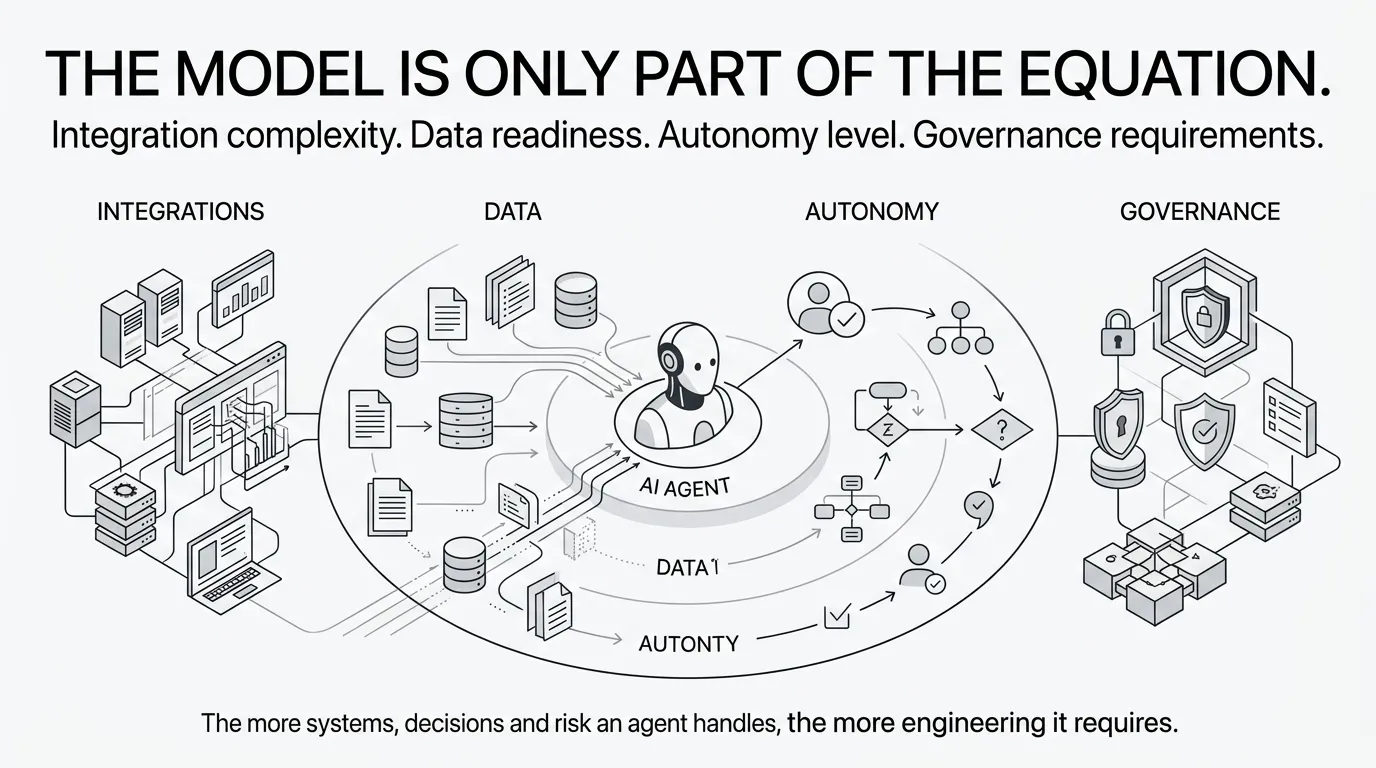
Integration count and complexity. Every system your agent needs to read from or write to — Salesforce, your ERP, a legacy database with no clean API — adds engineering time. A single well-documented API integration might add a few thousand dollars. A legacy system with no API at all can add tens of thousands.
Data readiness. If your data lives in clean, structured systems, a team can build against it quickly. If it's scattered across spreadsheets, PDFs, and three generations of CRM exports, expect a data preparation phase before agent development even starts — and expect it to be billed separately.
Autonomy level. An agent that drafts a response for human approval is cheaper to build and cheaper to govern than an agent authorized to send that response, update a record, or issue a payment without review. Every increase in autonomy requires more guardrails, more testing, and more monitoring infrastructure.
Model choice and usage costs. The development cost and the running cost are two different line items. Development is a one-time (or milestone-based) fee. Model usage — the API calls the agent makes once it's live — is an ongoing operating cost that scales with volume. For most mid-sized deployments, this runs a few hundred to a few thousand dollars a month, not a rounding error but rarely the dominant cost either.
Governance and compliance requirements. Agents making decisions that affect customers, money, or regulated data need audit trails, versioning, and documented escalation paths. If you're in healthcare, finance, or another regulated industry, budget for this from the start — retrofitting compliance after launch is far more expensive than building it in.
The Real Total Cost of Ownership
The build fee is the number everyone asks about first. It's not the number that determines whether the project was worth it.
Plan for ongoing costs of roughly 15–25% of the build cost annually — covering model usage, hosting, monitoring, and periodic retraining or prompt updates as your business processes change. A $60,000 agent that isn't maintained will quietly degrade: the model drifts, your business rules change, and six months later it's making decisions based on assumptions that stopped being true.
Budgeting for maintenance up front — rather than treating it as a surprise line item — is the single biggest predictor of whether an agent project delivers ROI in year two.
How to Scope a Build Before You Ask for a Quote
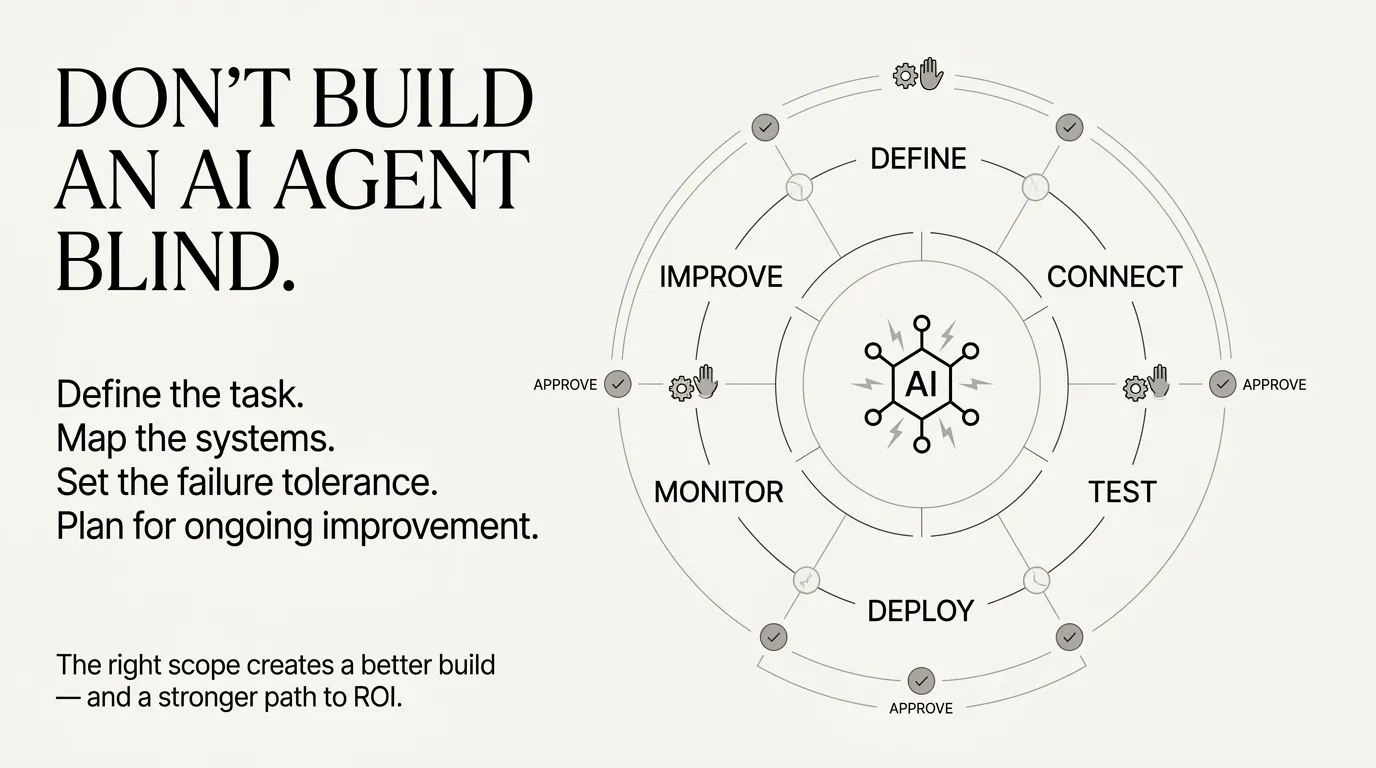
Before you talk to a vendor, get clear on three things:
- The exact decision or task you're automating — not "customer service," but "first-response triage for billing questions, escalating anything with a dollar amount over $500."
- The systems it needs to touch — list every tool it reads from or writes to, and note which have clean APIs and which don't.
- The acceptable failure mode — what happens when the agent gets it wrong? If the answer is "nothing serious," you can move fast with lighter guardrails. If the answer is "a customer gets billed incorrectly," your governance requirements just changed the whole cost structure.
Walking into a scoping call with these answers is the difference between a vendor quoting the agent you actually need and a vendor quoting the agent that's easiest to estimate.
Key Takeaways
- AI agent costs range from roughly $8,000 for a prototype to $500,000+ for enterprise multi-agent systems — the category of agent matters more than the model behind it.
- Integration complexity, data readiness, and required autonomy level are the biggest cost drivers, not the AI model itself.
- Budget ongoing costs at 15–25% of the build price annually — an unmaintained agent is a depreciating asset.
- Scoping the exact task, systems, and failure tolerance before requesting quotes gets you accurate pricing instead of guesswork.
Build an Agent That Actually Fits Your Budget and Your Business
At TechConnect USA, we start every AI agent engagement with a scoping session, not a sales pitch — because a quote that isn't grounded in your actual systems, data, and risk tolerance isn't a real quote. Our team has built everything from single-workflow task agents to multi-agent enterprise systems for companies that needed the automation to work in production, not just in a demo.
If you're trying to figure out what an agent for your specific workflow would actually cost, talk to our team for a free scoping consultation. You'll walk away with a realistic estimate — and a clear picture of whether an agent is the right tool for the problem you're solving.
Frequently Asked Questions
Why are AI agent quotes so varied among different vendors?
AI agent pricing can vary significantly because the term 'AI agent' encompasses projects with different levels of complexity and engineering requirements. For example, a simple task agent may cost around $20,000, while a multi-agent system could range from $150,000 to $500,000. It's crucial to understand the specific type of agent being quoted to make accurate comparisons.
What factors influence the cost of building an AI agent?
The cost of building an AI agent is driven by factors such as the complexity and number of system integrations, data readiness, and the level of autonomy required. Each additional integration or the need for data preparation can add thousands to the overall project cost.
What are the ongoing costs associated with maintaining an AI agent?
Ongoing costs for an AI agent typically range from 15% to 25% of the initial build cost annually. These costs cover model usage, hosting, monitoring, and necessary updates to keep the agent functioning effectively as business processes evolve.
How can I ensure I get an accurate quote for my AI agent project?
To receive an accurate quote, it's essential to clearly define the specific task you want to automate, the systems the agent will interact with, and the acceptable failure mode. Providing this information during the scoping call will help vendors understand your needs and provide a more precise estimate.
What types of AI agents are available and how do they differ?
AI agents generally fall into three categories: task agents, which handle single workflows; workflow agents, which execute multi-step processes across systems; and autonomous multi-agent systems, which manage complex operations with minimal human intervention. The category significantly affects the project cost and complexity.
What is a prototype AI agent and why might I need one?
A prototype AI agent is a working demo built to validate an idea before committing to a full-scale project. It typically costs between $8,000 and $25,000 and is useful for testing the feasibility of your concept using real data, which can inform your decision for a more extensive build.
Why is data readiness important for AI agent projects?
Data readiness is crucial because clean and structured data allows for faster and more cost-effective development of an AI agent. If your data is disorganized or spread across various formats, it may require significant preparation before development can begin, potentially increasing project costs and timelines.
























Sign in to leave a comment.