
Introduction
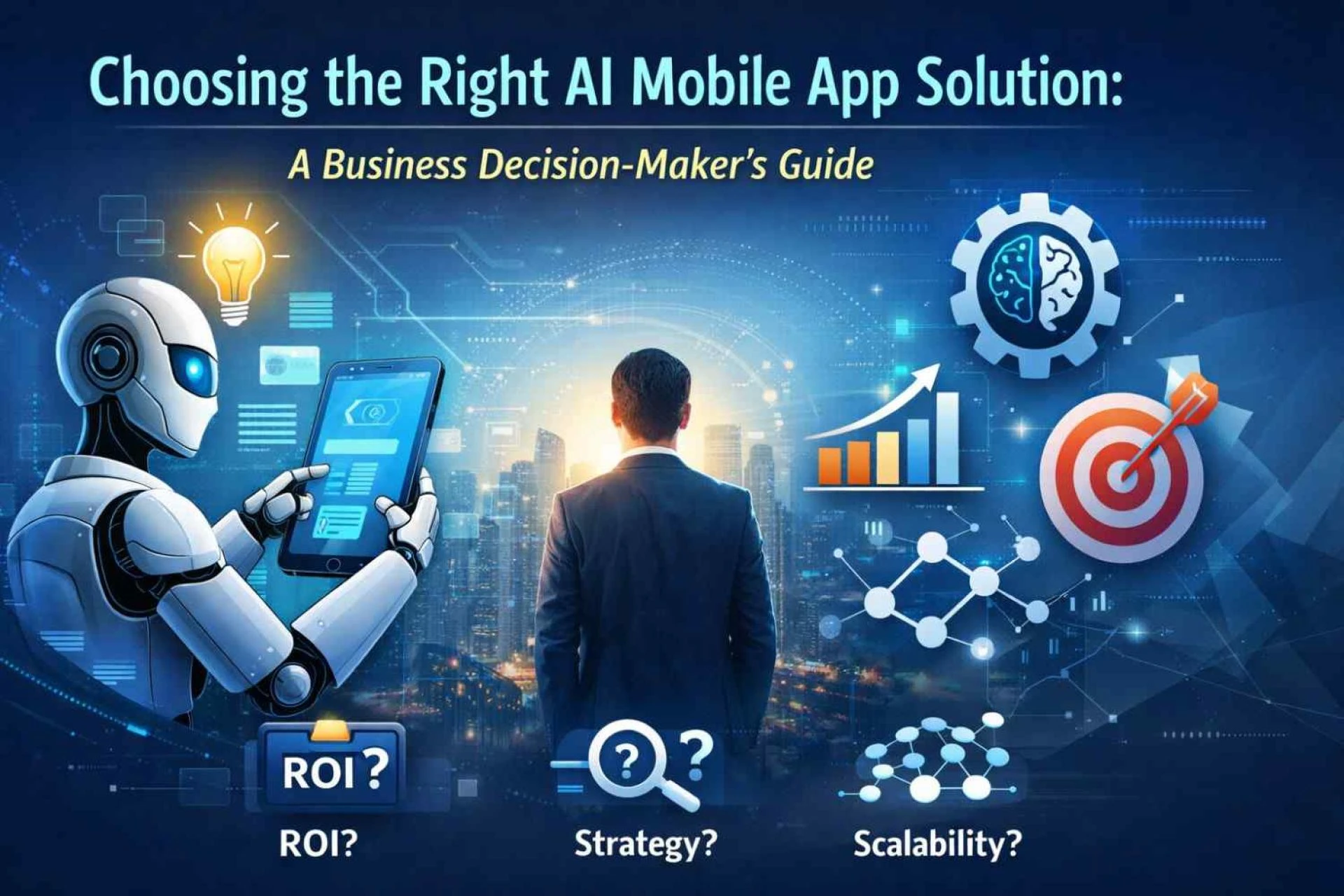
Choosing an AI-powered mobile app today feels a bit like shopping for a self-driving car while the salesperson keeps shouting acronyms at you ML! NLP! GenAI!. We’ve seen decision-makers excited, overwhelmed, and occasionally burned. At KanhaSoft, we believe AI should earn its place in your business, not just look impressive in a pitch deck. This guide is written for leaders who want clarity, not code. We’ll walk through how to evaluate AI mobile app solutions with a business-first mindset, sprinkle in a few real-world observations we’ve picked up along the way, and keep things practical. Because when AI decisions go right, they scale beautifully—and when they go wrong, they become very expensive learning experiences.
Why AI Mobile Apps Are a Strategic Business Move (Not a Tech Experiment)
AI mobile apps are no longer “nice-to-have” innovation projects parked in a lab somewhere. When done right, they influence revenue, efficiency, and customer loyalty. We’ve watched companies move faster than competitors simply because their apps could predict behavior, automate decisions, or personalize experiences at scale. Of course, we’ve also seen AI treated like a science fair project—interesting, shiny, and ultimately abandoned. The difference is intent. Businesses that win treat AI as a strategic lever, not a technical toy. They tie it to outcomes early and revisit those outcomes often. Once that mindset clicks, the conversation naturally shifts from “Can we build this?” to “Should we build this—and why?”
Start With the Business Problem—Not the Algorithm
Here’s an uncomfortable truth: customers don’t care about your algorithm. They care about speed, accuracy, and convenience. Yet many AI initiatives start with technology choices instead of business pain points. We’ve learned (sometimes the hard way) that the smartest AI mobile apps begin with a clear problem statement—reduce churn, improve forecasting, automate support, or personalize onboarding. Only then does AI enter the room. This approach keeps scope realistic and expectations grounded. It also helps stakeholders stay aligned when trade-offs appear (and they always do). Once the problem is well-defined, choosing the right AI technique becomes far less intimidating—and far more effective.
Assessing Your Organization’s AI Readiness
Before committing to an AI mobile app solution, it’s worth asking a simple question: are we ready for this? Readiness isn’t just about budgets or ambition. It’s about data quality, internal workflows, and decision-making culture. We’ve seen teams eager to deploy AI, only to realize their data lives in silos—or worse, spreadsheets no one trusts. There’s also the human side: will teams adopt AI-driven recommendations, or quietly ignore them? Honest answers here save months later. AI thrives in environments that support iteration, feedback, and learning. If those foundations aren’t in place yet, that’s not failure—it’s a roadmap.
Types of AI Mobile App Solutions Businesses Commonly Choose
Not all AI mobile apps are created equal, and thankfully, not all need to be complex. Some businesses benefit from rule-based automation enhanced with light machine learning. Others need predictive models or generative capabilities. We often advise clients to resist the urge to over-engineer early on. Simpler systems are easier to test, explain, and scale. Over time, sophistication can grow with confidence and data maturity. The key is matching the solution to the use case, not the trend of the month. Once leaders understand the major categories of AI solutions, conversations become more strategic—and far less buzzword-heavy.
Build vs. Integrate vs. Customize—Making the Right Call
One of the most common decision points is whether to build an AI solution from scratch, integrate third-party tools, or customize an existing platform. Each path has trade-offs. Off-the-shelf tools offer speed but limited differentiation. Fully custom solutions provide control but demand investment and patience. Hybrid approaches often strike a balance. In our experience with Mobile App Development projects, the “right” choice depends on long-term vision, not just launch timelines. Leaders who think beyond version one tend to make calmer, more confident decisions here. And yes—this is usually where strategy finally beats impulse (after a few spreadsheets and debates).
Scalability, Security, and Compliance (The Unsexy—but Critical—Stuff)
It’s tempting to focus on features and demos, but scalability and security quietly determine whether an AI app succeeds or stalls. We’ve seen promising solutions buckle under real-world usage because scalability wasn’t planned early. Compliance and data privacy—especially in regulated industries—add another layer of responsibility. Ignoring these factors doesn’t make them disappear; it just postpones the reckoning. Smart teams bake scalability and security into the architecture from day one, even if it feels premature. It rarely is. These considerations may not win applause in meetings, but they protect trust, budgets, and reputations in the long run.
Evaluating ROI—How Decision-Makers Should Measure Success
AI ROI isn’t always immediate, and it’s rarely one-dimensional. While cost savings and revenue growth matter, so do speed, accuracy, and decision quality. We encourage leaders to define success metrics before development begins—then revisit them regularly. This avoids the awkward moment where everyone agrees the app is “impressive,” but no one can explain its value. ROI improves when AI outputs are actionable and embedded into daily workflows. Over time, the best AI mobile apps fade into the background—not because they’re forgotten, but because they quietly become essential to how the business operates.
Choosing the Right AI Mobile App Development Partner
Selecting a partner is less about who promises the most features and more about who asks the best questions. We believe strong partners challenge assumptions, explain trade-offs, and prioritize outcomes over hype. Experience across industries helps—but so does transparency when something won’t work as planned. We’ve found that trust grows fastest when teams communicate openly and iterate together. Decision-makers should look for partners who understand business context as deeply as technical architecture. After all, AI projects aren’t just built—they’re nurtured. And like any long-term relationship, clarity and honesty matter more than grand gestures.
Common Mistakes Businesses Make When Choosing AI Mobile App Solutions
If there’s one pattern we see repeatedly, it’s rushing in without alignment. Other common missteps include underestimating data preparation, overlooking user adoption, and chasing trends without purpose. AI doesn’t fix broken processes—it amplifies them. Another classic mistake is treating launch as the finish line, rather than the starting point. Successful AI mobile apps evolve continuously, guided by feedback and performance data. The good news? Most of these mistakes are avoidable with planning and patience. Learning from others’ experiences (including ours) is far cheaper than repeating them firsthand.
Conclusion: Making AI a Business Asset, Not a Boardroom Regret
Choosing the right AI mobile app solution is ultimately a leadership decision, not a technical one. When guided by strategy, realism, and long-term thinking, AI becomes a powerful business ally. We’ve seen it streamline operations, unlock insights, and create experiences customers genuinely value. We’ve also seen what happens when decisions are rushed or driven by fear of missing out. The difference is intention. Treat AI as an evolving capability, invest thoughtfully, and surround yourself with partners who prioritize outcomes. Done right, AI won’t just support your business—it will quietly help shape its future.
FAQs
1. What is an AI mobile app solution?
An AI mobile app solution is a mobile application that uses artificial intelligence to analyze data, learn from user behavior, and automate or enhance decision-making. Instead of relying only on fixed logic, these apps adapt over time. For businesses, this means smarter recommendations, faster responses, and more personalized user experiences. The real value comes when AI is embedded into everyday workflows rather than treated as a standalone feature.
2. How do businesses decide if they actually need AI in a mobile app?
The decision should always start with the business problem. If automation, prediction, personalization, or real-time insights can improve efficiency or customer experience, AI may be a strong fit. If the app works perfectly with simple logic, adding AI may increase cost without clear returns. Clear goals and measurable outcomes help determine whether AI is necessary or optional.
3. Is AI mobile app development suitable for small and mid-sized businesses?
Yes, AI mobile app development is no longer limited to large enterprises. Many small and mid-sized businesses successfully use AI for customer support, analytics, and operational automation. The key is starting with a focused use case and scalable architecture. A phased approach allows businesses to control costs while still gaining measurable value from AI-driven capabilities.
4. How long does it take to build an AI-powered mobile app?
Timelines vary based on complexity, data availability, and integration needs. A basic AI-enabled mobile app can take a few months, while advanced solutions may require longer for training, testing, and optimization. Planning, data readiness, and clear requirements significantly reduce delays. Ongoing improvement is also expected after launch, as AI systems evolve with real-world usage.
5. What factors should decision-makers prioritize when choosing an AI solution?
Decision-makers should focus on business impact, scalability, data security, and long-term maintainability. Cost matters, but value matters more. A solution that aligns with business goals, integrates smoothly into workflows, and can evolve over time delivers stronger ROI. Choosing the right development partner also plays a critical role in long-term success.


Sign in to leave a comment.