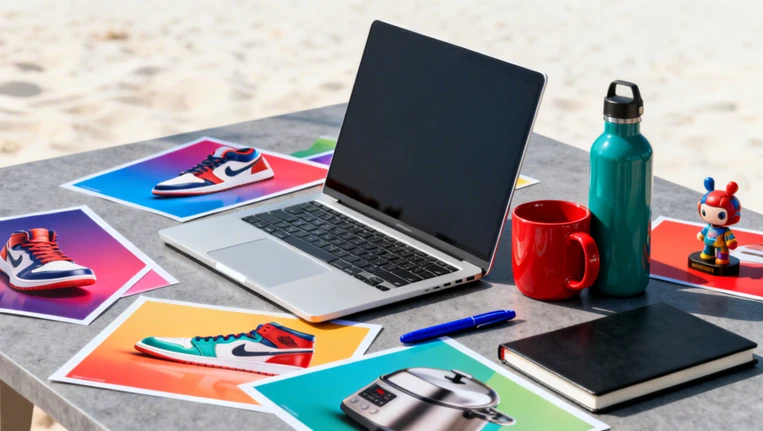

Color Jet technology focuses on visual realism. It uses a liquid binder combined with colored inks to create full color models directly from digital files. Instead of relying on post processing or manual painting, the system integrates color during the build process itself. This makes it ideal for design validation and presentation purposes where appearance matters as much as shape.
Because the technology works from detailed CAD data, it allows designers to convert digital concepts into physical models that accurately represent textures, logos, color schemes, and surface details. For marketing teams and product developers, this capability significantly improves communication during early stage development.
Realistic Model Production
In CJP 3D printing, each layer receives precise color application during the build. Thin layers of powder are spread across the platform, and a printhead deposits binder along with colored ink according to the digital design. As layers stack, the model gradually takes shape with embedded color information throughout the structure.
The result is vibrant prototypes that do not require painting or external finishing for visual presentation. Fine details such as text labels, gradients, branding elements, and surface textures can be reproduced directly from the file. This method is commonly used in architecture for scaled building models, in product design for concept visualization, and in education environments for anatomical or engineering demonstrations.
Speed and Presentation Value
Companies providing full color rapid prototyping services use CJP to quickly showcase product concepts without waiting for tooling or manual finishing. The build process is relatively fast compared to traditional model making techniques, allowing teams to move from digital rendering to physical presentation in a short timeframe.
It helps stakeholders visualize branding, textures, and overall form in a tangible format. Instead of interpreting a flat screen render, decision makers can hold the product model, evaluate proportions, and assess visual appeal in real space. This speeds up feedback cycles and improves approval processes.
Limitations and Best Uses
While mechanically weaker than other processes, CJP excels in communication, concept development, and visual storytelling. The material strength is generally suitable for handling and display but not for functional mechanical stress.
For that reason, it is best suited for presentation models, marketing samples, exhibition pieces, and design validation prototypes where visual accuracy is the priority. When structural durability is required, other polymer or metal based processes are more appropriate.
FAQs
Are CJP parts durable?
They are mainly designed for display, concept modeling, and presentation purposes rather than heavy functional use.
Can gradients and detailed graphics be printed?
Yes, complex color patterns, gradients, textures, and fine graphic details can be reproduced directly from the digital file.
Is CJP cost effective for presentations?
Yes, especially when visual accuracy and speed are more important than mechanical strength.
For more information on 3D printing projects, visit KAD 3D.






























Sign in to leave a comment.